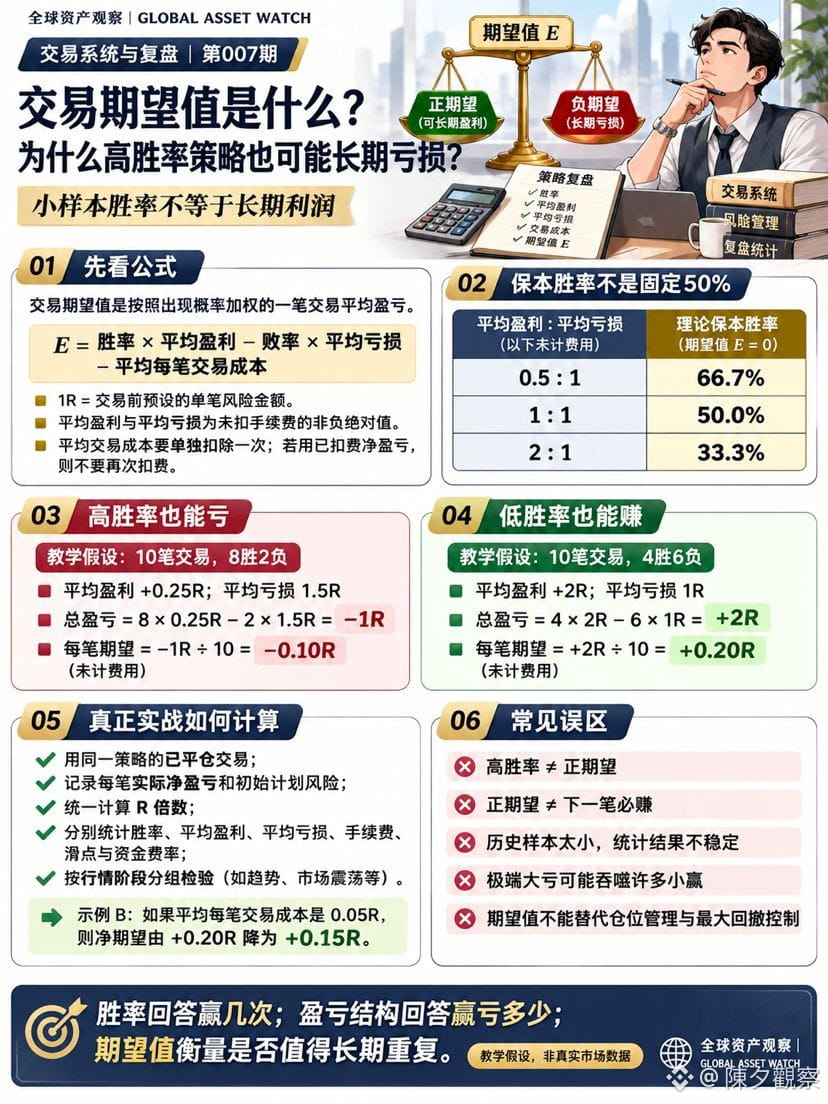
📊 Why can a trading strategy with an 80% win rate still lose money over the long term?
The key to trading isn’t how often you’re right, but how much you make when you’re right and how much you lose when you’re wrong.
Trade expectancy = win rate × average win − loss rate × average loss − average cost per trade
Two examples:
🔴 Strategy A: 80% win rate
* 10 trades: 8 wins, 2 losses
* Average win: 0.25R; average loss: 1.5R
* Total profit/loss = 8 × 0.25R − 2 × 1.5R = −1R
* Gross expectancy per trade: −0.10R
🟢 Strategy B: 40% win rate
* 10 trades: 4 wins, 6 losses
* Average win: 2R; average loss: 1R
* Total profit/loss = 4 × 2R − 6 × 1R = +2R
* Gross expectancy per trade: +0.20R
If the average cost per trade for Strategy B is 0.05R, its net expectancy is still +0.15R.
A high win rate doesn’t make a strategy good, and a low win rate doesn’t make it unprofitable.
What really needs to be tracked over the long term: win rate, average win and loss, trading costs, maximum drawdown, and sample stability.
⚠️ Positive expectancy doesn’t guarantee that the next trade will be profitable, and historical expectancy may no longer hold if market conditions change.
📅 Coming next
Monday | Macroeconomics & Finance Course | Episode 008
“What is an inverted yield curve? Why does the short-term interest rate being higher than the long-term rate signal a recession?”
#Anthropic上市次日大跌,股价接近破发