
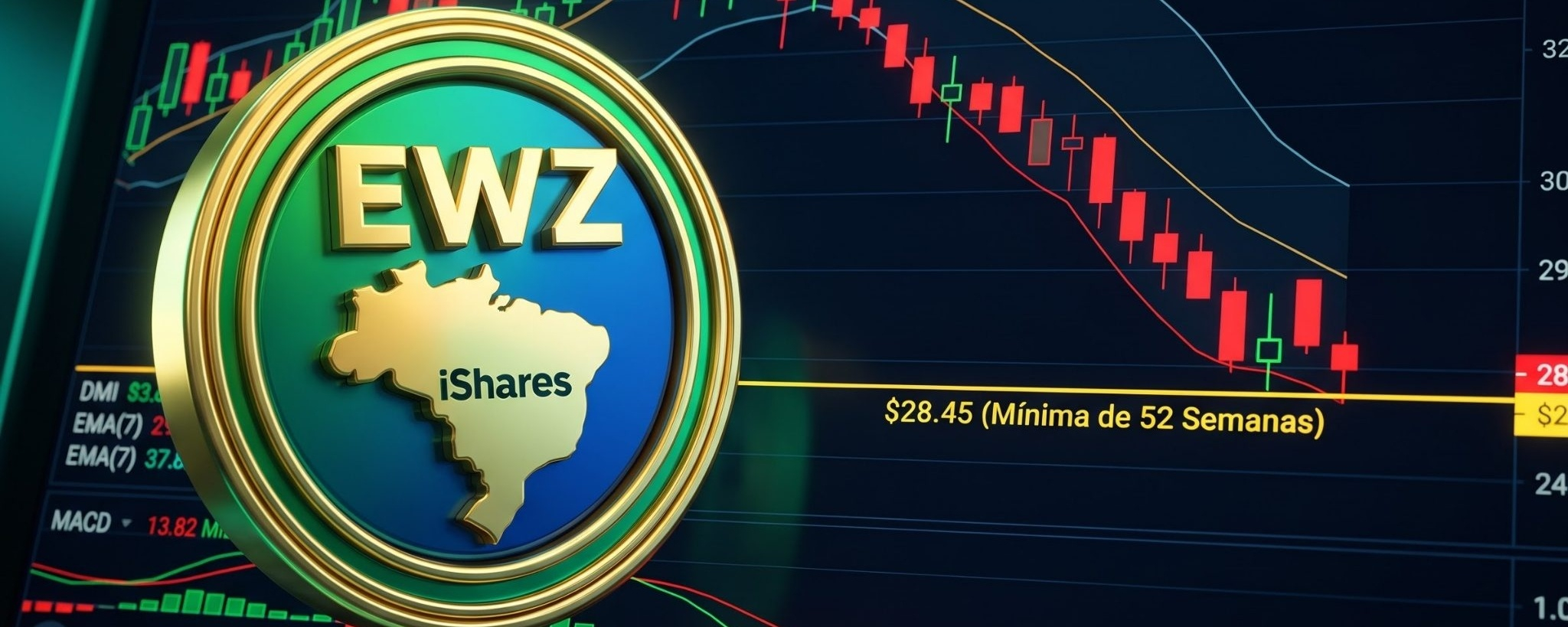

The iShares MSCI Brazil ETF (EWZ) closed the trading session on 11/20/2026 at $28.54 (-3.28%), after touching exactly its 52-week low of $28.45 — bringing its decline since the annual high of $43.90 to -34.99%. After hours, the asset attempted a technical rebound of +1.01% ($28.83), but the chart structure and macro-fiscal outlook call for heightened caution.
🔍 Multi-Timeframe Technical Analysis
• Short Term (1m and 1h): The after-hours rebound to $28.88 met immediate resistance at the 1-minute upper Bollinger Band ($28.93), with the MACD histogram losing momentum (-0.01). On the 1-hour chart, the downtrend channel remains intact below the VWAP ($28.91) and Supertrend ($29.25).
• Medium-Term (1D): The close at $28.54 broke below the lower daily Bollinger Band ($29.15), representing a statistical deviation of more than 2 standard deviations from the 20-day average ($31.94). Although this extreme oversold condition leaves room for short-term technical rebounds, the DMI(14) shows strong seller dominance (-DI at 40.45 versus +DI at 18.69 and ADX at 21.16), while the daily MACD (-0.19) remains negative.
• Long-Term (1M): The simultaneous loss of the 7-, 25-, and 99-month averages ($33.63, $32.86, and $33.38) and the Bollinger midline ($33.10) raises a structural warning: if the $28.45 support is lost at the close, the next technical target at the lower monthly band is $24.80.
🏛️ The Fiscal Factor (PLP 299/2026) and the EWZ Equation
The fiscal package approved by the Senate and sent to the Chamber projects a primary impact of between R$ 45.1 billion and R$ 56.1 billion in 2027, but around 70% depends on uncertain revenues, with effective spending containment estimated at between R$ 8.8 billion and R$ 11 billion.
The key point the market is pricing in is the continuation of mandatory spending dynamics:
1️⃣ Protected Indexed Expenses: Pensions, benefits under the BPC program, public-sector payroll, real increases to the minimum wage, and constitutional funding floors for Health and Education remain protected from budget cuts, in addition to the exclusion of R$ 10.5 billion in diesel expenses from the 2026 target.
2️⃣ Burden on the Corporate Sector: Without reforming the structure of mandatory spending, the adjustment falls on increasing the effective tax burden on companies—doubling the across-the-board cut to tax benefits to 20% and limiting tax credit offsets.
3️⃣ Double Pressure (Exchange Rate + Interest Rates): Since EWZ is priced in U.S. dollars, the perception that the public debt trajectory still lacks a long-term anchor pushed USD/BRL into the R$ 5.87–R$ 5.93 range and drove up futures interest rates (DI Jan/29 above 15.15%). Even at discounted multiples (P/E of 10.17x), the ETF’s heavyweights—banks, fintechs, energy, and commodities—are suffering from the rising cost of capital.
🎯 Levels to Monitor
• Critical Support: $28.45 (52-week low). Below this level, there is a risk of an extension down to $24.80.
• Rebound Resistances: $29.15 (lower daily Bollinger Band), $30.26 (daily EMA7), and $31.94 (20-day average).
⚠️ Legal Disclaimer (DYOR): This analysis is strictly for informational and educational purposes and does not constitute a recommendation to buy or sell assets. Do your own research (DYOR) and manage your risk before trading.
#EWZ #brasil #MacroEconomia #analisetecnica #MercadoFinanceiro