
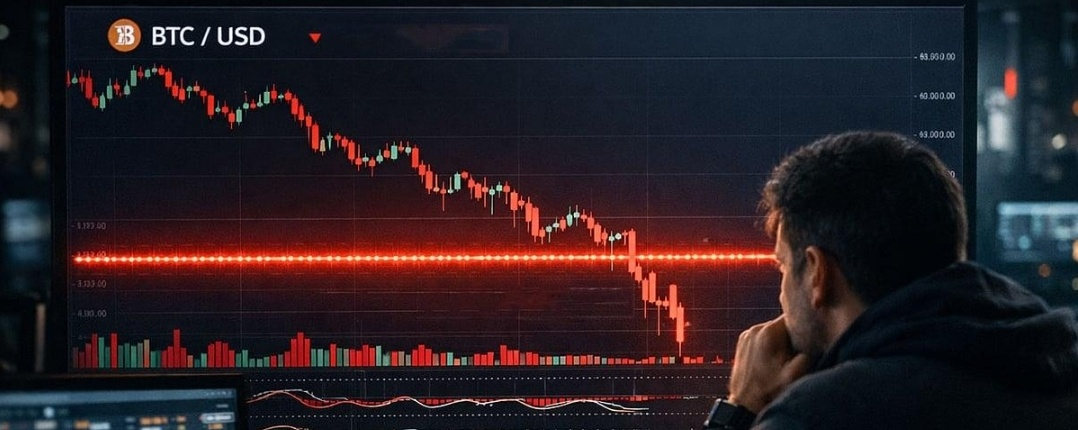

How to survive a bear market, protect your capital, and take advantage of dips without making mistakes.
The cryptocurrency market is going through one of its most challenging periods in recent months.
Bitcoin fell to around $55,251, its lowest level since September 2024. It then rebounded by more than 8%, briefly recovering the $60,000 level.
But behind these moves, there’s something more important than price: investor behavior.
Bitcoin ETF outflows, economic uncertainty, weakness in technology stocks, and liquidations of leveraged positions are putting pressure on the market.
For example, BlackRock’s Bitcoin ETF recorded daily outflows of $541.1 million on November 19.
*Sources: Reuters and CoinDesk.
And here’s the real question: what should an investor do when practically everything is falling?
Not all downturns mean the same thing
One of the most common mistakes is treating all downturns as if they were the same.
A one-off 5% correction is not the same as a downtrend that lasts for weeks.
We can distinguish three situations:
● A brief drop: may represent a temporary correction. If the asset’s fundamentals remain intact, there may be an opportunity to buy at better prices.
● A prolonged downturn: requires analyzing the causes. Are we seeing a technical correction, a loss of confidence, or a structural shift in the market?
● A structural decline: when a project loses utility, funding, development, or confidence, buying simply because its price is lower can turn out to be a mistake.
The difference between these situations can determine the outcome of an investment.
The danger of making decisions out of fear
When prices fall rapidly, three common behaviors emerge:
* Selling impulsively to avoid greater losses.
* Buying too early because we think the bottom is in.
* Holding leveraged positions while waiting for a recovery.
All three can be dangerous.
In particular, futures can turn a relatively small drop into a total loss of the margin on a leveraged position.
In recent trading sessions, LONG liquidations have shown how vulnerable leveraged trading can be when the market moves sharply.
The winner isn’t always the person who correctly predicts the market’s direction. Often, it’s the person who manages risk better who survives.
Buying while everyone else is selling: a good strategy?
Personally, I think downturns can present interesting opportunities, especially when we’re talking about assets with solid fundamentals and long-term prospects.
But there’s one condition: never commit all your capital to a single purchase.
One strategy I find interesting is making purchases in stages.
Instead of investing all our money when Bitcoin drops 10%, we can spread out our entries depending on how far the price has fallen.
For example:
| Asset movement | Hypothetical action |
| ---------------------- | ------------------- |
| -5% | First small purchase |
| -10% | Second purchase |
| -15% | Third purchase |
| -20% | Reevaluate and consider another entry|
| Additional sharp drop| Use part of the reserve|
The percentages are illustrative, not automatic buy signals.
The key is to preserve liquidity.
If we use all our capital during the first drops, we may run out of resources when a much more attractive opportunity arises.
Liquidity is also a position
There’s something many investors forget: not being invested can also be a strategic decision.
Holding USDT or USDC gives us capital to take advantage of future opportunities.
Let’s imagine we have 1,000 USDT set aside to invest.
Instead of using it immediately, we can allocate it hypothetically as follows:
* 300 USDT for the first opportunities.
* 200 USDT for additional purchases if the decline continues.
* 500 USDT as a strategic reserve.
This way, if the market experiences a further crash, we’ll still be able to act.
We don’t need to pinpoint the exact bottom.
We need to avoid running out of capital before it appears.
What if the market keeps falling for months?
This is where the strategy changes completely.
If a downturn lasts for two or three days, weeks, or even months, we can’t just buy every time the price drops.
We need to do our research.
Some important questions:
* Why is Bitcoin falling?
* Are institutional investors pulling out their capital?
* Is selling pressure increasing?
* Is the market losing key support levels?
* Is there a fundamental problem behind the decline?
* Are there signs of recovery, or only temporary rebounds?
If we don’t see signs of improvement after an extended period, we need to reconsider our investment.
And one crucial point: not every project will return to its all-time highs.
A cryptocurrency can fall 90% and never recover.
That’s why buying cheap doesn’t necessarily mean buying wisely.
The long term can change our perspective
When we’re talking about investments with a time horizon of two, five, or more years, downturns take on a different dimension.
A crash can represent an opportunity to acquire solid assets at considerably lower prices.
However, we need to distinguish between two concepts:
* Buying an asset because it’s cheap.
* Buying an asset because we believe it will continue to have value in the future.
The second line of reasoning is much more important.
A recovery isn’t guaranteed, even for well-known projects.
That’s why asset selection and capital management should take priority over the emotions of the moment.
Conclusion: It’s not about buying every dip, but knowing when to do so
Bear markets test our patience, our strategy, and our ability to manage risk.
Selling out of fear can cause us to miss opportunities.
Buying impulsively can leave us trapped in a downtrend.
Trading with too much leverage can wipe out our capital.
And having no liquidity can prevent us from taking advantage of the best prices.
My perspective is simple:
■ We shouldn’t fear downturns, but we shouldn’t fall in love with them either.
■ We need to do our research, allocate our capital, preserve liquidity, and understand what we’re buying.
Because in the market, a decline can be an extraordinary opportunity or the start of a much bigger problem.
The difference lies in knowing how to recognize it.
💬 I’d like to hear your opinion:
If Bitcoin drops another 20% from its current price, what would you do?
* Buy more and take advantage of the lower prices.
* Hold on to your liquidity and wait for a sign of recovery.
* Sell to protect your capital.
* Analyze the fundamentals before making a decision.
And what do you think about buying gradually during a bear market?
#Bitcoin #CryptoMarket #CryptoCrash #Trading #BinanceSquare $BTC $BNB $NVDA.US
*Market figures are as of November 21, 2026