
Background: A veteran crypto trader who turned $26,000 into $9 million through compounding over the past 23 days.
This post is a review of my trading methods and experience from eight years in crypto. It is not live-trading instruction. The content is largely subjective; my actual trading style is relatively aggressive and strongly reflects my personal approach. Some points are controversial, and this may not be suitable for everyone.
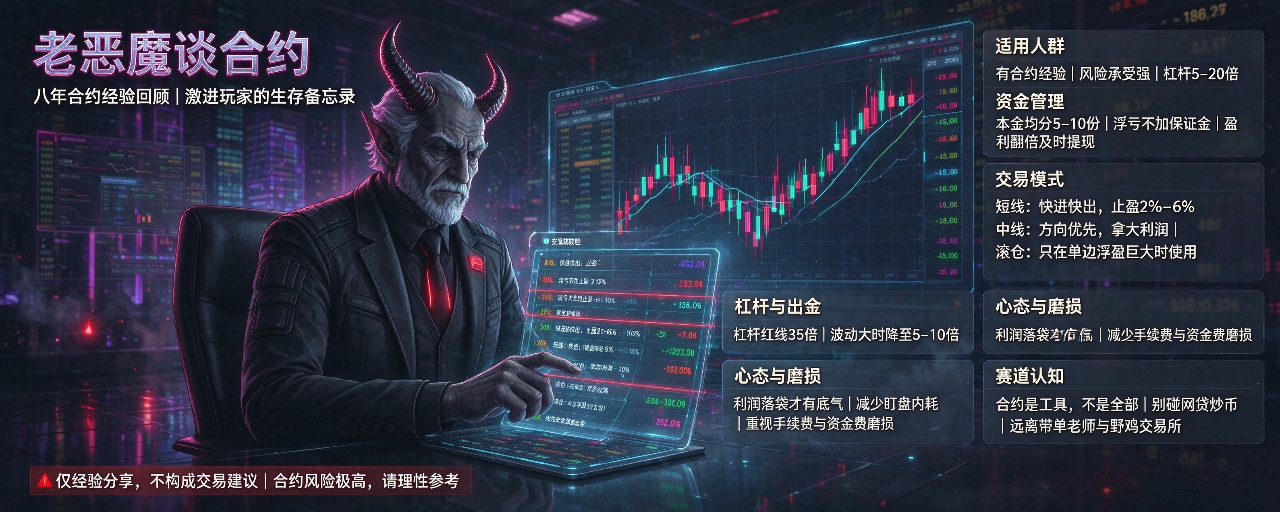
Suitable for: traders with some futures experience who can assess information rationally, have a reasonable amount of capital, use 5x–20x leverage, seek high returns, and have a high risk tolerance.
Use with caution: beginners, spot traders, those who prefer low leverage below 3x, quants who rely on objective data, and arbitrage traders.
I hope you'll use this only as a reference. Don't rush to change a trading approach that's making you money. Learn from its strengths and apply what works for you.
This post is free to share. Please don't repost it for a fee!
First—and what I consider most important—manage your capital properly.
Even the most capable cook can't make a meal without ingredients. A trader who has lost their capital has also lost most of their hope. Many people in crypto make a fortune on one big move, but many others end up with nothing. The importance of money management is obvious. Good money management can help you survive longer in this market and wait for the opportunities you're good at. Even with relatively high leverage, it's hard for the market to wipe you out in a single move, and sound money management can help protect you from crypto black swan events.
Money management has three parts:
1. Managing your principal. Calculate how much capital you can afford to invest, then divide it into 5–10 portions. When your account is wiped out, deposit the next portion. For example, if you have 100,000 in capital, divide it into 20,000 deposits. Remember, don't add margin to hold a position when it's deeply in the red. A large unrealized loss means your judgment was wrong; if the market makes a one-way move, adding margin may not save you from the loss. Adding margin does have a high success rate, but if you fail even once, all your previous efforts will go to waste. In an extreme market move, you could lose both your capital and your profits.
2. Managing profits. Once your capital has grown to three times its original amount or more, you must withdraw profits promptly. If you can't control yourself and tend to get carried away, it's best to convert the money into RMB and separate your principal account from your investment account. For example, if you turn 10,000 into 50,000, withdraw 30,000 and put it in Alipay.
3. Re-dividing your capital. If you've managed to multiply your capital several times, your withdrawn profits can add up to a substantial amount. Next, you need to reassess how to divide your principal and withdrawn profits: first, divide them into more portions to lower the risk of losing everything; second, increase the amount of each deposit to make fuller use of your capital and push profits further. For example, if you have 50,000 in total capital and deposit 10,000 at a time, then grow your principal and profits to 200,000, you could raise each deposit to 25,000, giving you eight deposits.
Second, let me share some thoughts on my own trading skills.
I don't think my trading skills are particularly good. Like most people, I still think of myself as a small fish in the market. I've also done things like holding losing positions against the trend, failing to hold on to unrealized profits, and going all-in with high leverage when I get carried away. But I've achieved some results, so I want to share my views on trading.
Most of the time, I only trade a few major coins, such as Bitcoin and Ether. Trading major coins has the advantages of high liquidity and relatively small price swings, which suits my aggressive leverage style. There's also much less insider trading and market manipulation. Altcoins are a matter of personal preference. They can certainly generate huge short-term profits, but you can also get liquidated overnight. Market makers have too much control, and large traders are easily tracked. I can't manage that and don't know how to play that game, so I choose not to trade altcoin contracts. The advice below is based on trading major coins.
Note: The following is based on my own trading approach. Use it only as a reference—don't believe it blindly!
1. Short-term trades
Short-term trading is all about being fast, decisive, and accurate. Positions are usually held for less than 24 hours, and this is the type of trade most commonly used by aggressive high-leverage traders. Short-term strategies generally involve either chasing a rally or selling into a drop, or shorting at highs and buying at lows. So your entry price and timing are very important. Before opening a trade, be clear that it's intended to be a short-term trade.
If a high-volume bullish candle forms, and the price doesn't quickly fall afterward but instead rises gradually or moves up in a choppy way, while the daily chart is clearly strong, the upward move is likely to continue and you could consider chasing the rally.
If a high-volume bearish candle forms and, for the next few hours, the candlesticks struggle to rebound and keep hovering near the bottom, while the daily chart faces resistance or its trend has already turned down, you could consider chasing the move lower.
If the market drops sharply and then quickly rebounds (a wick), the 4H chart doesn't show consecutive bearish candles, the daily and 4H charts aren't extremely weak, and the price shows strong support at the bottom, you could consider buying the dip. If you're using extremely aggressive leverage, I don't recommend trying to catch the bottom.
If the market rallies and then meets resistance, several 4H candles show bearish signals near the top, and the daily chart isn't strong—or even looks like it's turning down—you could consider shorting at a high. Again, I don't recommend doing this with extremely high leverage.
Looking back at my trading history, chasing rallies and drops in short-term trades has had a much higher win rate than selling at highs and buying at lows. I'm not particularly good at short-term trading. I usually use 10–30x leverage and often end up holding on to losing positions when trying to catch a short-term move. I also fail to cut losses promptly, which often turns a trade I meant to keep short-term into a big loss. That's a common problem with short-term traders.
If your goal is to make a short-term trade, set a target in the 2%–6% range and calculate the take-profit price based on your entry. Don't set your take-profit below a support level or above a resistance zone, and avoid placing it at a major round number. Short-term trades also require you to monitor market sentiment. If it moves against your position—for example, the decline continues or the price keeps rising—you should cut your losses promptly and decisively. Short-term trades must have tight stop-losses, ideally within 3 points. Since the profit target is modest, holding on to a losing position can easily turn a small loss into a big one, defeating the purpose of a short-term trade.
For short-term trades, I usually fill my entire position in one order. The key is speed. Choose a favorable entry price and place a limit order. Once the trade is open, take profit at your target—don't fantasize about more or get attached to the position. If you've chosen to trade short-term, you need to let go of the bigger trend and get in and out quickly.
Also, after taking profit on a short-term trade, don't immediately reverse your position. If the trade was profitable, the trend was moving in your direction. Trends don't reverse instantly, so I strongly advise against reversing immediately after taking profit on a short-term trade.
Reversing after a stop-loss on a short-term trade is worth considering, though. The success rate is much higher than reversing after taking profit.
2. Medium-term trades
Medium-term trades are what I make most often, and they're the kind of trade I'm best at and have made the most money from. There are only two kinds of medium-term trades: long or short. Chasing rallies and drops, or selling high and buying low, doesn't really apply.
First, look at the daily and 4H charts to gauge the overall market's strength. If you think the trend will continue or reverse, you can open a medium-term position. The exact entry isn't that important; direction comes first.
A medium-term trade that works out is usually in profit soon after you open it, and the unrealized profit gradually grows. It's normal for some profits to pull back along the way. Stay calm and tell yourself: as long as the price hasn't reached my stop-loss, I'll hold firmly until it reaches my take-profit. Don't keep opening your account to check the amount of profit or loss.
To judge whether you've made the wrong call, look at how often the position is profitable after you open it. If an unrealized profit turns into a loss, check whether that loss is gradually growing. If it reaches more than half your principal, you've probably got the direction wrong.
However, medium-term contract trades need room for you to be wrong. Don't use too much leverage; 5–10x is enough. You need to be prepared to hold through temporary losses on medium-term trades. Accept that a single trade could lose 80% before you can reap profits many times over. Get your mindset right, wait patiently for the market to move, and when the market is moving in the same direction as your position, hold patiently. Set your take-profit order and wait for it to be filled. Don't do anything unnecessary.
Only by trading medium-term contracts can you rapidly multiply your profits. Compared with high-leverage short-term trading, medium-term trading also carries less risk and has a higher expected value. This is also key to how I quickly earn back my losses after major drawdowns.
3. Take-profit and stop-loss
Taking profits and cutting losses is a very important part of contract trading. Whether you trade medium-, short-, or long-term, you need to learn when to hold and when to exit: be decisive about cutting losses on a position in the red, and just as decisive about closing a profitable position.
After opening every contract position, the first thing you must consider is where to place your stop-loss.
For short-term trades, I recommend using a fixed-percentage stop-loss. I don't recommend stubbornly holding on. A stop-loss is essential for short-term trades; preserving your capital is what gives you a chance.
For medium- to long-term trades, I recommend placing a wide stop-loss at a resistance level, such as the previous high or low on the daily or 4H chart from the past three to five days. If you still have capital and profits to add, and can keep a steady mindset, then you can simply accept the possibility of losing it all and place your stop-loss around 1%–2% before the liquidation price. Only with this kind of attitude toward stop-losses can you hold on to several multiples of unrealized profit.
The biggest mistake with stop-losses is hesitating when you should act, and constantly changing your stop price. A stop-loss is only effective if you stick to it. Don't place a short-term trade and then let it turn into a huge loss. Once you've set your stop-loss level, even if you later find out it was the wrong call, I still consider it effective.
You should only start thinking about taking profits once your position is showing an unrealized profit. For short-term trades, you can take profit based on a percentage. With medium-term trades, you shouldn't exit just because you're a little in the green. For example, I look for at least 150 points on Ether and over 4,000 points on Bitcoin—more than a 100% return. Once you've set your profit target, be just as firm about taking profits as you are about cutting losses. When the price reaches your target, don't hesitate or get greedy, hoping to hold on for a little more. Knowing how to buy is only half the job; you also need to know how to sell. Profits don't come from wishful thinking.
4. Adding to a winning position
First, be clear that the goal of adding to a winning position is to use capital more efficiently and earn outsized returns during a one-way market. That's why I only do it with medium-term trades, and only when unrealized profits are substantial. If the account is deeply in the red or the market direction is unclear, I don't recommend adding to a position at all.
For a typical medium-term trade, I fill my position through no more than three orders, then leave it alone. If the position is in the red, I don't touch it; I keep monitoring the market and consider where to stop out.
If the unrealized profit is substantial, I'll consider adding to the position. The amount I add is generally less than half of the original position, and I do so well above my take-profit target. After adding, I continue holding patiently until the take-profit level is reached.
Pay attention to your effective leverage after adding to a position; don't let it exceed the leverage you had when you opened the trade. Adding to a position is extremely risky: it raises your average entry price and increases your leverage. If you don't have extensive experience doing this, or the market isn't clearly moving in one direction, I don't recommend it. In a ranging market, it's easy to lose everything in one move.
5. Trading indicators, news, and capital flows
I don't have much to say about these two aspects, and I don't have any particularly good advice.
I don't look at any technical indicators. I only look at candlestick charts. I don't trust any quant strategies or software. My decisions to open and close positions are highly subjective—I just go with my gut.
I rarely follow the news, especially cluttered, unimportant stories—like positive news about a particular coin, US Federal Reserve data, or exchange inflows and outflows. I think most news in crypto is designed to fit the price action. To keep my trading focused, I choose to block out all news. Of course, that's just my personal trading habit. Some news can significantly affect the market, so use your own judgment.
I do pay some attention to capital flows, such as net inflows into US stock ETFs, daily/4H trading volume, and the ratio of long-to-short positions by value or number of traders. I use these alongside candlestick patterns to analyze the market.
Third, let's talk about leverage, withdrawals, and capital.
Compared with traditional finance, crypto's advantage lies in contracts, which conveniently offer different levels of leverage as well as short and long positions without owning the underlying asset. This is both an advantage traditional finance can't match and the reason cryptocurrency is so risky. My view is that using 5–20x cross margin on major coins sensibly to pursue large returns with a small amount of capital offers good value for money.
(The leverage discussed below refers to the effective leverage of the actual position, not the leverage setting you choose.)
Of course, I'm not advising you to constantly scalp with high leverage and burn through your capital. I'm a fairly aggressive crypto trader. For Bitcoin and Ether, I think leverage below 3x is inefficient: even if you're right, your profits don't grow fast enough, and if you're wrong, the liquidation price is so far away that it's easy to fool yourself into holding a losing position. If you get caught in a major one-way move, your losses can be severe. It's very difficult to rebuild your capital using low leverage.
Normally, after I deposit capital, I start with 10x leverage. At the most, I may go as high as 35x (though rarely, and only when market volatility is low). Overall, I use 10–20x cross margin. As unrealized profits grow, my leverage falls below 10x, sometimes to 3–5x.
Looking back at my years of live trading, positions above 35x leverage are like bombs—completely unpredictable. The market often makes sharp wicks and V-shaped reversals, which can easily trigger a stop-loss or liquidation at the very high or low of a move and completely wreck your mindset. You can refer to the first few trades in my OK6 live-trading account. So here's my advice: never cross the red line of 35x leverage.
Some traders may think cross margin at 10x-plus leverage is too high. I'm an aggressive trader, and I think it's workable when the market's price swings aren't too large. When volatility is high—for example, when Bitcoin or Ether's daily range exceeds 10%—you should lower your leverage to 5–10x.
If you use high leverage to catch and hold a major one-way move, the profits can be substantial. In 2024, I made two BTC contract trades. I started with 80,000 USDT and shorted from 69,000 to 62,800, taking the account to 400,000 USDT. On the second trade, I reversed and went long from 62,000 to 71,000, bringing the account to 1 million USDT. Those two trades grew my capital more than tenfold. I added to my positions several times along the way, but never used more than 20x leverage. That's the outsized return aggressive leverage can bring. You don't need to scalp back and forth with high leverage. Catch a major move; if you're right and hold on, the profits can be substantial.
I've never believed in the trading theory that “slow is fast.” In the opaque, unregulated crypto market, nobody can consistently make a profit every single day. Black swan events happen often. If you don't use stop-losses and just keep holding losing positions, even low leverage can get you liquidated. So don't imagine that you can make a little every day with a large account and then walk away. The prerequisite for trading with high leverage is to withdraw profits promptly; otherwise, high-leverage trading will inevitably end in losing everything.
Speaking of withdrawals, here's how I cash out:
1. In terms of withdrawal safety, the order is Alipay > WeChat Pay > bank card. If your funds are under 1 million RMB, try to avoid withdrawing via bank card.
2. Don't use the quick-buy/sell crypto feature. Find merchants manually who have been registered for at least two years and make a living arbitraging price differences. Don't buy or sell based on price alone, and avoid merchants with close to 10,000 transactions a month. Check whether they have both buy and sell orders on the market, to avoid unscrupulous merchants who only collect and never sell.
3. Add the WeChat accounts of some reliable merchants and, as much as possible, stick to the same trading partners. Don't constantly switch merchants. Never accept payments from accounts that aren't in the payer's real name, whatever the reason.
Be aware that C2C withdrawals in the market operate in a legally gray area. The steps above can only reduce risk, not eliminate it. When withdrawing—especially large amounts—please consider the legal risks carefully. Don't withdraw recklessly.
I know many people have borrowed money to trade crypto and lost it. I'm neutral on borrowing to trade crypto. If you have a decent job that generates some cash flow, and you're mentally prepared to keep working if you lose the money, you could consider a bank loan where you pay interest first and repay the principal later. The interest rate on this type of loan isn't high, the repayment burden is manageable, and the approval requirements aren't strict. Ask at a bank branch; in most cases, social insurance contributions are enough to qualify.
I'm not a rich second-generation kid. After graduating from college, I worked at a bank. After losing my salary and savings in crypto, I borrowed 600,000 RMB from a bank in 2017/18, withdrawing the full credit limit over time. The interest alone was over 3,000 RMB a month. Whenever a principal payment came due, I had to ask friends for help, and I was barely making ends meet. Then, during the big drop in 2019, I shorted all the way down to 5,000. Bitcoin turned bullish at 4,000, and I rode it up to 14,000, gradually filling the hole from my loan losses. After 2020, once I started making some profits, my mindset improved. Whenever my capital multiplied, I withdrew some. In mid-2021, I finally made my first 1 million RMB in crypto. Maybe the market was favorable, maybe I was lucky, or maybe my money management was good enough. In any case, I never again lost everything and my capital, and my assets continued to grow despite the ups and downs.
As for all kinds of shady online loans, I'm firmly against them. On the one hand, the interest is extortionate—it can reach over 10% or even several dozen percent annually. On the other, you're under pressure to make repayments every month. It's hard to stay calm and trade under that kind of pressure. If you lose money, you can become deeply frustrated and start doubting yourself. All of this can keep you from getting back on your feet and drag you further and further down.
I feel strongly about this because, when I was in college, I borrowed nearly 300,000–400,000 RMB through various online loans to trade stocks and gamble online, and lost it all. My part-time jobs couldn't even cover the monthly interest. I had to borrow from one place to pay another. Eventually, I couldn't take it anymore and had to come clean to my parents and relatives and borrow from them to fill the hole.
If you've already borrowed money and entered the contract market, be clear about the consequences of failing. Never make impulsive trades. For people with unstable incomes or who struggle to manage their emotions, the pressure of debt can be fatal!
The best capital is savings you can afford to lose without affecting your life, or profits you've already accumulated. Returns are proportional to risk. If you enter the contract market hoping to get rich overnight, be prepared to lose everything. Don't borrow money from everyone you know to trade. Plan your finances before entering the market. Don't go all-in with your entire principal and drive yourself into a corner; doing so will greatly help your trading mindset.
Fourth, some thoughts on mindset and luck.
A lot of people ask me how I manage to stay so calm: unmoved by unrealized profits and refusing to close before my target; unfazed by losses and patient enough to build back up?
My answer is:
“First, I've been through a lot in the crypto market over the years and have witnessed many dark and bright moments. My trading experience helps me calmly accept profits and losses when the market moves. As the saying goes, I've weathered all kinds of storms.
Then, a big reason I maintain a good mindset is that I've withdrawn most of my profits—or, rather, most of my assets. I don't keep them in cryptocurrency. Good money management gives me the confidence to face every market move. Even if I'm wrong once or twice, I still have chances to try again. I know that all I need is to catch one or two market moves, and I can get back on my feet.
Also, don't let trading emotions spill over into your personal life. Losing money in your account and then getting drunk or smashing a TV won't change anything. Stay humble and live with an easygoing attitude. Keep your emotions calm; it will help your trading a lot. That's the mindset a competent trader needs to maintain.”
Before or after opening a trade, I basically always set my take-profit and stop-loss levels.
If I'm wrong and the account goes into unrealized losses, my focus is definitely on figuring out where to stop out. Almost none of my stop-loss trades end in liquidation; even in the worst cases, I still have a little left.
If I'm right and the price quickly moves away from my entry, with unrealized profits continuing to grow, then holding the position is fairly straightforward. No matter how bumpy the ride gets, I just wait patiently for my take-profit level. I may also find an opportunity to add to the position along the way. Even if some of my unrealized profit is lost, I can keep holding as long as the price doesn't hit my stop-loss.
I entered the market in 2017 and quickly spent my salary and savings as tuition fees. Like most people, I then chose to borrow money to trade crypto. It's very hard to manage your mindset when trading with borrowed money: there's the pressure of repayments on top of the pressure of losses. Every night I held a position was agonizing. I can't clearly explain how I managed my mindset back then. I just remember constantly telling myself I could do it. Whenever I made money, I'd withdraw it to repay the loan, then set a new capital target for my account. When I reached it, I'd withdraw; when I lost it all, I'd borrow again and deposit more. Even though the money was borrowed, I always made sure to keep some capital, so I wouldn't truly end up penniless with nowhere left to borrow. I think setting yourself a realistic profit target is key. People need something to believe in.
A lot of people think traders' success is largely down to luck, and that's true to some extent. Luck has played a part in many of my trades, too. There are plenty of opportunities in crypto. Making money through luck is great; the hard part is holding on to your profits. People say that money earned through luck will be lost through luck, and there's some truth to that. We encounter many black swan events, such as the crashes on 9/24, 3/12, and the Luna collapse. If you managed to short those successfully and held your position, you were incredibly lucky. But think about it the other way: if you went long and got liquidated, would you call that bad luck? I don't think it's entirely down to luck. Holding on to unrealized profits depends on having some understanding of market movements. Getting liquidated on a losing position is usually due to poor risk management, putting too much into one trade, recklessly adding margin, or not using a stop-loss. Without good trading habits and money management, luck can turn into bad luck.
Also, do good things in your daily life! Stay humble, optimistic, and kind. Maybe Lady Luck will smile on you next time. At least, that's what I think when talking about this rather mystical topic.
Fifth, let's talk about trading costs and my trading habits.
I'm extremely sensitive to trading costs—perhaps a bit obsessively so. These costs include trading fees, funding fees, liquidation penalties, the spread when buying and selling USDT, and other expenses.
If you've been in crypto for a while, trade frequently, and use substantial leverage, you'll know how much money exchanges make. All kinds of inexplicable fees really sting: thousands of USDT in funding fees on a single charge; 30,000 in trading fees on an account loss of 100,000; buying USDT at 7.5 and selling it at 7.25, and so on.
Crypto comes with high leverage, so the erosion of your capital is far more extreme than in traditional finance. If you open a 10x contract with 10,000, trading fees are calculated on 100,000. The higher the leverage and the more frequently you trade, the more your capital gets eaten away.
Generally, maker and taker fees on exchanges differ by 2–10 times, depending on your fee tier. If a single order is liquidated or forcibly reduced, the portion of your capital held as maintenance margin is taken by the platform. The liquidation/forced-reduction penalty = maintenance margin rate × value of the liquidated/forcibly reduced position.
In my view, the idea that “fees and other costs don't matter as long as a trade is profitable” is extremely foolish. For one thing, I use relatively high leverage and trade frequently, so the fees add up. For another, losing trades also incur trading fees and other costs.
Reducing trading costs is an important part of my trading system. I've taken many steps to manage them, such as using limit orders strictly for take-profits and stop-losses, opening an account with a rebate program specifically for trading, closing positions manually before liquidation, reducing the time I hold a position in the opposite direction when funding fees are high, and trying to withdraw when the USDT price is favorable during a market crash.
These practices have clearly reduced my trading costs. For example, in 2024–2025, after rebates, I paid only 150,000 yuan in contract trading fees. If I'd always used taker orders and had no rebates, the fees would have reached an astonishing 1.2 million yuan (OKX VIP 2 taker fees are four times maker fees). The savings add up trade by trade, but over the long term they amount to a very substantial sum. That's why I've always stuck to these trading habits, and will continue to do so.
I usually use my computer to watch the market and my phone to place orders. I make sure not to use the same account to watch the market that I use to open trades. I try to minimize how often I open the account with active positions, keeping the constantly changing numbers in my trading account out of sight. This helps me hold positions patiently until they reach my take-profit level.
You don't need to stare at the market on your screen all the time. Leave your computer running while you do other things, and check in now and then. The market isn't always making big moves. Staring at candlesticks nonstop can easily mess up both your mindset and your health. After opening a trade, set a stop-loss and go to bed. You don't need to set an alert and wake up in the middle of the night to check the charts.
I generally trade on OKX because I'm used to the interface. Sometimes I also use Binance for spot trading. I've never downloaded any shady exchanges. The safety of my capital and deeper liquidity are what I value most in an exchange.
If you're new to crypto and based in China, try to avoid exchanges other than the two mentioned above. Also, don't trust anyone who offers trading signals. Nine out of ten crypto signal providers are scammers. Be especially wary of people who post profit screenshots to attract users, then ask you to download some shady platform and copy their trades—it's a scam, 100% of the time! There are also plenty of scammers on Binance Square and the BiCoin forum. Understand this: people who can make serious money from their own trading skills focus on trading. They don't bother offering signals, and they certainly don't run ads everywhere. Successful traders don't lack capital or profits. If you want to make money in crypto, you have to rely on yourself: learn, observe, research, ask questions, search, and discuss. The market is your best teacher.
Sixth, let's take a closer look at the crypto market.
Crypto can change your social standing, but it can also destroy your family—and the latter is far more likely. Before entering the contract market and deciding to fight it out, or even borrow money to trade crypto, you need to understand clearly: Is contract trading really your only way to turn your life around? Are you simply addicted to the gambling-like thrill of contracts? Can you control yourself and avoid driving yourself and your family into a desperate situation?
If your life is stable, you have parents and children to support and a small business, and you've only lost some money in crypto without it seriously affecting your life, I strongly advise you not to keep stubbornly fighting it out with contracts. Knowing when to cut your losses is important, too.
I've added a lot of people from the group and had in-depth conversations with many of them. It's hard for me to find people who've made a lot of money through trading, but people who've lost millions or tens of millions are everywhere, and countless others are buried in debt. That tells you just how difficult it is to succeed at contract trading. Even if I could start over, I still couldn't do everything the same way again. Even now, I can't say with confidence that if I keep trading, I won't eventually lose everything. In 2023–2024, I had three short-term drawdowns of over 10 million, and more than ten drawdowns of several million. No matter how many assets you have, contracts can wipe you out. Statistically, if you keep trading contracts, never withdraw, and often add margin to hold losing positions, the chance of eventually losing everything approaches 100% because of trading costs and black swan events.
Trading success has a huge element of chance, but there are also factors that are more predictable. If you enter the contract market and your account keeps losing money, your returns decline in stages, you only deposit and never withdraw, and you regularly suffer huge losses without ever making huge short-term profits, that means your current trading approach is completely wrong. You need either to cut your losses and walk away, or decisively overhaul your trading approach from the ground up.
Everyone has their own path to follow. Forcing your way into someone else's path doesn't mean you'll succeed. This market takes courage, but it doesn't need gamblers. Many people get hooked on the gambling-like excitement of contract trading and refuse to face the consequences of their losses. They get overconfident after one or two profitable trades and fail to prepare for trouble, then panic when they lose, worrying themselves sick and even obsessively watching the charts until they neglect sleep and meals. Don't treat contracts like gambling. Without good trading habits, contract trading isn't any better value than gambling.
Now that we're in 2025, looking back, it seems that the crypto market outside Bitcoin has gradually entered a bear market. Looking at historical candlestick charts, bull markets rise quickly and sharply, while bear markets decline slowly and unevenly. This suggests we'll be in a long period of choppy trading ahead. That's my personal view of the long-term market. I only have faith and confidence in Bitcoin and a few other coins I believe have value. Stay away from old altcoins that have plunged more than 70%, clearly have no money flowing into them, or have fallen back to the starting point of the bull market. Even if you're prepared to hold them long term, most of them won't recover in the next bull market.
Also, crypto doesn't mean contracts. Contracts are just one trading tool. During the major bull market of 2024, I knew a few spot traders who made it to the A8 level. Without exception, they had a utopian faith in cryptocurrency, especially BTC. There are plenty of other ways to participate in crypto: farming airdrops, buying meme coins, arbitrage, on-chain yield farming, and many other projects I don't know much about. Opportunities come in many forms. If you've spent a lot of time without making progress trading contracts, there's no need to keep banging your head against the wall. Find something you're good at and build it up; that can bring huge returns, too.
There's no denying that after more than a decade of development, crypto projects have become increasingly predatory toward retail investors. Many new projects are essentially trying to get something for nothing, while countless older projects are barely alive. It's become very difficult for retail investors to build wealth from scratch. But I believe there will always be new ideas and projects in crypto. So don't tie yourself to projects that are nearly dead. Take an active interest in new things and be open to learning and accepting them. You might catch the next big trend in crypto.
Writing a post about my own experience to share with traders in the crypto contract market is something I've wanted to do for a long time but never got around to. For one thing, I feel I haven't yet reached the end of my trading journey; for another, I could never settle down to write. I'm not writing this to show off or prove anything. I really dislike people who make money, act like big shots, and then recklessly offer trading signals. People who know me understand that I'm lazy, low-key, and easygoing. The day-to-day life of a full-time trader is pretty dull. By chance, I started a community and realized that many people had lost so much they were numb to it. They had no clear understanding of the market and no complete trading system. So I pushed myself to write this post. It's just a dense block of text, but it represents the things I've stuck to over the years. If it can change things for, or help, even a few people, that would be great!