
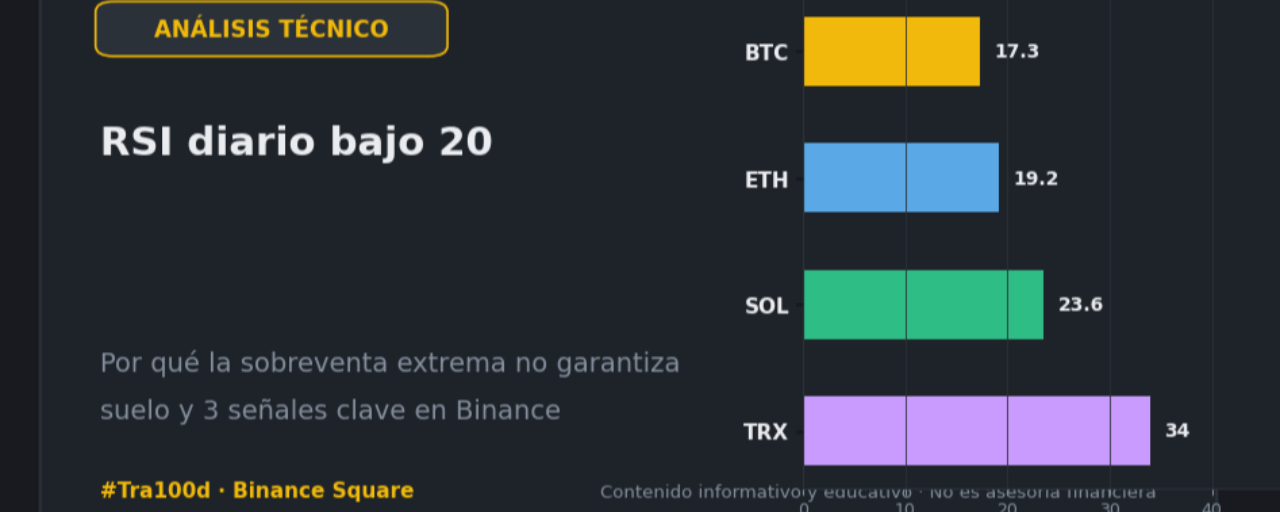

Extreme oversold conditions in crypto (daily RSI below 20): why a low RSI doesn’t guarantee a bottom and which 3 signals to watch for
When the market posts several consecutive down days and the Fear and Greed Index settles in the Extreme Fear zone, many traders open the daily chart and see a number that seems like an automatic invitation to buy: an RSI below 20. Intuition says that if an asset has fallen so quickly, “it has to bounce now.”
However, in crypto, that reasoning often proves costly. An extremely low daily RSI describes selling intensity, not a guaranteed bottom. Understanding the difference helps you avoid catching falling knives during a capitulation.
1. What a daily RSI in extreme territory really indicates
The 14-period RSI (Relative Strength Index) compares the average magnitude of bullish closes with bearish closes. By convention, readings below 30 are considered oversold, but during strong crypto downtrends, the indicator can remain compressed between 15 and 25 for days while the price continues to make lower lows.
When we see deep oversold readings across market pillars at the same time—such as $BTC at 17.3, $ETH at 19.2, BNB at 20.7, or $SOL at 23.6, compared with more defensive assets like TRX at 34.0—the message isn't "the decline is over," but rather that supply and demand are extremely imbalanced. In that environment, technical rebounds are often violent, but also brief if the broader structure doesn't change.
2. Why buying based only on a low RSI fails in strong trends
There are three classic traps when trading extreme oversold conditions:
Oscillator compression: a move from RSI 20 to RSI 15 can mean another double-digit drop in price, even though the indicator itself has moved only a few points.
Cascading liquidations: in markets with perpetual futures, a break below support triggers forced closures of long positions that completely ignore any technical indicator.
Dead-cat bounces: a breather that takes the RSI from 17 to 30 usually serves simply to ease selling pressure before a second leg down.
3. Three stronger signals to look for before calling a bottom
Rather than entering blindly because the oscillator shows a low number, it's worth demanding confirmation across three layers of the market:
Climactic volume followed by absorption: a capitulation candle with volume more than 2x its average often signals panic, but a real bottom starts to take shape when subsequent candles leave long lower wicks and stop closing at their lows.
Open interest (OI) flush: if the price falls while OI continues to rise, leveraged positions are still being opened and could fuel further liquidations. A clear OI flush (a marked drop in open contracts) indicates that excess leverage is being wiped out.
Price structure and reclaiming moving averages: as long as the price remains below its 4-hour EMA 20 and continues to form lower highs, momentum remains bearish. Reclaiming key levels at candle close—or forming a bullish divergence where the price makes a similar low but the RSI makes a higher low—offers a much clearer risk reference.
4. How to manage risk while the market searches for a bottom
During periods of extreme oversold conditions, position size matters more than guessing the exact penny at which the low will occur. Waiting for confirmation means giving up the first leg of the rebound, but it helps avoid getting caught in the most aggressive phase of a capitulation. Monitoring clear support levels, volume behavior, and leverage conditions separately helps you make clear-headed decisions.
Conclusion
A daily RSI below 20 on $BTC or $ETH is a warning sign to pay close attention to the chart, not an automatic buy button. The best reversals take shape when oversold conditions coincide with a leverage flush, volume absorption, and a genuine recovery in market structure.
When you see the daily RSI below 20, do you usually wait for confirmation above the EMA 20, or scale into positions near support levels? Let me know in the comments 👇
#TechnicalAnalysis #CryptoEducation #BTC #ETH #SOL #Tra100d
⚠️ For informational and educational purposes only; this is not financial advice. Cryptocurrencies are volatile: do your own research and trade with caution.