This afternoon’s candle bounced from a low of 55,130 to around 58,500. People are already saying the weekend panic is over and dip-buying money has come in. That logic doesn’t hold up. If people were really buying back in, we shouldn’t be seeing USDT trading at a discount first.
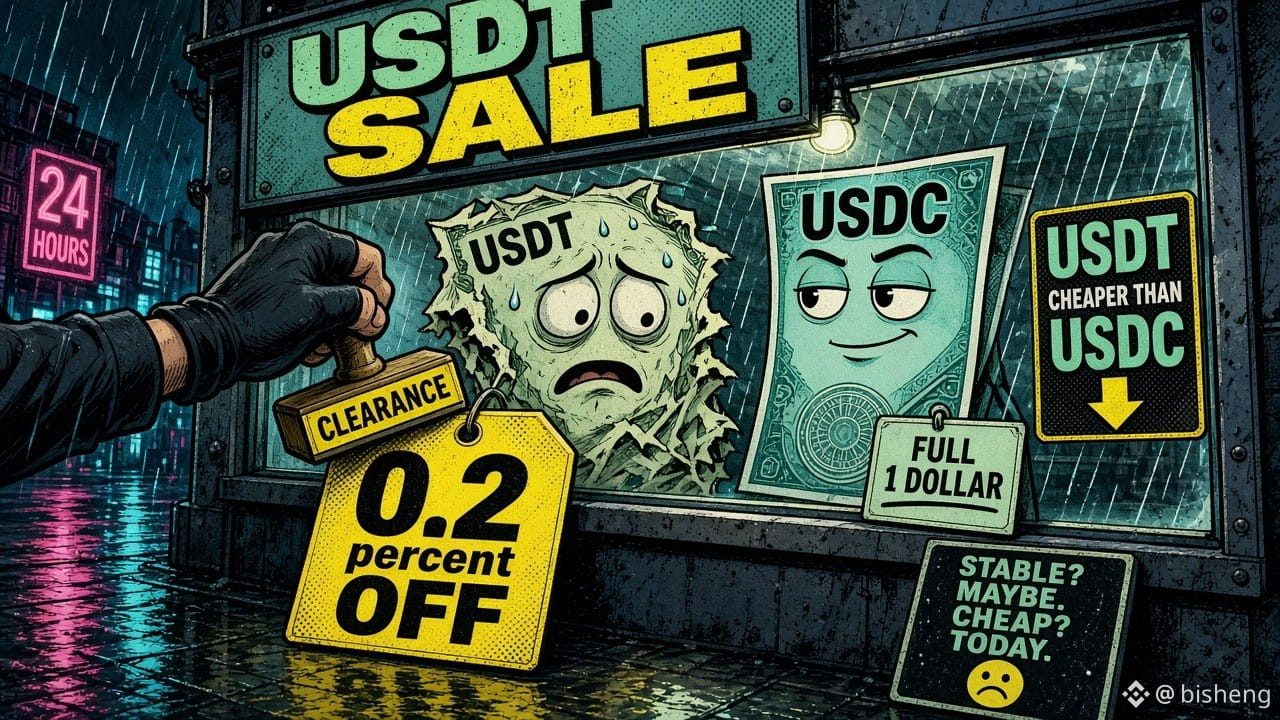
Here are this morning’s numbers. BlockBeats, citing HTX market data, reported that USDT briefly traded at a 0.2% discount to USDC. They wrote that the last time the discount reached this kind of daily level was in February this year. I checked Binance: for several hours this morning, USDCUSDT hovered around 1.0022, meaning one USDC cost about 1.0022 USDT, so USDT was roughly 0.22% cheaper. It was still around 1.0016 just a moment ago. The discount hasn’t fully gone away.
Let’s spell out what this means. This isn’t people buying Bitcoin back. It’s people swapping the USDT they hold for USDC. They’re both supposed to be worth one dollar, but some people are no longer willing to accept Tether at the same price. When stablecoins start trading at a discount, people are switching to a cleaner dollar—not buying the dip.
S&P’s assessment lines up with this, too. On November 18, S&P Global Ratings kept its assessment of USDT’s ability to maintain its dollar peg at 5, the worst rating on its scale of 1 to 5, called “weak”—the same as in November 2025. As of September 30, the higher-risk reserves they identified accounted for 28% of the circulating supply, up from 24% a year earlier. Gold holdings rose from $12.9 billion to around $19 billion, and during the same period they added $4.2 billion in publicly traded equities. Bitcoin reserves, meanwhile, fell from $9.9 billion to $8.4 billion. Tether’s own figures, verified by BDO Italia, showed assets of $191.45 billion, liabilities of $183.50 billion, and excess reserves of $7.95 billion at the end of September. S&P put it plainly: the scale of these higher-risk assets already significantly exceeds those excess reserves. If these assets were to fall sharply in value, USDT might not have enough backing for redemptions. Tether disputes this, telling Cointelegraph that the problem lies with S&P’s framework, not its reserves. But it hasn’t changed the rating of 5.
To redeem directly with Tether, you have to be a verified customer, and the minimum is $100,000. The fee is whichever is higher: $1,000 or 0.1%. You can’t just casually cash out.
Now look at Bitcoin itself. Binance spot was around $58,480 just now, down about 5.2% over 24 hours. Today it reached a high of $62,179 and plunged to a low of $55,130—below the 55,555 candle I wrote about at noon. It has bounced about 6% from the low to now. Today is Saturday, and the ETF channel is closed. According to Farside, IBIT is still showing a dash for the 20th; products that have reported so far have recorded a combined net outflow of $124.5 million. Those books won’t reopen until Monday. You can’t credibly say this weekend’s bounce means the money is back.
Here’s where I stand: I don’t consider this 0.2% a glitch in the order book. Someone is unloading USDT. If Bitcoin can’t hold around 58,500 after this weekend’s bounce, that discount could widen further. On Monday, the market will first have to deal with the IBIT figures that are still pending, and then with a dollar that’s already trading at a discount.
#USDT #Bitcoin