
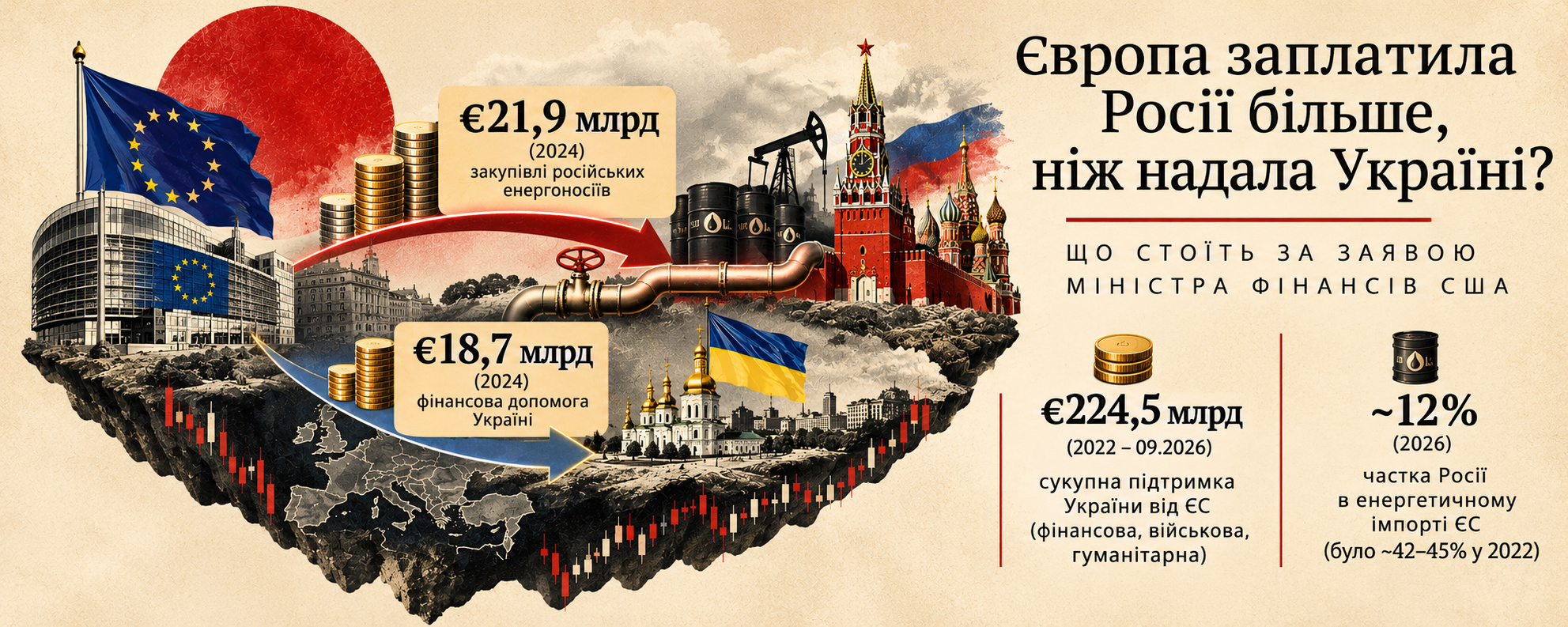

U.S. Treasury Secretary Scott Bessent said in an interview with NBC that European countries have transferred more money to Russia for energy supplies during the war than they have provided to Ukraine.
He also gave a specific example: according to him, 140 shipments left a Russian facility during the first six months of 2026, 136 of which were bound for European countries. Their total value exceeded $8 billion.
📊 What do the data show?
According to research by the Centre for Research on Energy and Clean Air (CREA):
▪️ In 2024, the EU purchased €21.9 billion worth of Russian fossil fuels.
▪️ In the same year, the EU provided Ukraine with €18.7 billion in financial assistance.
▪️ Thus, the cost of Russian fuel purchases exceeded financial assistance to Ukraine by approximately €3.2 billion, or 17%.
But this comparison does not take into account military and humanitarian aid to Ukraine.
According to the European Parliament, the combined financial, military and humanitarian support for Ukraine from the EU and its member states (Team Europe) amounted to around €224.5 billion from February 2022 to September 2026.
Therefore, Bessent’s claim cannot be considered a comprehensive summary of all financial flows between Europe, Russia and Ukraine.
⚖️ What is the main contradiction? Europe is financing Ukraine’s defense while continuing to purchase Russian energy resources. These payments support Russia’s foreign currency revenues, its budget’s tax revenues, and its ability to finance the war.
At the same time, the EU has significantly reduced its energy dependence on Russia, although it has not eliminated it completely. In particular, purchases of liquefied natural gas and some pipeline deliveries continue.
The problem lies in the contradiction between sanctions policy and continued trade with an aggressor state. As long as European companies buy energy resources from Russia, some of that money continues to support the economy that supplies resources to Russia’s war machine.
And this is not only a question of political consistency, but also of the effectiveness of sanctions.
Sources: NBC News (interview with Scott Bessent, 18.10.2026), CREA, European Parliament.