


Bitcoin is public by design. Satoshi Nakamoto knew that this openness would raise privacy concerns.
Anyone can verify Bitcoin’s transaction history without a bank’s approval. But that same public record can reveal far more information than most people imagine. Satoshi Nakamoto discussed this issue in Section 10 of the white paper. Since then, researchers and developers have found ways to protect information while preserving verifiability. How far have we come?
What a Bitcoin transaction reveals
You pay someone in Bitcoin. Once the transaction is confirmed, it becomes part of the public record, where anyone can look it up.
They can see the inputs, the recipient addresses, the amount corresponding to each output, and which block the transaction was included in. They may not know your name. But once one of your addresses is linked to your identity, the rest of your activity becomes easy to trace. Your salary, savings, business dealings, and spending habits could all leave clues on the same public ledger.
For a system that lets people “transfer money without a bank,” that's a strange trade-off. And Nakamoto didn't overlook it—the white paper has a section called “Privacy,” section 10.
To understand where blockchain privacy is headed, we need to go back to what Nakamoto actually wrote, look at the research that came before Bitcoin, and then examine what today's privacy systems can and can't do.
People were working on this problem before Bitcoin
Discussions about privacy and digital currency didn't start with Bitcoin.
In 1982, David Chaum published (Blind Signatures for Untraceable Payments). He explored how someone could obtain digitally signed payment tokens without the issuer being able to link the tokens to the eventual payment. This idea matters because a payment reveals more than “money was transferred.” It also reveals who transacted with whom, when the transaction happened, and how often they transact.
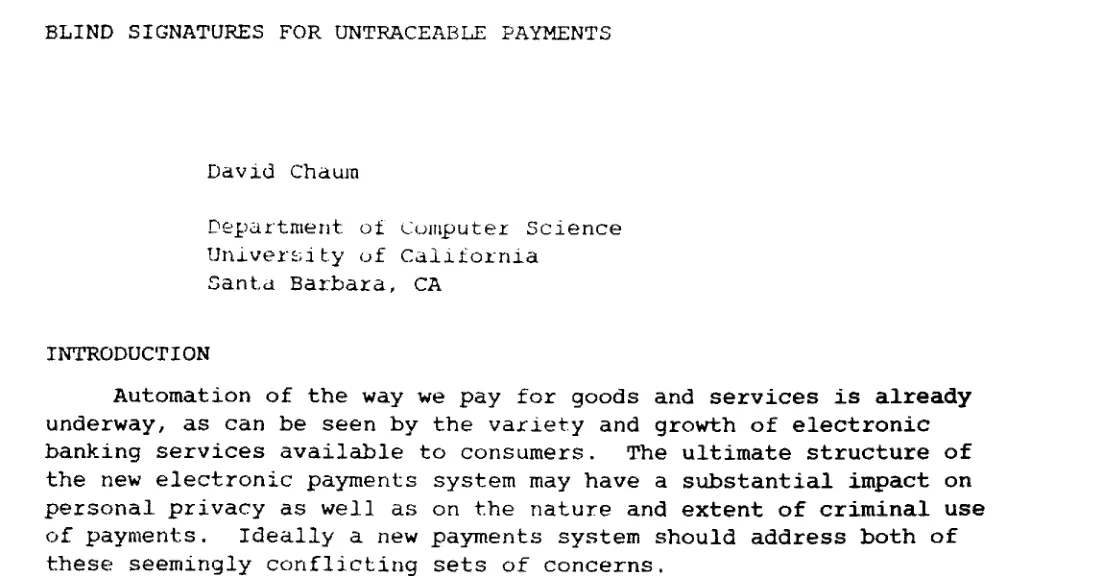 Image source: Lithos.eth
Chaum's work established an important direction for digital cash, but his electronic cash model still relied on an issuer. Protecting payment information and removing centralized trust are two separate problems. Other researchers and programmers continued working on them. The cypherpunks wanted to go further.
In September 1992, a group of cryptographers, programmers, and privacy advocates came together around a mailing list moderated by John Gilmore. The name “Cypherpunks” came from Jude Milhon, who reportedly used it to describe the people in the group. Their interests went beyond digital currency. They also discussed encryption, anonymous communication, digital identity, freedom of information, and how individuals could use software to protect themselves. Timothy C. May wrote (The Crypto Anarchist Manifesto) in 1988, and it was circulated electronically around the early gatherings of the movement in 1992. On March 9, 1993, Eric Hughes published (A Cypherpunk's Manifesto).
One line has remained relevant for more than three decades: privacy is necessary for an open society in the electronic age.
But Hughes had another line that's even more useful for understanding blockchain privacy: privacy is the power to selectively reveal oneself to the world.
He wasn't saying that people should hide everything, but that they should control what they show. A store selling you something doesn't need your entire financial history; someone receiving a payment from you doesn't need to see every transaction in your wallet. Hughes put it plainly: the parties to a transaction should know only what is directly relevant to that transaction. This idea remains central to discussions of privacy today. The cypherpunks also didn't believe privacy would be granted to them—they believed they had to build it themselves. Their famous saying was: Cypherpunks write code.
The paths that led to Bitcoin
Bitcoin didn't appear out of nowhere. People were already working on different parts of the digital currency problem.
Hashcash (Adam Back, 1997) was a proof-of-work system designed to make certain forms of abuse—including spam—more expensive. b-money (Wei Dai, 1998) proposed an anonymous, distributed electronic cash system. bit gold (Nick Szabo) proposed building digitally scarce value around computational work; he later published a detailed description in 2005. Reusable proof of work (Hal Finney, 2004) explored making proof-of-work results reusable as transferable digital value.
These were different proposals, none of them Bitcoin, and they didn't solve the same set of problems. But they show the research environment Nakamoto emerged from: people were already seriously working to build digital currencies that didn't rely entirely on banks, governments, or centralized payment processors. Nakamoto's white paper cited Hashcash and b-money.
Bitcoin brought together ideas from this earlier work to answer a difficult question: how can people agree on a shared payment record without a central authority to prevent double-spending? That was a breakthrough, and it solved an important problem. But its answer required transactions to be public—that was the trade-off.
What exactly did Nakamoto say?
On October 31, 2008, Satoshi Nakamoto published (Bitcoin: A Peer-to-Peer Electronic Cash System). Section 10 is titled “Privacy.”
The section begins by comparing Bitcoin's public transaction model with the kind of privacy people are used to with traditional banks. At a bank, transactions are visible to the bank, but the public generally can't inspect everyone's account history. Bitcoin is different: transactions are publicly broadcast, and users represent themselves with public keys rather than real names.
Nakamoto wrote: “The necessity to announce all transactions publicly precludes this method, but privacy can still be maintained by breaking the flow of information in another place: by keeping public keys anonymous.”
His proposed approach included using a new key pair for each transaction, making it harder to link different payments to the same person. But he also acknowledged a weakness: when a transaction uses multiple inputs, it reveals that those inputs belong to the same owner. If one of the addresses is linked to a real identity, other activity may be easier to associate with that person.
This is the key distinction: Bitcoin's original design offered pseudonymity, not confidential transactions. Your real name isn't automatically written into the ledger as it is with a traditional bank, but transaction details are public, and off-chain information can help link addresses to real people. Nakamoto didn't claim this was perfect privacy. He described a way to reduce the link between public transactions and real-world identities in a system that needed to support public verification.
What a transaction can reveal
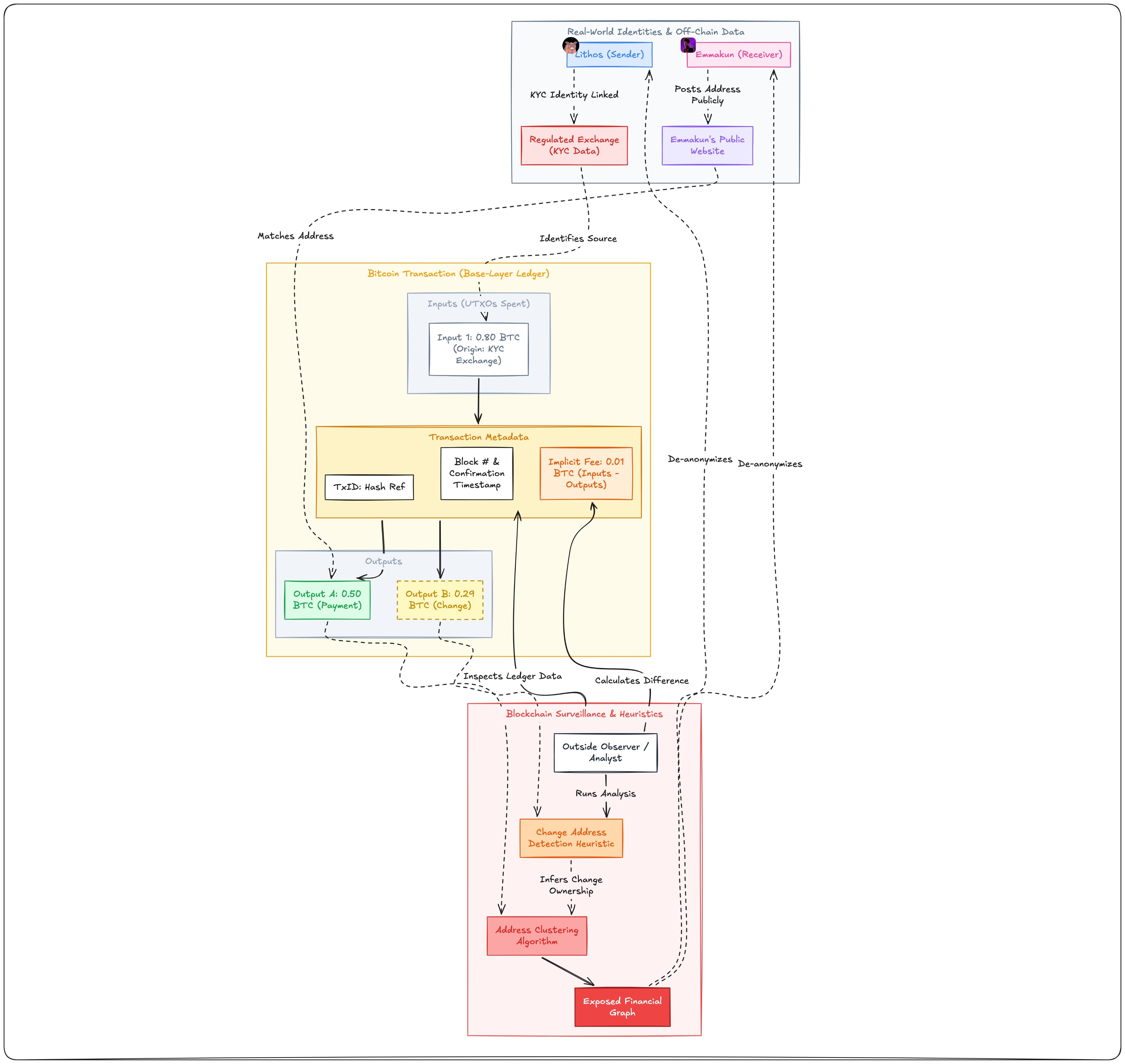
Here's a simple example. Lithos wants to pay Emmakun 0.5 BTC and constructs a transaction using her existing unspent transaction outputs. The transaction is broadcast, included in a block, and added to the chain.
Outside observers can see the inputs being spent, the output addresses, the amount of each output, the transaction fee (the total input amount minus the total output amount), and the block and timestamp that confirm the transaction.
Observers don't automatically know Lithos's or Emmakun's real names. But suppose Lithos received funds from an exchange that requires identity verification, or posted one of her addresses on a website. Observers could then link the address to her identity. From there, other transactions can be analyzed and connected.
There's another complication: an output might be change returned to the sender rather than a payment to someone else. Blockchain analysis often relies on assumptions to determine which output is which. These assumptions are useful, but they're not always correct.
 Image source: Lithos.eth
The key point is that Bitcoin doesn't need to reveal someone's name for their transaction history to reveal useful information. So when discussing Bitcoin, I don't think “anonymity” and “privacy” are interchangeable. Its addresses are pseudonymous, while its underlying transaction history is public—those are two very different things.
Satoshi Nakamoto was already thinking about this in 2010.
The 2010 discussion: Why zero-knowledge proofs are hard
On August 11, 2010, Satoshi Nakamoto took part in a BitcoinTalk discussion titled “Not a suggestion.” The topic was whether Bitcoin could avoid storing the complete transaction history, as it did at the time. The problem was double-spending: if a node didn't have enough information to check the transaction history, how could it know that a coin hadn't already been spent?
Nakamoto explained that verifying the “absence of double-spending” required global knowledge of the relevant transactions. Then he wrote: “It's hard to think of how zero knowledge proofs would apply in this case.”
Those words are worth reading again, because context matters. He wasn't saying that zero-knowledge proofs were useless. He was discussing a specific problem: how can a node prove that no other spend exists without knowing all the relevant transactions? In other words, how can the network verify the “absence of double-spending”? That's a different question from “Can proofs hide payment details?”
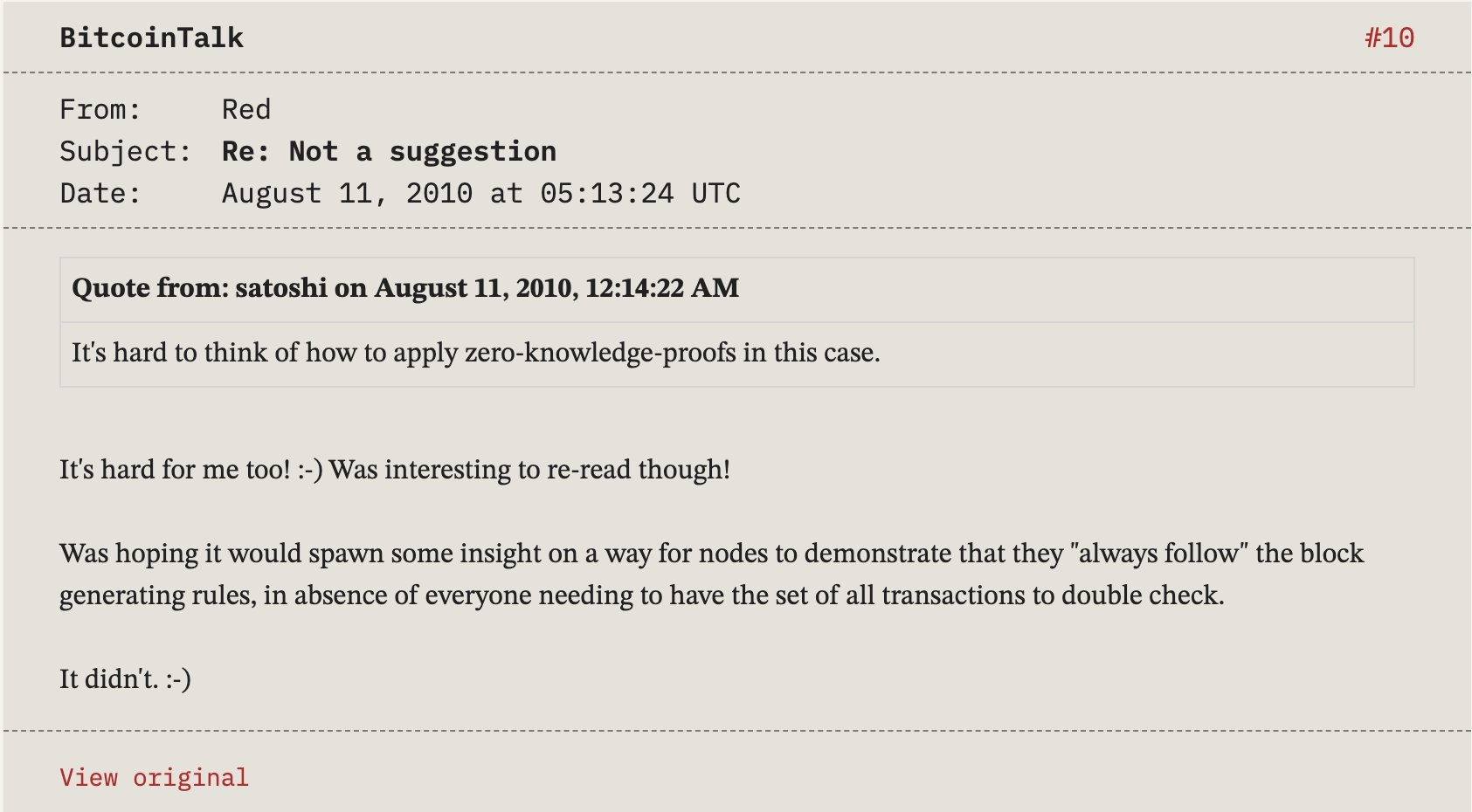 Image source: Lithos.eth
This matters because modern discussions of privacy sometimes make it sound as if Nakamoto overlooked zero-knowledge cryptography. The historical record is more interesting than that: he knew about the idea and was thinking about how difficult it would be to apply it to Bitcoin's double-spending problem. In fact, later research explored precisely how zero-knowledge proofs could protect transaction information while still allowing the network to verify that transactions complied with the rules.
From hiding identity to hiding the payment itself
The research didn't stop with Bitcoin.
In 2013, researchers published (Zerocoin: Anonymous Distributed E-Cash from Bitcoin). The paper pointed out a clear limitation of Bitcoin: a public transaction log means privacy relies mainly on pseudonyms. Zerocoin explored how cryptography could break the link between a transaction and its origin, improving Bitcoin's privacy. But it still revealed the destination and amount of payments, and its payment method had limitations.
 Image source: Lithos.eth
In 2014, work in the same direction advanced with (Zerocash: Decentralized Anonymous Payments from Bitcoin). Zerocash proposed a payment system using zk-SNARKs that could hide the origin, destination, and amount of a transaction while still allowing the network to verify that the payment was valid.
This is different from Bitcoin's original privacy model. Bitcoin tries to separate public keys from real-world identities; Zerocash explored keeping more of the transaction itself out of public view. That's a meaningful shift: the network doesn't need to see every detail of a payment to check that it complies with the rules. Cryptographic proofs can establish that a transaction is valid without revealing all the information used to construct it. That's one reason zero-knowledge proofs are so important to privacy research.
What today's privacy systems protect
When people discuss blockchain privacy, they often lump every project together. But hiding the recipient isn't the same as hiding the amount, and hiding the amount isn't the same as hiding the transaction graph. Nor does hiding information on-chain automatically protect network activity that occurs before a transaction is recorded on-chain. It's worth looking at the different approaches separately.
One system might hide the recipient but reveal the amount; another might hide the amount but still leak information through wallet or network connections; a third might let someone prove that they meet a condition without revealing their full identity. These are different kinds of protection.
Bitcoin and Payjoin. Bitcoin's underlying transaction layer remains public and transparent, but that doesn't mean nothing can be done. Developers have found ways to make some forms of transaction analysis less reliable. Payjoin Dev Kit describes one such method in BIP 78: the sender and recipient collaborate to construct a payment, and the recipient contributes an input too. Why does this matter? Some blockchain analysis assumes that multiple inputs in a transaction belong to the same person. With Payjoin, that assumption may no longer hold, because the recipient also contributed an input. But Payjoin doesn't hide the transaction amount or turn Bitcoin into a confidential payment system. It makes some forms of analysis less reliable—useful, but not to be confused with full transaction confidentiality.
Monero. Monero builds privacy into its ordinary transaction model, using several mechanisms to protect different parts of a payment: ring signatures provide sender ambiguity, making it difficult for outside observers to determine which output was actually spent; stealth addresses generate one-time recipient addresses, making payments harder to link to a recipient's public address; and Ring Confidential Transactions (RingCT) hide the amount while still allowing the network to verify the monetary rules. Together, these mechanisms protect information about the sender, recipient, and amount.
But there are limitations. Sender privacy is probabilistic and depends on the transaction's ring and the other information available to an observer. Monero also uses Dandelion++ to make transactions harder to trace across the network, but its official documentation warns that this doesn't protect against every network observer—the user's ISP, VPN provider, or certain remote-node configurations may still expose information. Monero is therefore a useful example of how far transaction privacy can go, but it doesn't promise that every aspect of a user's activity will be invisible.
Zcash. Zcash turned Zerocash research into a working cryptocurrency. Its shielded transactions use zero-knowledge proofs to protect transaction information. When transferring funds between two shielded addresses, the public ledger doesn't reveal the sender, recipient, amount, or memo as it would for a transparent transaction, while the network can still verify that the transaction is valid. This is much stronger than Bitcoin's original model.
But Zcash also supports transparent addresses, and transactions involving them remain publicly visible. The proportion of shielded transactions, the movement of funds between transparent and shielded pools, wallet support, and the size of the anonymity set all affect the privacy users actually get. Zcash also illustrates an important idea: privacy and disclosure don't have to be opposites. Its shielded ecosystem includes viewing-key mechanisms that allow selected information to be inspected without handing over the ability to spend funds. The specific capabilities depend on the pool and wallet implementation, so you shouldn't assume that every address offers the same disclosure features.
The key takeaway from the comparison is simple: privacy isn't a single feature, but a set of distinct protections. A project needs to be clear about which of them it provides. This comparison describes only what an outside observer can learn from the blockchain itself. It doesn't assess IP address exposure, wallet security, exchange records, compromised devices, coercion, or information users voluntarily disclose. Nor does it mean that all privacy protections are equally strong—for example, Monero's sender protection is probabilistic, while its recipient and amount protections use different mechanisms; Payjoin isn't a standalone currency, but a way of constructing a Bitcoin payment.
The next question: privacy inside applications
The biggest developments since Bitcoin aren't limited to cryptocurrencies that hide transaction details. Privacy is becoming part of smart contract and application design. This matters because people do more than transfer money on blockchains: they trade, lend, vote, manage assets, prove eligibility, and interact with applications. These activities can expose information that individuals and businesses may not want to make public.
Traders don't want everyone watching their positions; businesses don't want competitors tracking their funds; people applying for services may need to prove that they meet certain criteria without revealing their full identity or financial history. Different technologies are addressing these problems, which is why private smart contracts matter. The idea is to let an application do useful work without making every piece of information involved in that work public. Several projects approach this from different directions.
Aztec: private and public functions in the same application. Aztec is building a privacy-focused Layer 2 on Ethereum, where smart contracts can contain both private and public functions. The difference lies in where the computation happens. Private functions run in a private execution environment (PXE) on the user's device. The PXE performs private computations and generates zero-knowledge proofs, which are sent to the network so it can verify the required result without private inputs being sent to the sequencer. Public functions are different: they run on the network and use public state. A transaction can involve both types of function.
This is programmable privacy: developers decide, function by function, which parts of an application should remain private and which need to be public. Take a voting application: a person should be able to vote without revealing their choice, while the final tally needs to be public so everyone can verify it. The private part handles the ballot; the public part updates the count. The application can make the final tally verifiable without exposing individual ballots. That's what private smart contracts make possible. The network itself is decentralized: sequencers stake to produce blocks, provers can join without permission, and governance is open. Aztec describes itself as one of the few fully decentralized L2s on Ethereum, with no central operator controlling sequencing or the rollup.
But we shouldn't overstate the case. Aztec's documentation explains that when the PXE queries nodes for network state—for example, to check whether a particular nullifier exists—nodes can learn which data the user is interested in. Running your own node can reduce this exposure. Private execution doesn't make every surrounding interaction private. Developers still need to consider public function calls, network requests, transaction timing, and the information the application chooses to reveal. What's interesting about Aztec isn't just that it hides transactions, but that it gives developers a way to decide which parts of an application should be private and which should be public.
Oasis Sapphire: confidential execution using hardware. Sapphire runs confidential smart contracts in a trusted execution environment (TEE). A TEE is a protected hardware environment that isolates data and computation from the rest of the system. Sapphire supports encrypted transaction inputs and confidential contract state, allowing contracts to process information that shouldn't be publicly visible.
The difference between it and Aztec matters. Aztec's private functions use client-side execution and zero-knowledge proofs; Sapphire relies on a protected hardware environment. They're not interchangeable. TEEs introduce trust assumptions around the hardware, its security, attestation, and implementation. Zero-knowledge systems have their own assumptions, including the correctness of circuits, software, and proof systems. Both approaches can be useful, but they protect information in different ways.
Umbra: keeping transfers inside a shielded pool. I've been following Umbra's work on Solana, especially the changes from its first version to V2. As the Umbra team explained to me, V1 used encrypted token accounts to deposit into a shielded pool, which acted as an intermediary between those accounts and public token accounts or other encrypted token accounts. V2 abandoned that setup and focused on the shielded pool: users can make private transfers within the pool instead of moving funds between multiple encrypted token accounts.
This distinction matters because the pool becomes the place where private balances and transfers are managed. But it's important to understand what the pool does and doesn't hide. Deposits into and withdrawals from the pool may expose information on-chain: observers might see the addresses, assets, and amounts involved in a deposit or withdrawal. Timing and amounts can also help people guess which flows of funds are connected. The privacy protection applies to activity inside the pool. So I wouldn't say that it makes every part of a user's Solana activity private—it protects a specific part of the transaction flow. That's still useful, but it should be evaluated on those terms.
Privacy Pools: proving something without revealing everything. Privacy Pools, built by 0xbow, is a compliance-focused privacy protocol on Ethereum and other chains. Users can transfer cryptocurrency privately while deposits are screened to prevent illicit funds from entering the pool. You deposit ETH or stablecoins from an ordinary wallet into the (shielded) pool, where an Association Set Provider (ASP) operated by 0xbow screens the deposit. Only approved deposits can be used privately. There's no KYC and no global viewing key. Zero-knowledge proofs let you prove that your funds came from an approved deposit without revealing which one, breaking the on-chain link between deposits and withdrawals. It's non-custodial and deployed on Ethereum, Arbitrum, Base, Optimism, BNB Chain, and other networks. The design is based on a 2023 research paper co-authored by Vitalik Buterin. The goal is to offer practical privacy to ordinary users while keeping funds from known bad actors out of the pool.
There's another question I think matters: what if someone needs to prove that their funds meet certain criteria without revealing their entire transaction history? The Privacy Pools research paper (Blockchain Privacy and Regulatory Compliance: Towards a Practical Equilibrium) explores one approach using zero-knowledge proofs and association sets. Users can prove that their funds belong to a set of deposits without revealing the specific deposit or disclosing their full transaction graph. For example, a user might want to prove that their funds aren't associated with a set of known illicit sources. The proof can establish membership in an association set, but it doesn't prove that someone is generally innocent or establish that every source of their funds is legitimate. The result depends on the information used to construct the association set and the rules applied by the provider. Privacy Pools is an interesting example of selective disclosure: users can prove a particular attribute without handing over their entire transaction history. That comes closer to Hughes's idea of selective disclosure than systems in which all information must be either fully public or fully hidden.
Kohaku: what a wallet reveals before a transaction. One aspect of blockchain privacy deserves more attention: someone can use a private transaction protocol and still leak information through the wallet they use to access it. When a wallet checks a balance, it usually asks a remote provider for information about an address. That request tells the provider which address the user is interested in. The same problem arises when a wallet requests transaction history, simulates a transaction, or fetches other account information. The transaction itself may be private, but requests made before the transaction are another matter.
This is one of the areas Kohaku is exploring. Kohaku is an Ethereum privacy project described as a reference implementation of a privacy-preserving wallet and open-source wallet SDK. Ethereum's official channels have called it potentially the most exciting privacy development in recent years. Its work covers several parts of the wallet experience, including privacy protocols, provider abstraction, light-client integration, and post-quantum account tools. One area worth watching is private information retrieval (PIR). With an ordinary balance query, the server receives an address and returns information. With PIR, a wallet can construct a query that lets the server return the information it needs without learning which address was queried. I like this direction because it takes the discussion beyond transactions. The wallet is where users manage keys, accounts, permissions, and applications. If that layer keeps leaking information, private transactions alone can't solve the whole problem.
Have we gone beyond Nakamoto's privacy model?
I think the answer is: yes, in terms of specific technical capabilities.
When it comes to transaction confidentiality, Monero and Zcash shielded transactions protect payment details that Bitcoin exposes. When it comes to proving that a computation or transaction is valid without exposing all the underlying information, zero-knowledge systems can do that. Aztec brings private execution to smart contracts; Oasis Sapphire uses confidential hardware execution; Umbra's shielded pool focuses on private transfers; Privacy Pools explores how to prove specific properties of funds without revealing a complete transaction history; and Kohaku makes privacy on Ethereum easier to use through an open-source privacy wallet and SDK.
These are real advances. But I wouldn't say the privacy problem is solved.
A private transaction doesn't automatically hide the IP address it was submitted from. A private smart contract doesn't make every public function or interaction private. A shielded pool doesn't erase information exposed when funds enter or leave it. A TEE doesn't eliminate hardware trust assumptions. A zero-knowledge proof can't protect a user whose device has been compromised. And a privacy feature that people can't understand or use correctly may provide less protection in practice than its technical description suggests.
We have to look at the whole path: the wallet, device, application, network, contract, and the information ultimately made public. So there has been real progress, but we still need to make these tools easier to use and available to everyone.
What should be public, and what should be private?
For years, blockchains have been built around public state. Anyone can check balances, track transactions, and analyze activity. This transparency makes independent verification possible, but it also exposes personal and commercial activity in ways that are difficult to justify.
I don't think every part of a blockchain should be hidden—you've seen me write about selective disclosure. Public institutions should be held accountable, public spending should be scrutinized, and networks should provide ways for people to verify that rules are being followed and claims about their operation can be checked. But I also don't think someone's savings, income, private payments, investment positions, identity documents, and business activity should become automatically public just because they use a blockchain.
These goals can coexist. Someone should be able to prove they're eligible for a service without handing over every detail of their identity. A business should be able to settle payments without exposing its entire financial position to competitors. Voters should be able to vote privately while the final result remains publicly verifiable. A wallet should be able to check a balance without telling a remote provider which account its owner is looking at. These aren't arguments for hiding everything; they're arguments for giving people control over what they disclose.
That's why I keep coming back to Hughes's definition of privacy: privacy is the power to selectively reveal oneself to the world. It's much more useful than simply asking, “Does the project have private transactions?”
Bitcoin began a significant part of this work, but it didn't finish it. Whenever I read section 10 of Nakamoto's white paper, what stands out isn't Bitcoin's failure to solve every privacy problem. It's that Nakamoto understood and acknowledged the tension between a public transaction system and personal privacy, then proposed a pragmatic compromise in the design he was building. For years, cypherpunks have been asking a broader question: how can people use digital systems without giving up information they don't need to reveal? Bitcoin answered an important part of that question, and those who came after pushed the work further. Chaum explored untraceable digital payments; Zerocoin and Zerocash advanced transaction privacy; Monero and Zcash brought different forms of confidential payments into use.
So have we gone beyond Nakamoto? In some technical capabilities, absolutely. But the cypherpunks' broader goal wasn't just to hide transactions—it was to let people control what they disclose without losing the ability to verify what matters. Newer systems bring privacy into smart contracts, wallets, identity, and selective disclosure. Each approach has different strengths and limitations. That's what I hope readers keep in mind when evaluating privacy projects: don't just look at claims on a website, technical names, or whether a transaction is described as private. Look at what the system actually hides and what remains visible. Find out who can access the information, what assumptions the system relies on, and what happens when people use it in the real world.
The cypherpunks' original question is still worth asking: why should a system know more information than it needs to do its job?
Bitcoin made it possible to verify money without relying on banks. The work now is to give people more control over what they disclose while preserving the ability to verify. That's the part of the privacy movement I want to keep exploring.
This article is republished with permission from: (Foresight News)
Original title: (Bitcoin Is Public by Design, Satoshi Knew That Came with a Privacy Problem)
Original author: Lithos.eth
Translated by: AididiaoJP, Foresight News
The article “Bitcoin's Openness and Privacy Are a Paradox: Satoshi Acknowledged It Early On—Have Later Generations Solved It?” was first published on “Crypto City”