
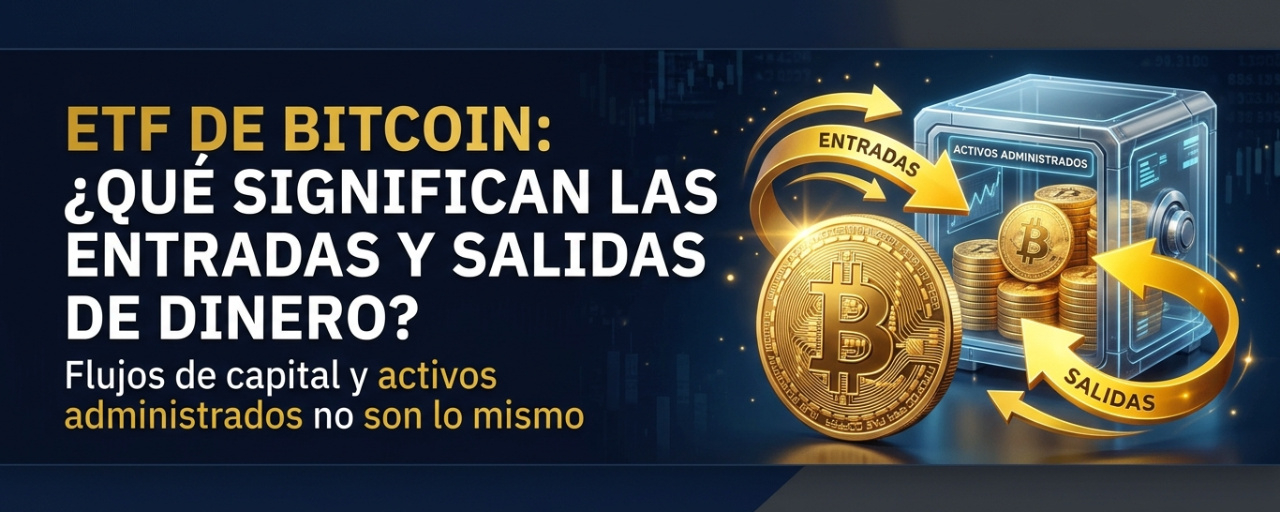

Since the launch of spot Bitcoin ETFs, news about capital inflows and outflows in these financial products has become increasingly common.
Some headlines highlight large inflows as a positive sign for Bitcoin. Others present outflows as a possible sign of waning institutional interest.
But what do these movements really mean?
To interpret them correctly, we must first distinguish between three concepts: net flows, assets under management, and the price of Bitcoin.
1. What does it mean when an ETF receives inflows?
A spot Bitcoin ETF provides exposure to the price of BTC through a financial instrument traded on traditional markets.
When net inflows are recorded, it means that, over a given period, the value of shares created has exceeded the value of shares redeemed.
Put simply, more shares have been created than redeemed in the fund, based on its reporting methodology.
This process involves authorized participants who can create or redeem large blocks of shares directly with the ETF. Other investors, by contrast, typically buy and sell their shares on the stock exchange.
For a spot Bitcoin ETF, new creations may require contributions of cash or assets, depending on the fund’s structure and operating mechanism. When cash is used, the fund may use it to purchase Bitcoin and back its shares.
That’s why net flows can provide useful information about demand for Bitcoin exposure through these products.
However, we should not interpret every inflow as a direct and immediate purchase of BTC on the market, or as an automatic signal that its price will rise.
2. And what does it mean when an ETF records outflows?
Net outflows represent the opposite situation: over a given period, the value of shares redeemed exceeds the value of newly created shares.
This may be related to different investor decisions:
Reducing exposure to Bitcoin.
Rebalancing portfolios.
Liquidity needs.
Changes in market expectations.
Risk management adjustments.
In the case of a spot ETF, redemptions may involve the fund delivering cash or assets, depending on its structure and operating mechanism.
A net outflow does not necessarily mean that all institutional investors are abandoning Bitcoin.
Nor does it, by itself, prove that the market has entered a downward trend.
What matters is whether these movements recur, how long they last, and how they evolve alongside other market variables.
3. What are assets under management, or AUM?
This is where one of the most important distinctions comes in.
Assets under management, known by the acronym AUM, represent the total value of the assets managed by a fund.
For a spot Bitcoin ETF, this figure is determined primarily by the market value of the BTC it holds, although it may also include cash and other components of its structure, taking into account its liabilities and expenses.
Let’s imagine the following example:
An ETF holds 10,000 BTC, and each Bitcoin is worth $70,000.
The value of those holdings would be approximately $700 million.
If Bitcoin rises to $80,000 and the fund holds exactly the same amount of BTC, the value of those holdings increases to $800 million.
Did $100 million in new money come in?
Not necessarily.
The increase can simply be explained by Bitcoin’s appreciation, without the fund receiving any new net contributions.
That’s why an increase in AUM does not automatically mean that new capital has flowed in.
4. Why should we distinguish between flows and AUM?
Because each indicator answers a different question.
Net flows show the value of shares created and redeemed over a period. They provide a reference point for analyzing demand for exposure through ETFs.
AUM shows the economic value of the assets managed by a fund at a given point in time. Its changes depend both on flows and on the valuation of the assets it holds.
The price of Bitcoin reflects the market valuation of BTC, which is influenced by many participants and factors beyond ETFs.
The three indicators are related, but they are not interchangeable.
For example, an ETF can record net inflows while the price of Bitcoin falls if selling pressure from the rest of the market outweighs the demand observed through these products.
Its AUM can also increase without any new net inflows, simply because Bitcoin has appreciated.
It is even possible for ETF shares to change hands between investors on the exchange without any shares being created or redeemed. That’s why ETF trading volume should not be confused with its net flows either.
This distinction is essential to avoid misinterpretations.
5. How should we analyze ETF data?
Rather than focusing on a single figure or trading day, it is helpful to look at several elements:
Daily net flows: These help identify specific movements of capital, although they can be volatile and do not always reflect a sustained trend.
Cumulative flows: These help identify whether there is a trend of inflows or outflows over several weeks. It is important to check the period analyzed and the methodology used by the source.
Assets under management: These show how the economic size of the funds is changing, although they are also affected by fluctuations in the price of Bitcoin.
BTC holdings: These show how many bitcoins the funds collectively actually hold. This information helps distinguish changes in the amount of BTC from changes in its valuation.
Bitcoin price and volume: These help examine how the market behaves while these movements are taking place.
Financial context: Interest rates, liquidity, and the performance of other risky assets help interpret investors’ decisions.
None of these variables should be used in isolation. They are more useful when analyzed together and over sufficiently long periods.
Conclusion
Spot ETFs have introduced new tools for analyzing investor participation in Bitcoin and demand for exposure through traditional markets.
However, correctly interpreting their data requires distinguishing between net inflows and outflows, assets under management, BTC holdings, and price changes.
A high AUM figure does not, by itself, prove that new capital is flowing in. Likewise, a day of net inflows does not guarantee that Bitcoin’s price will rise, nor does it necessarily represent an equivalent purchase of BTC on the market.
The key is not just how much money ETFs manage, but understanding how their flows, holdings, and valuations change over time.
This article is for educational and informational purposes. It does not constitute financial advice or a recommendation to buy or sell crypto assets.
#Bitcoin #BTC #BitcoinETF #CryptoEducation #InstitutionalInvesting