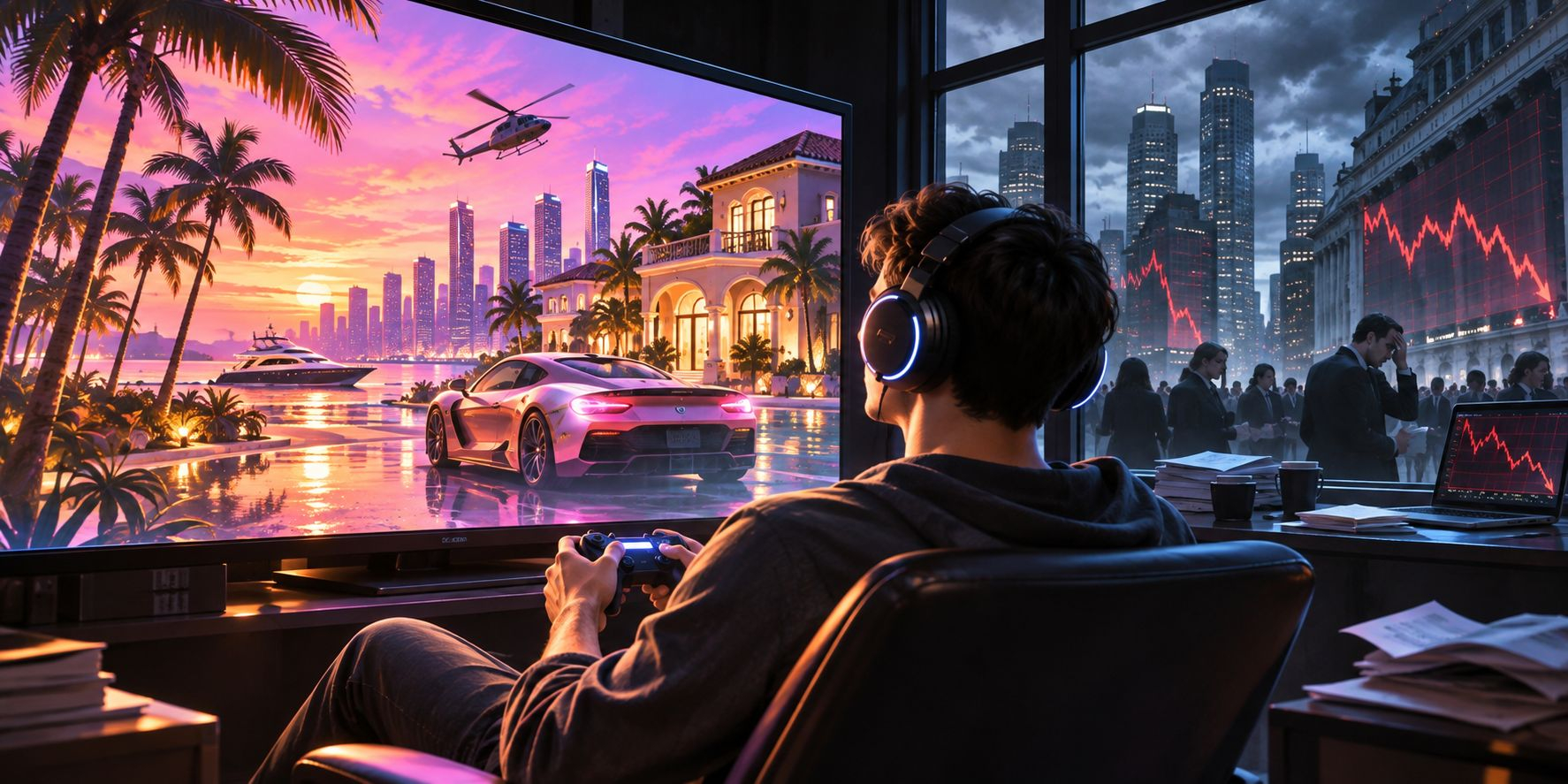


Perhaps years from now, when people look back on 2026, they’ll be shocked to discover an eerily strange coincidence.
At a time when the global financial system faces massive uncertainty and AI mania is pushing U.S. stocks to historic highs, an immense, bustling virtual world filled with money and desire is about to open its doors to hundreds of millions of people.
This world is GTA 6.
Here, you can drive luxury cars, live in mansions, splash your cash, and experience a freedom that’s out of reach in real life. The most unsettling thing is that the real world may be heading in the exact opposite direction.
What would happen if Wall Street’s AI bubble suddenly burst in the next few years? Imagine this.
Tech giants once considered invincible could lose trillions of dollars in market value in just a few months.
Nvidia, Microsoft, Apple, Google—if the growth expectations for these giants underpinning the U.S. stock market’s boom were to collapse all at once, the entire market could face a brutal repricing.
The Nasdaq could plunge day after day. The S&P 500 could sink into a prolonged bear market. Trillions of dollars in wealth could vanish in wave after wave of panic selling.
And what’s truly frightening is that today’s U.S. stock market is no longer just a casino for Wall Street’s wealthy. It’s tied to ordinary people’s retirement accounts, pensions, index funds, and the wealth accumulated over decades by countless families around the world.
When the stock market crashes, it’s not just numbers on a screen that disappear. It’s the money countless people had planned to use for retirement, buying a home, and raising their children.
Even worse, financial crises never stay confined to the stock market. When tech companies’ market values plunge and financing dries up, businesses may begin laying off workers on a massive scale.
As unemployment rises and consumer spending shrinks, the real estate market may also come under immense pressure. When banks face mounting bad debts and tighten credit further, panic that was once confined to capital markets could gradually spread throughout the real economy.
That’s what makes financial crises truly so devastating. They begin as a numbers game on Wall Street, but can end with ordinary people unable to pay rent or repay loans—and suddenly losing their jobs.
In 2000, the dot-com bubble burst, and the Nasdaq plunged about 78% from its peak. In 2008, the subprime mortgage crisis triggered a global financial tsunami. Lehman Brothers collapsed, and countless families lost their homes and savings.
Today, a far larger, more complex financial system—one more dependent on technology and capital markets—is facing a new test. I suspect that if the AI investment frenzy ultimately turns into a systemic financial crisis, its impact could extend beyond what many people imagine.
This time, global capital markets, the tech industry, pension systems, and ordinary people’s wealth are all tightly intertwined. If one critical link runs into serious trouble, the risk could spread rapidly like a line of dominoes.
But perhaps what’s most chilling isn’t the collapse of the financial system. It’s something else that’s happening quietly, right now.
As the real world becomes harder and harder to live in, the virtual world is becoming ever more addictive. Imagine this.
One day, you open your phone and see that U.S. stocks have plunged again. Your investment account has lost half its value. The news is full of stories about corporate bankruptcies, banking crises, mass layoffs, and soaring unemployment. You realize that the wealth you spent more than a decade working hard to build could shrink dramatically in just a few months.
Rent in the real world keeps getting more expensive, the cost of living keeps rising, and jobs are getting harder to find.
And right then, you launch GTA6.
Suddenly, everything changes.
You can drive supercars worth millions of dollars through a city ablaze with neon lights. You can move into a mansion overlooking the coastline and enjoy a luxurious virtual life.
You can temporarily forget your real-world debts, unemployment, inflation, and the financial world that keeps devouring ordinary people’s wealth. In reality, you may be going through the worst economic crisis of your life.
But in the game, you’re still living in a never-ending carnival of capitalism. That’s the strangest contrast of all.
As Wall Street’s wealth myth begins to falter, the virtual world can keep manufacturing the illusion of wealth and success. As the American Dream in the real world grows ever more distant, games let you experience in a few dozen hours a life you might never have in reality, even if you lived to be a hundred.
You can even imagine an even more unsettling future. By day, people worry about work, mortgages, and bills in the real world. At night, they return to virtual cities, drive luxury cars, buy mansions, and experience wealth and power.
The real world is increasingly like a survival game you can’t quit. The virtual world, meanwhile, is increasingly like the place people truly want to live.
Perhaps the most terrifying future isn’t a sudden global stock market crash one day. It’s a financial crisis that continues to erode ordinary people’s lives, widening the wealth gap and gradually reducing social mobility.
Meanwhile, virtual entertainment is growing ever bigger and more sophisticated—and increasingly able to satisfy humanity’s fantasies of freedom, wealth, and success.
In the end, people may stop striving to change reality. Because in the virtual world, they’ve already found a life that’s easier to find fulfilling.
Of course, none of this means there’s any real connection between the release of GTA6 and a financial crisis. It may simply be a game that happened to emerge in an extraordinary era.
But sometimes, what’s most chilling about history is precisely the way seemingly unrelated phenomena of an era coincide. On one side is Wall Street’s wealth myth, built on trillions of dollars. On the other is the virtual American Dream, constructed from code by game companies.
One world’s prosperity may rest on ever-inflating asset prices. The other’s rests on digital fantasies that can never truly go bankrupt.
Years from now, people looking back on this era may discover an unsettling irony. Just as the American Dream in the real world began to fade, humanity created a virtual world even more dazzling than the American Dream.
Perhaps GTA6 really is just a game. But it could also become this era’s strangest cultural symbol. As hundreds of millions immerse themselves in the virtual world’s lavish excess, the financial storm in the real world may only just be beginning.