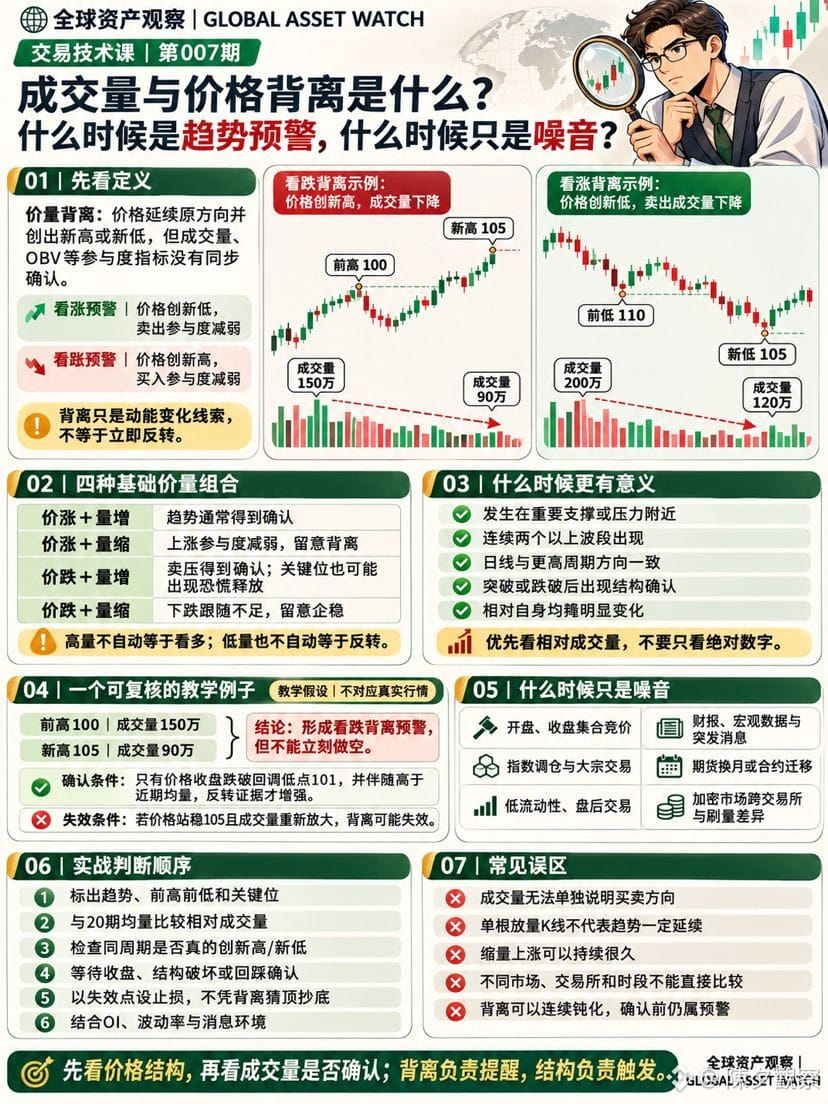
What is a divergence between volume and price? When is it an early warning of a trend, and when is it just noise?
If price makes a new high while volume keeps declining, can you short immediately?
No. A price-volume divergence only indicates that price and market participation are out of sync. It is an early warning of a change in momentum, not a signal to trigger a reversal trade.
Four common combinations:
Price rises + volume increases: the trend is usually confirmed
Price rises + volume decreases: participation in the rally is weakening; watch for bearish divergence
Price falls + volume increases: selling pressure is confirmed, but at key support it could also be panic selling
Price falls + volume decreases: the decline is attracting little follow-through; watch for signs of stabilization
Volume alone cannot tell whether trades come from aggressive buying, aggressive selling, opening positions, or closing positions. So a single surge or drop in volume cannot determine direction on its own. CME also cautions that a high-volume decline may be driven by new short sellers or by buyers stepping in at support.
A divergence is usually worth taking seriously when several conditions align: it occurs near key support or resistance, persists across multiple swings, shows a clear change relative to its own average volume, and is ultimately confirmed by the close, a structural break, or a retest. Technical patterns are clues about probabilities, not absolute rules.
Practical principle: Look at price structure first, then check whether volume confirms it. Divergence serves as a warning; structure provides the trigger.
Coming next:
Saturday | Trading in Practice | Episode 007
“How to control the cost of trial and error with scaling into a position: from an initial probe and confirmation to adding to the position”