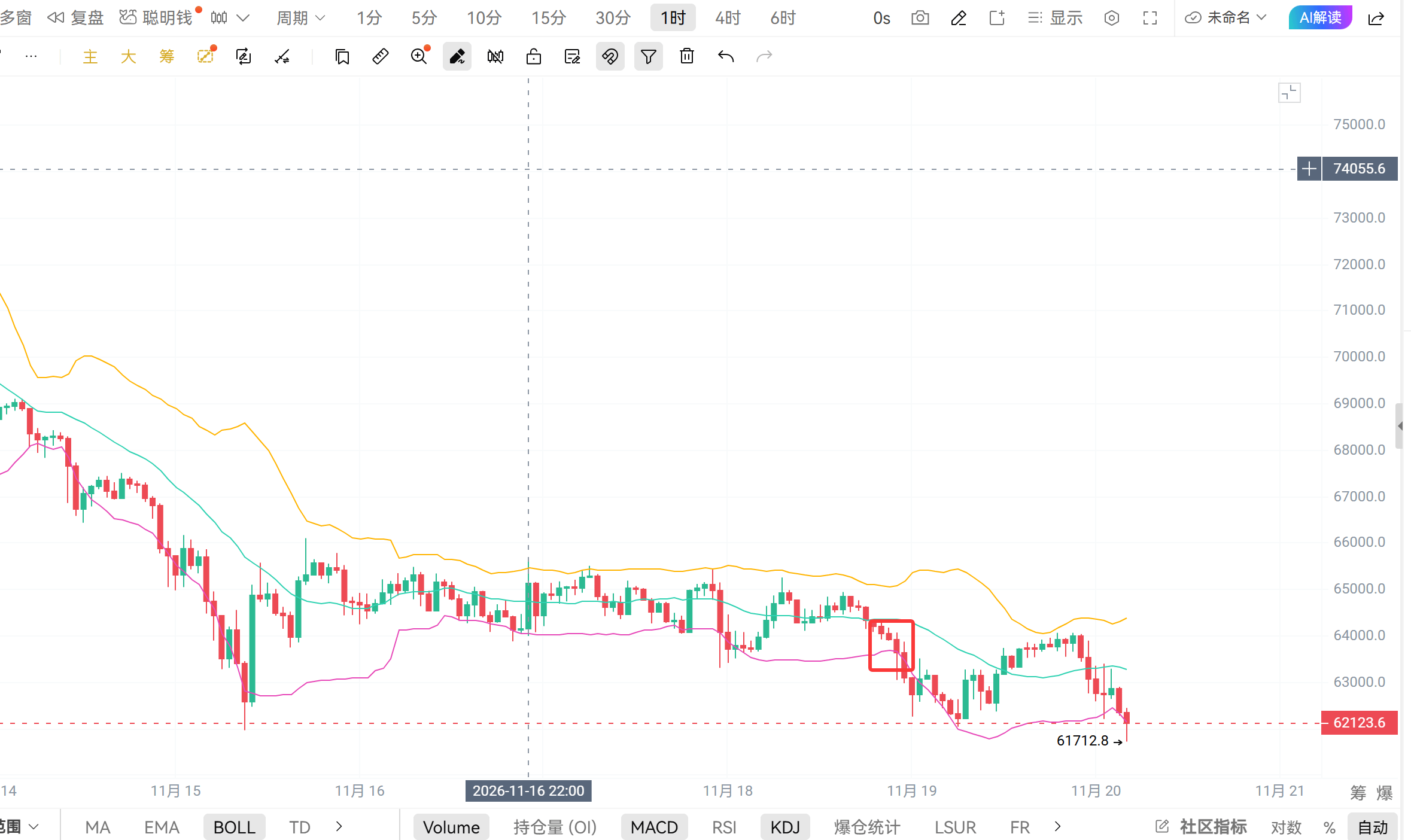
$BTC The price fell to 62200–62300, where the short position closed in profit. Don’t worry about whether it will break lower—take the profit while you can. Around this level, there’s a chance of a quick break below followed by a rebound, so you should be thinking about buying the dip and grabbing a long position. The price was then driven higher by bullish ultra-short-term indicators, reaching around 63300, before later dropping toward 61700. In the end, it did break below the hourly Bollinger lower band support, but that doesn’t mean the breakdown will hold; the candle still has to close.
The medium-term indicators don’t point to a sell-off, but they do suggest a choppy decline, range-bound movement, or a choppy rise. In other words, they don’t point to a sharp sell-off—that kind of dumping action. If you don’t understand, take a look at the 4-hour indicator set and you’ll see what I mean.
So the medium-term indicators can’t determine the direction, let alone the broader market trend. Choosing to trade swings is a very sensible approach. I don’t recommend shorting at low levels. Even if the price breaks below the lower Bollinger band, it may quickly recover; but there’s also a chance it won’t break down and will rise instead. So isn’t shorting at low levels risky too?
As I’ve said, shorting at highs and going long at lows is currently the most rational way to trade. If your technical skills aren’t yet mature, I suggest that once you’re up around 500 points on a low-level long or high-level short, move your stop to breakeven. Even if the market falls, it will be a choppy decline, with frequent swings up and down. Of course, if you’re happy with 500 points of profit, take it and leave. Sometimes 500 points is all the market offers. A rebound from 61700 to 62300 doesn’t necessarily mean it will keep rising; it could also be building a base before rising, or break below 61700 and go lower before slowly recovering. It’s up to you. In any case, these decisions are made from a position of profit, so there’s nothing wrong with them.
Others are still thinking about how to reduce their losses from being stuck in a position, while you’re thinking about how to hold on to as much of the whole move as possible while staying profitable, and give up fewer points. You’re already in a good place. Nobody’s perfect: retail traders can never capture an entire move every time, nor can they always spot and anticipate every opportunity for more profit when they’re already up around 500 points. It’s perfectly normal to occasionally get stopped out at breakeven.
For example, during my livestream tonight I called out two trades. I took around 1,000 points of profit on the short, then opened a long and made only 500–6000 points. I said plainly that the market might break above 63300, but it wasn’t guaranteed, and we’d still need to keep an eye on the indicators in real time. If you’re happy with the profit, close the trade. If it doesn’t look like enough to you, since you’ve already taken one profitable trade tonight, move your stop to breakeven and let it run.