


If you’re building AI applications or SaaS, or investing in the AI supply chain, Anthropic’s Nasdaq listing today is worth more than just its opening price: the computing contracts listed in its prospectus are worth taking the time to read.
First, the parts everyone can see. On November 18, the shares were priced at $83, above the previous range of $70–78. The company and existing shareholders sold a total of 980 million shares, raising $81.34 billion in total—a deal widely described by the media as the largest IPO in history. There was also a $26 billion private placement, with seven buyers: Google, Nvidia, AMD, Broadcom, Micron, Microsoft, and TSMC. Today’s opening price was $111.50, 34% above the offer price.
At the product level, the intuition of many people who use Claude every day holds up in the financials. Third-quarter 2026 revenue was $17 billion, up 1,127% year over year. The number of customers with annual revenue above $100,000 grew from more than 950 a year ago to more than 11,900. Net revenue retention was about 900%: under the prospectus’s definition, enterprise customers who were already customers a year earlier generated about nine times as much revenue in this year’s third quarter as in the same quarter last year (excluding individual subscribers).
But the same prospectus also gives another figure: Anthropic has signed commitments for about $900.9 billion in compute and infrastructure, more than 13 times its third-quarter revenue annualized.
Now look at who those contracts were awarded to: of the $900.9 billion, about $439.7 billion is under contracts related to Google, Amazon, Microsoft, and Broadcom—nearly half. All four are also Anthropic shareholders or creditors.
Let’s clear up one misconception first: 90% of the $104 billion loss came from valuation increases
For the first nine months of 2026, Anthropic reported a net loss of $104 billion. The figure has already spread across social media, often read as: “$33.2 billion in revenue, a $104 billion loss—the more it sells, the more it loses.”
Break down the income statement, and the conclusion is exactly the opposite:
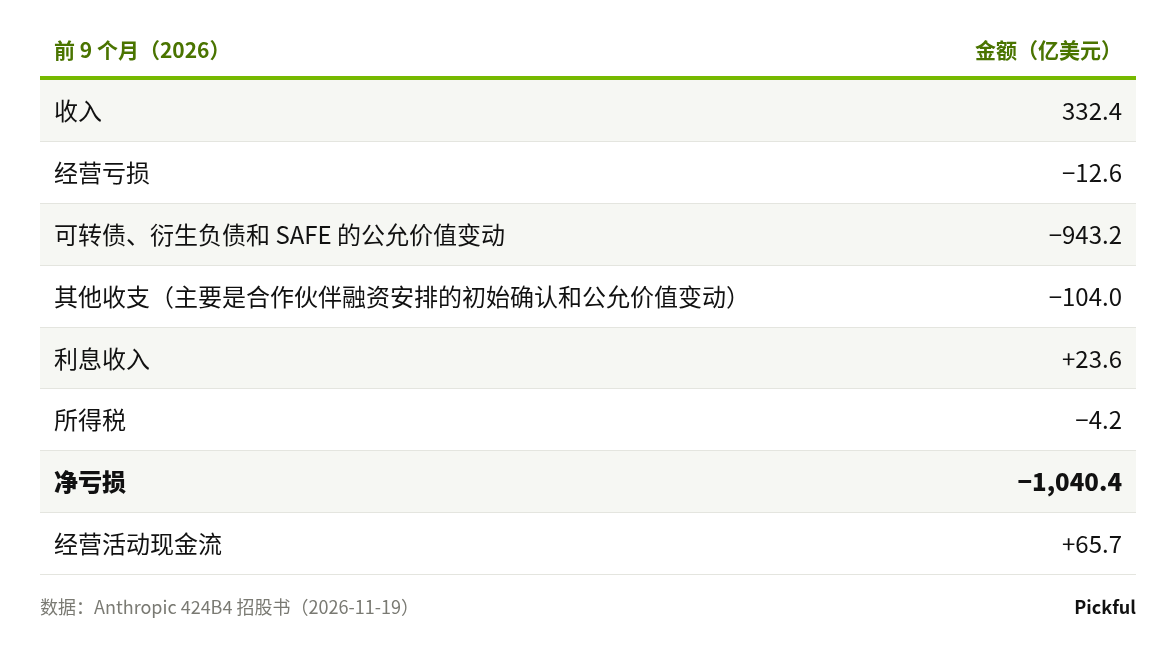
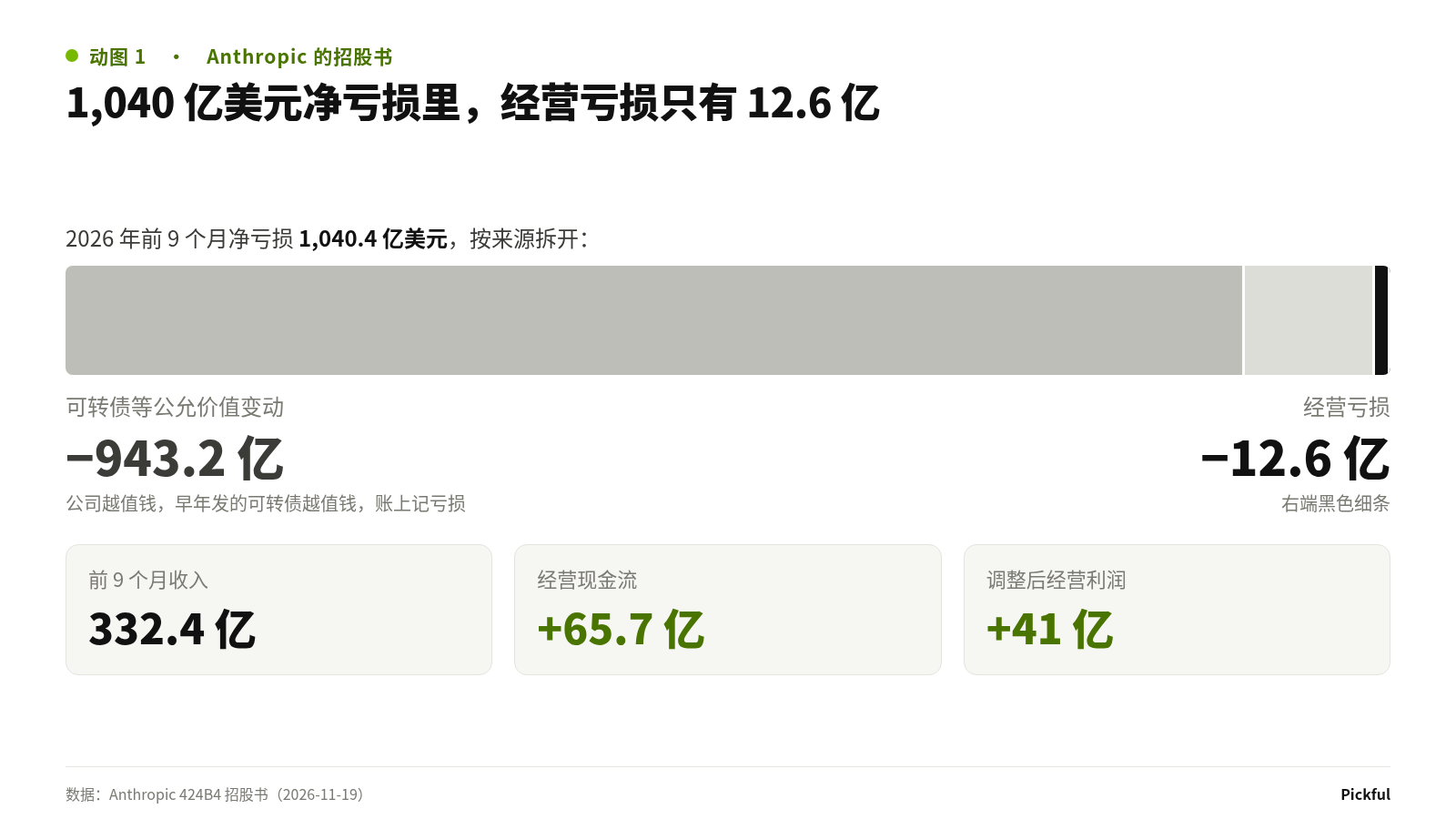
Chart 1 Of the $104 billion net loss, operating losses were only $1.26 billion
The $94.3 billion in fair-value changes came from convertible notes issued years ago. This is the easiest part of the income statement to misread. Let’s use Amazon as an example to explain it.
First, the direction of the transaction: Amazon lent money to Anthropic, with the option to convert it into shares later. In 2023 and 2024, Amazon lent money to Anthropic in exchange not for ordinary IOUs but for convertible promissory notes: they bear no interest and mature in 2034–2035. The key feature is a conversion clause that lets Amazon exchange the principal for Anthropic shares at a fixed price—$2.09 per share for the 2023 notes and $5.05 for the 2024 notes. There was no collateral, and this wasn’t equity issued first and later turned into debt. The sequence was: lend money first, convert it into shares later.
The value of these notes depends on how much Anthropic is worth. The principal not yet converted is $6.20 billion, which could be exchanged for about 1.84 billion shares, ignoring the ownership cap. At an offering price of $83, that’s 16 to 40 times the conversion price, valuing those shares at about $152.8 billion. Amazon won’t get back $6.2 billion in cash; it will get shares.
Why is it recorded as a loss? In accounting, these convertible notes are recorded as liabilities at fair value and revalued each period. When the company’s valuation rises, the value of the liability rises too, and that increase is recorded as a loss. The prospectus puts it plainly: the changes were “primarily driven by an increase in the fair value of outstanding convertible promissory notes resulting from increases in the enterprise valuation.” That’s how the $94.3 billion for the first nine months was recorded. The figures on the books are recognized period by period using valuation models, so they aren’t the same as the difference between $152.8 billion and $6.2 billion. But the direction is the same: the faster the valuation rises, the larger the “loss” in this line item.
Who bears this loss? It doesn’t use up Anthropic’s cash. In fact, operating cash flow was positive $6.57 billion for the first nine months. The real cost is borne by other shareholders: Amazon gets shares in exchange for $2–$5 per share, increasing the total number of shares and reducing everyone else’s ownership percentage. There’s also a cap on conversion: after conversion, Amazon’s ownership cannot exceed 12% of total capital under the prospectus’s definition. Any excess is converted in subsequent quarters, so at the time of listing it still had about 1.55 billion shares left to convert.
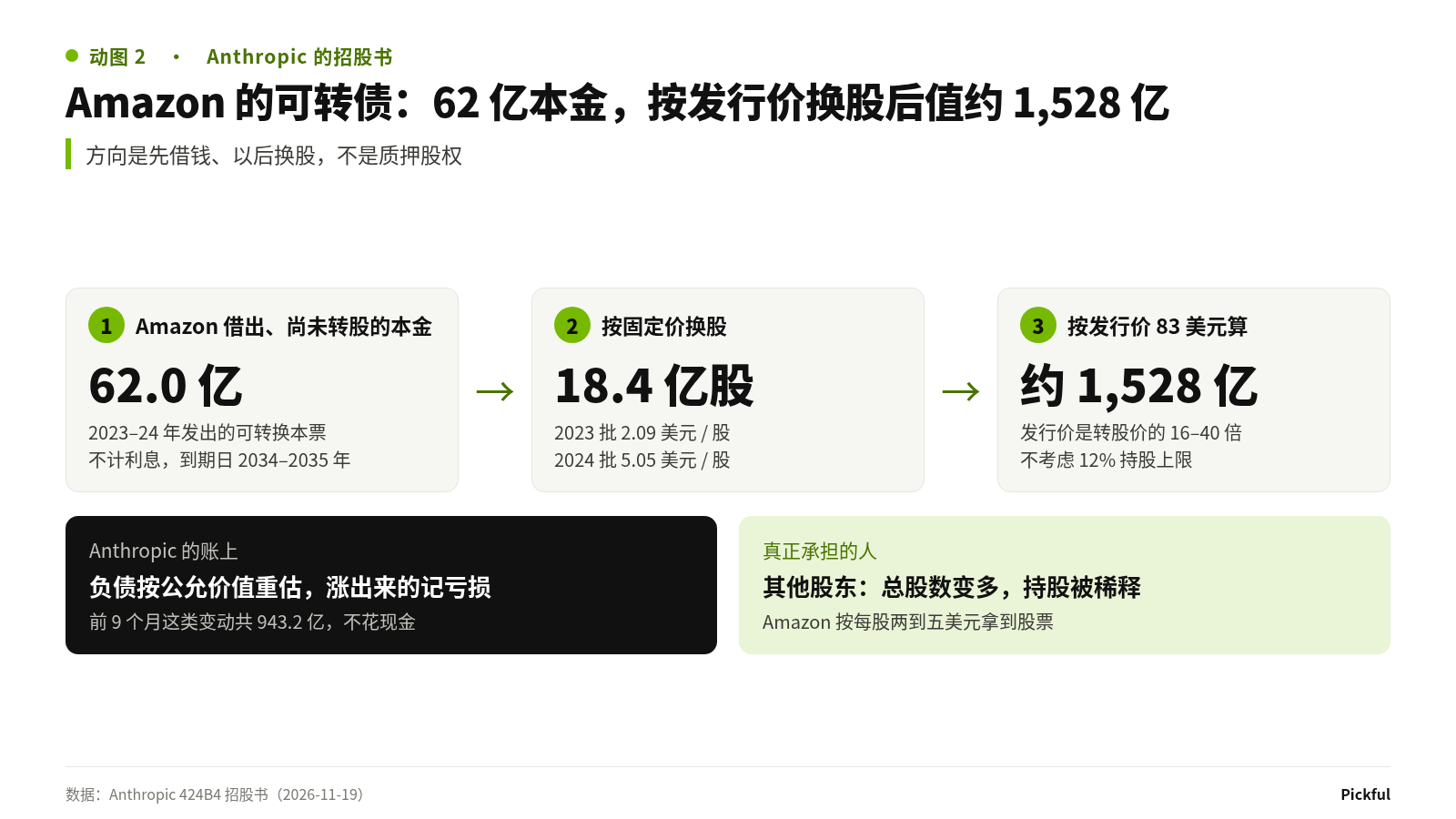
Chart 2 Amazon’s convertible notes: $6.2 billion in principal, converted into shares worth about $152.8 billion at the offering price
In other words, the $94.3 billion on the income statement reflects both Anthropic’s valuation rising rapidly and the gains locked in by early investors at the prices set back then—with other shareholders paying the price through dilution.
So the real thing to focus on in the income statement is operating performance: an operating loss of $1.26 billion for the first nine months, and adjusted operating income of $4.1 billion after excluding items such as stock-based compensation. Compute and infrastructure spending was $18.81 billion, or 57% of revenue; the same figure was 172% a year earlier, when spending exceeded revenue.
This shows that Claude’s unit economics are improving. The next question is what it takes to sustain that growth: how many contracts Anthropic has signed, and with whom.
$900.9 billion in compute commitments: who are the contracts with?
The total given in the prospectus is about $900.9 billion, almost entirely for compute and infrastructure. About $451.6 billion is due by the end of 2030, with most of the rest falling between 2031 and 2045. About $70.7 billion is due in the 12 months from September 30—roughly equal to the $68 billion in third-quarter revenue annualized.
That’s not all. There are also contracts with amounts not fixed in the prospectus, which Anthropic estimates will require another $150 billion to $175 billion in payments, beyond the $900.9 billion.
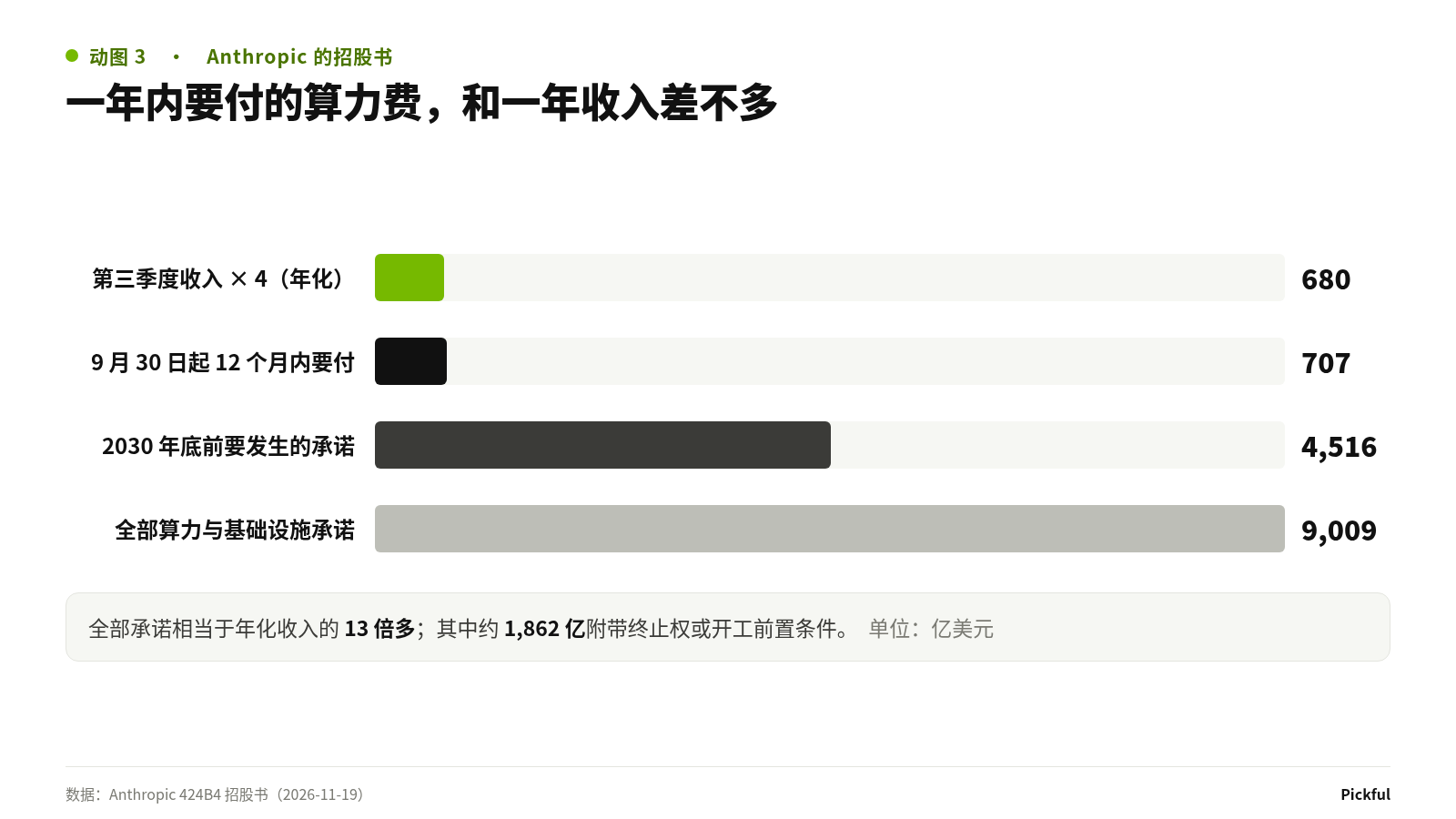
Chart 3 Compute fees due within a year are about equal to a year’s revenue
The major contracts specifically disclosed are as follows:
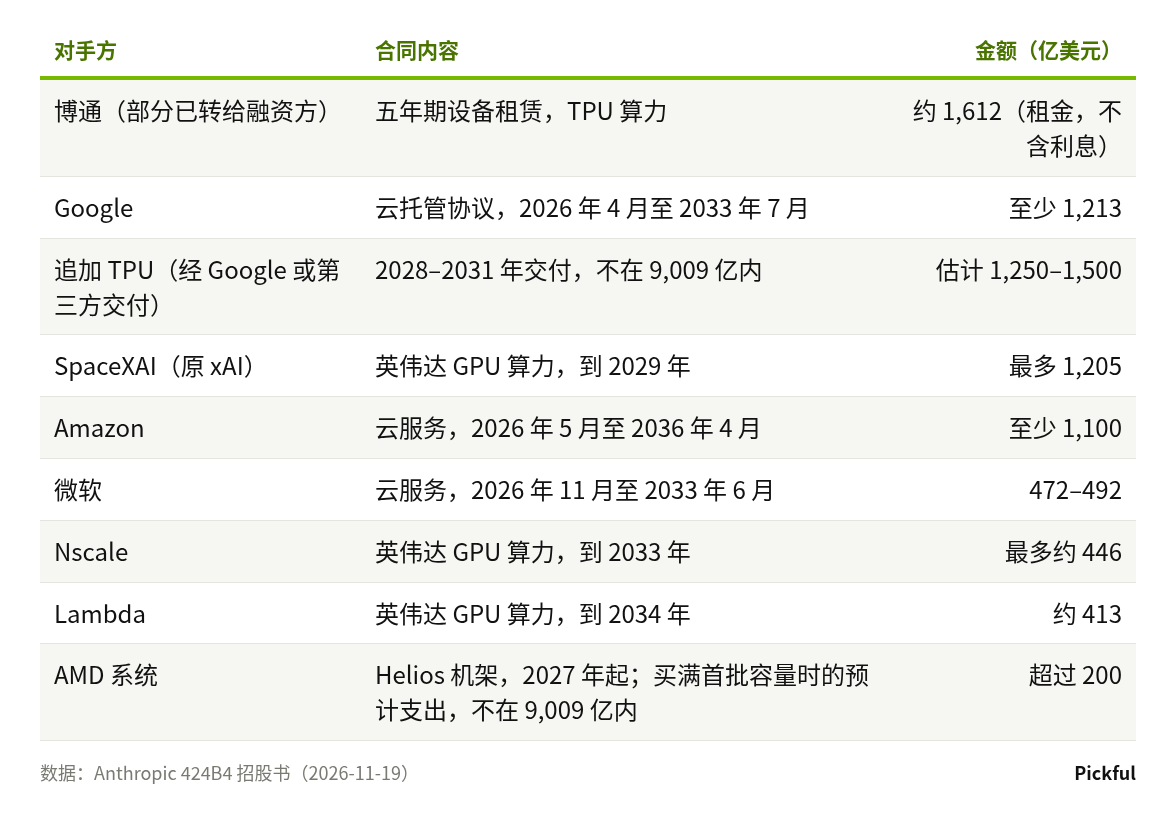
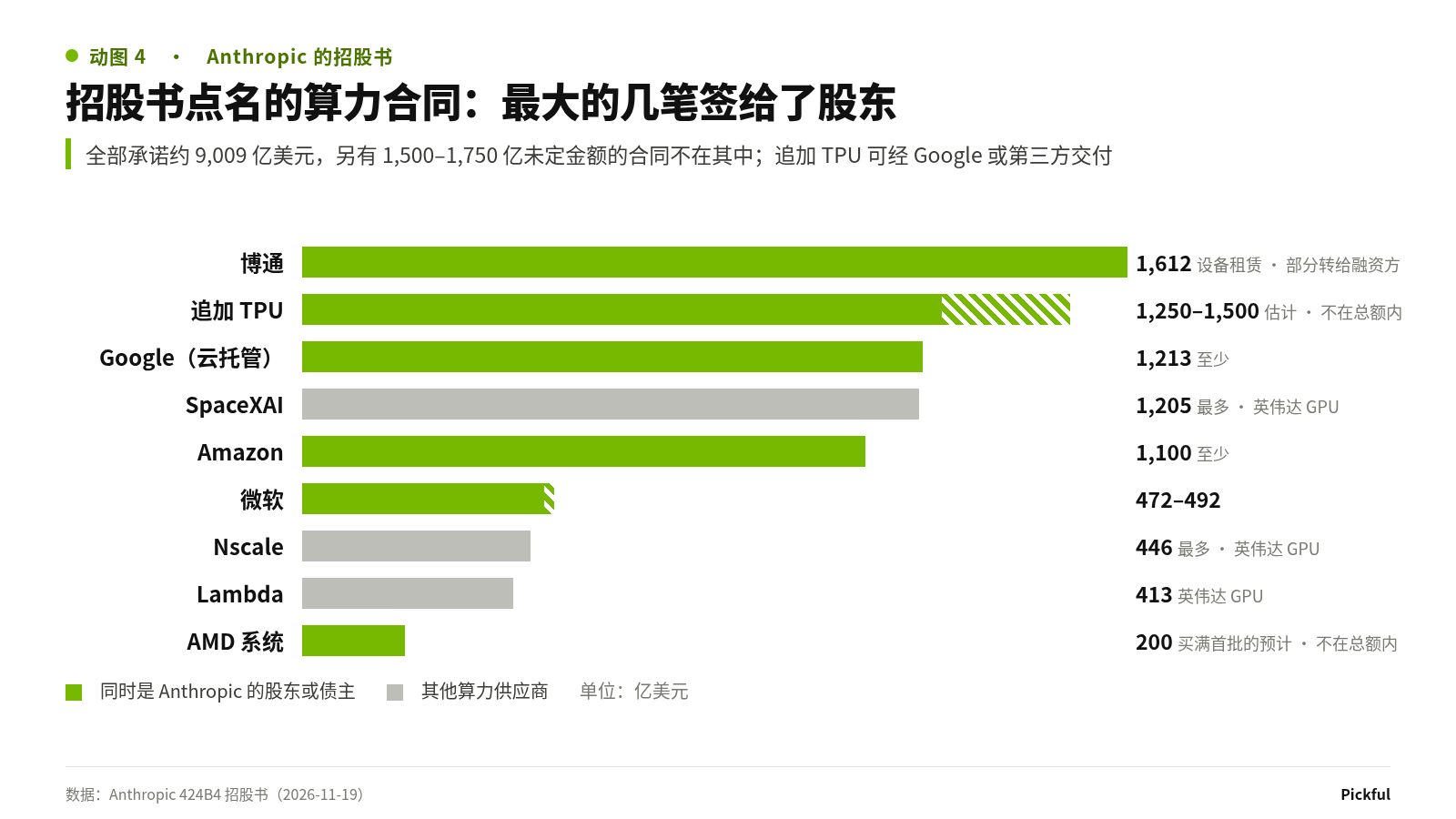
Chart 4 Compute contracts named in the prospectus: the largest ones went to shareholders
There are two things in this table worth pausing to consider.
First, the biggest counterparties are also Anthropic’s competitors. Google has Gemini, Microsoft is tied to OpenAI, and SpaceXAI is xAI, the company behind Grok. In its risk section, the prospectus itself says that these cloud and chip partners “provide us with capital or credit support, are infrastructure suppliers to us, and are also developing and providing AI models and services that compete with ours.” This may create conflicts of interest and affect access to compute, pricing, and scheduling.
Second, some contracts aren’t as firm as they look. About $186.2 billion in commitments come with exercisable termination rights or are subject to conditions that must be met before work begins—for example, whether the counterparty can secure financing, a site, and approvals. The clearest example is Lambda: under a contract worth about $34.9 billion signed in August, both parties can now terminate because Lambda failed to secure a data-center lease by the agreed date. As of the prospectus date, neither side had sent a termination notice.
Three roles for the same companies: shareholders, creditors, and suppliers
Once you lay out the capital side too, the cycle becomes clear.
As shareholders. The $26 billion private placement was entirely bought by suppliers. After the listing, Google held about 1.77 billion shares and Amazon about 1.94 billion. Based on the share count in the prospectus, that’s about 13.4% and 14.6% of the issued share capital, respectively. Amazon also has about 1.55 billion shares awaiting conversion of its convertible notes. Both hold Class N shares with no voting rights, but with dividend and liquidation rights.
As creditors. As of the end of September, Anthropic still had $77 billion in undrawn convertible note capacity: $20 billion from Google (reduced to $10 billion after the private placement closed), $15 billion from Amazon, and $42 billion from Broadcom. Most of these facilities can be settled in new shares, or converted at the holder’s option, at a price linked to the post-listing share price. The specific terms vary by lender, and some retain circumstances in which repayment in cash is required.
As suppliers. The biggest contracts in the table above were also awarded to these same companies.
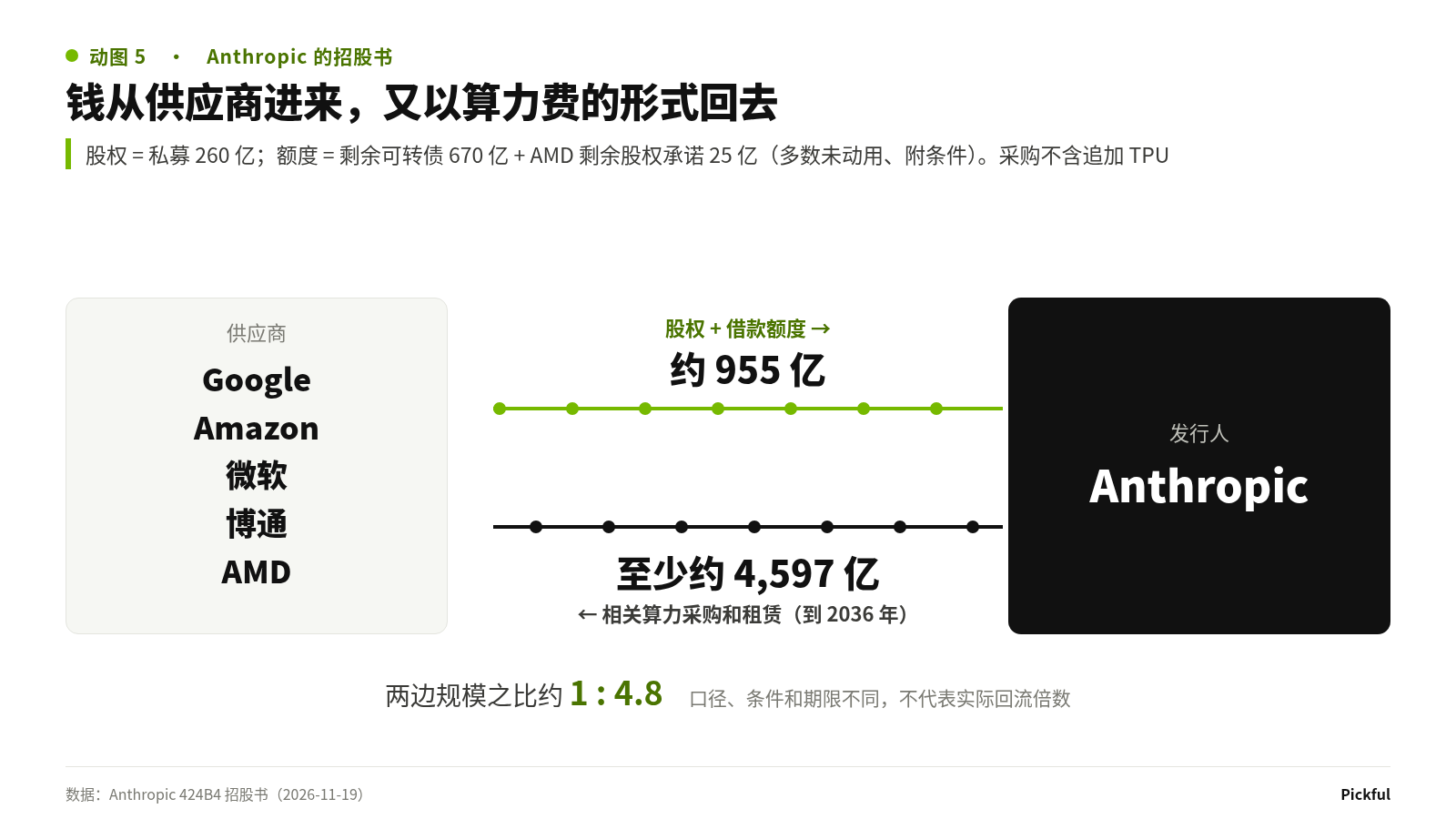
Chart 5 Money comes in from suppliers, then goes back out as compute fees
AMD is the clearest example. A hardware supply agreement signed in July stipulated that AMD would buy up to $5 billion worth of Anthropic shares, but not all at once: Anthropic can draw down the funds in stages after AMD GPUs are delivered and deployed against milestones. AMD’s $2.5 billion investment in this private placement directly offsets half of that capacity. The remaining $2.5 billion can’t be drawn until the cumulative milestone amount exceeds the $2.5 billion already paid. In other words, up to the cap, the more AMD chips Anthropic deploys, the more shares AMD can buy.
Broadcom works the same way. The prospectus states that its $42 billion convertible note facility can, when needed, be used to pay part of the quarterly rent on TPU equipment leased from Broadcom and its financing partners. The notes carry 9% annual interest, and holders can convert them at 90% of the 30-day volume-weighted average price (VWAP). If certain revenue conditions aren’t met, the interest rate rises to 13% and the conversion price falls to 85%.
A rough comparison of the two sides: $26 billion from the private placement, plus $67 billion in remaining convertible note capacity and AMD’s remaining $2.5 billion equity commitment, comes to about $95.5 billion. Anthropic’s purchasing and leasing commitments under contracts related to Google, Amazon, Microsoft, Broadcom, and AMD amount to at least about $459.7 billion, excluding additional TPUs. That’s a ratio of about 1 to 4.8, with the supplier-funded side much smaller.
This ratio shouldn’t be read as “suppliers get back $4.80 for every $1 they put in.” Most of the $95.5 billion is conditional capacity that hasn’t been drawn down; the $459.7 billion includes fixed commitments, rent excluding interest, and AMD’s projected spending, and extends through 2036. Some payments go to financing partners rather than the suppliers themselves. What it shows is how deep the relationship runs: part of these companies’ revenue over the next decade depends on Anthropic continuing to grow, while they also hold a significant share of Anthropic’s equity and financing capacity.
After the listing, the share price starts affecting compute financing
In my view, the most significant impact this listing will have on the AI industry is the following change.
While private, these equity-for-compute arrangements were priced at each funding round’s valuation, with prices changing only every few months. After the listing, a substantial portion is directly tied to market prices:
AMD’s future share purchases are priced at the 30-day VWAP before each closing;
Amazon’s $15 billion facility for 2026 converts shares each time a relevant compute milestone is reached, based on the 30-day VWAP on that date;
Broadcom’s convertible notes convert at 90% (or 85%) of the 30-day VWAP;
Amazon’s remaining legacy convertible notes convert at each quarter-end at the lowest of the fixed conversion price, the issue price, and the 10-day VWAP. The fixed price is only $2–$5, so this portion is basically unaffected by the share price.
This creates a transmission channel that didn’t exist before: for arrangements tied to market prices, a higher ANT share price means fewer new shares need to be issued for the same amount of compute financing. If the share price falls, more shares have to be issued, diluting existing shareholders more heavily and reducing the scope to keep financing compute this way.
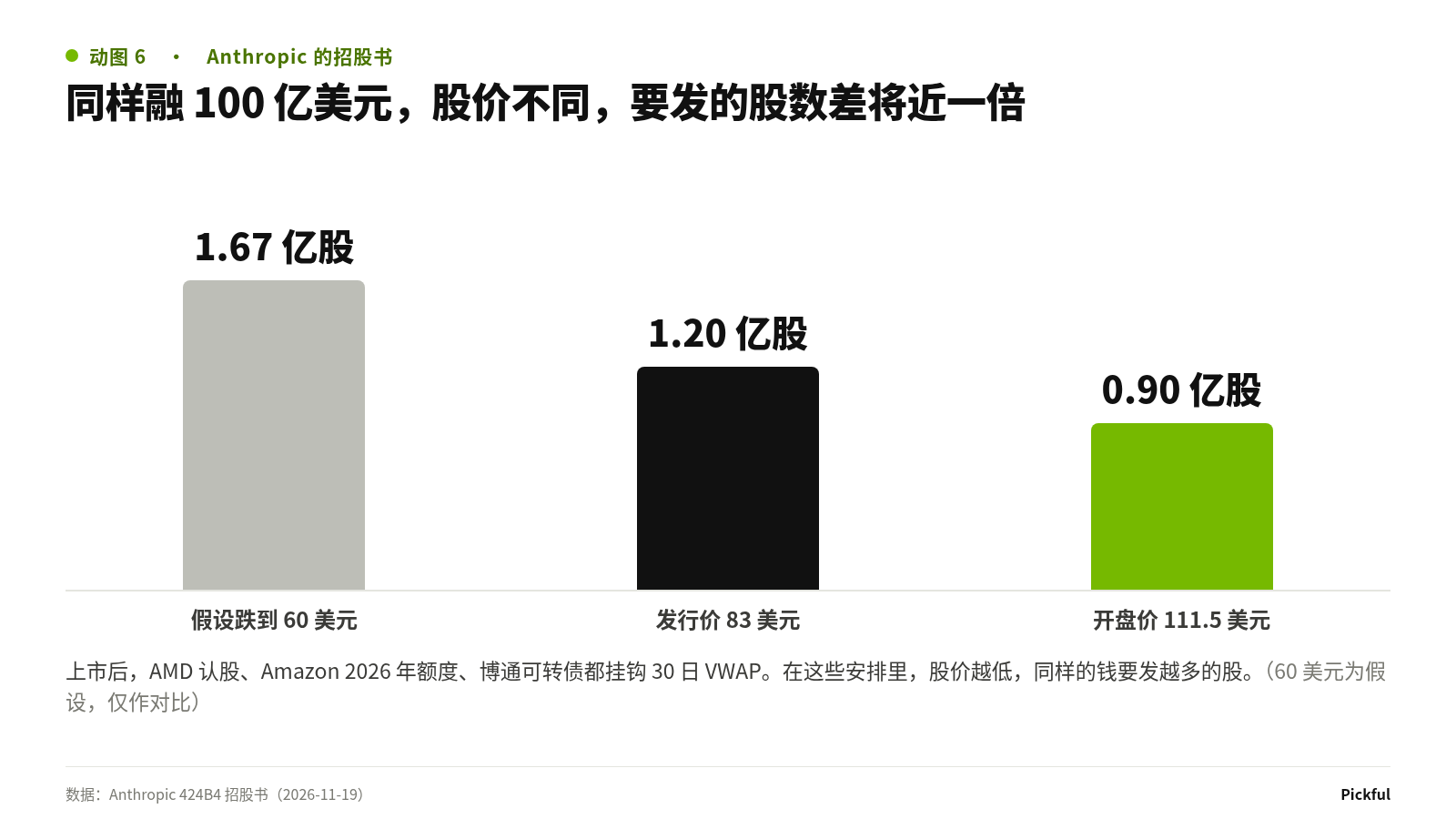
Chart 6 For the same $10 billion in financing, the number of shares issued can nearly double depending on the share price
Of course, this isn’t Anthropic’s only source of funding: it had $131.8 billion in cash and short-term investments at the end of September, operating cash flow has turned positive, and it also has a $15 billion revolving credit facility. But supplier financing is substantial. Investors used to look mainly at cloud providers’ capital spending to assess orders for Nvidia, Broadcom, AMD, and TSMC. From today on, they’ll also need to watch ANT’s share price.
How product quality shows up in the prospectus—and what sustains it
Back to the intuition we started with: Claude is useful, with enormous potential. Three sets of figures in the prospectus support that view.
Customers are using the products more deeply, not just growing in number: in the third quarter, more than half of customers paying over $100,000 annually used both the API platform and at least one of Anthropic’s own applications (Claude Code, Claude Cowork, and others), up from about 30% at the end of last year.
Revenue is becoming more diversified: the share of revenue from outside the top five customers rose from about 64% in the first quarter to about 79% in the third.
Efficiency is improving: third-quarter revenue grew 1,127% year over year, while compute spending grew only 382%.
But one set of figures also shows both the company’s strength and its fragility: more than 80% of third-quarter revenue came from model versions released in the previous six months. Revenue depends heavily on a steady stream of stronger new models. When Claude is ahead, this drives rapid revenue growth; if a model generation loses its competitive edge, growth will feel the pressure here first. This metric doesn’t show how quickly customers might switch to other models—that will take subsequent quarterly retention data to reveal.
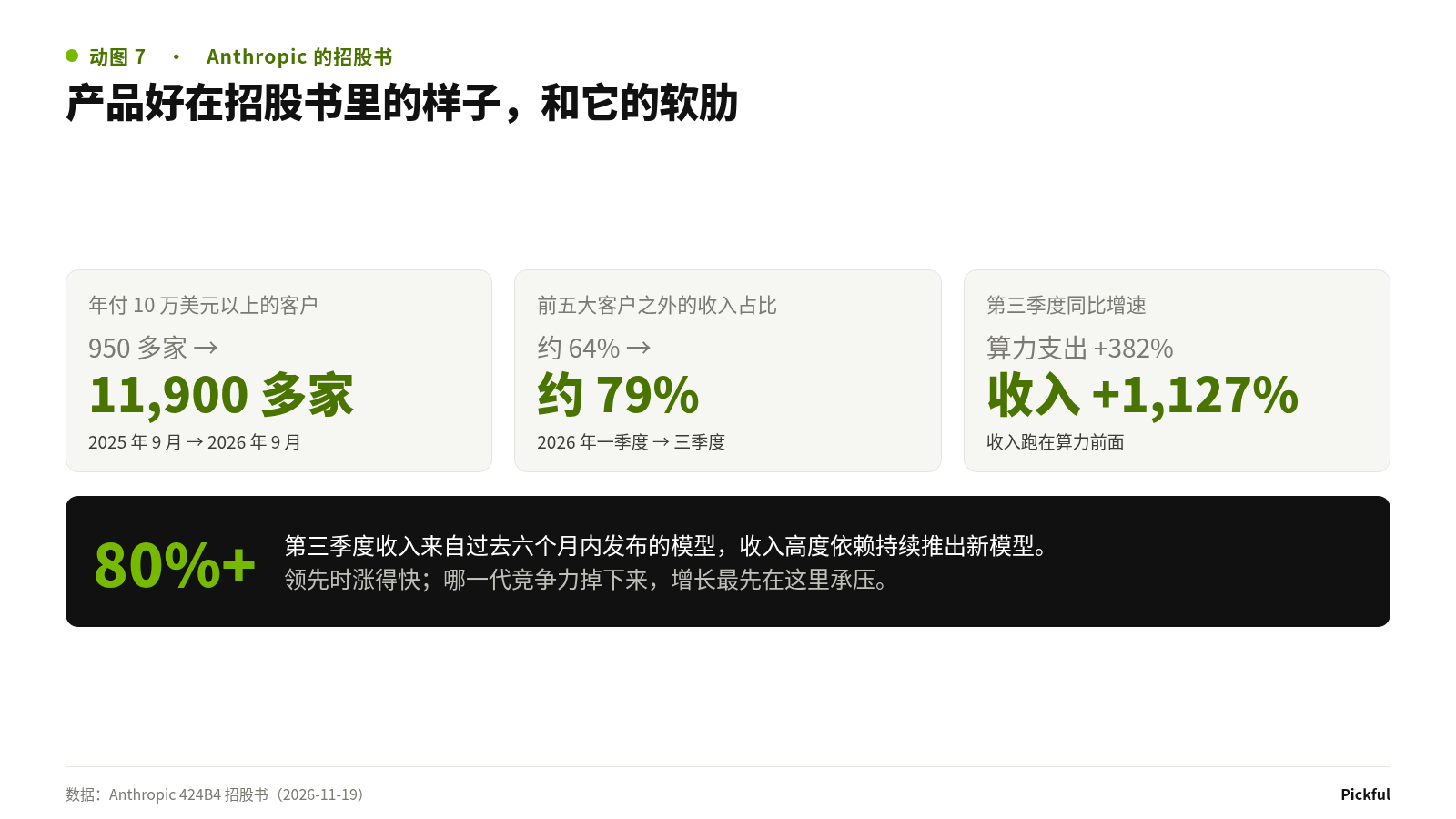
Chart 7 What product strength looks like in the prospectus—and where it’s vulnerable
Another thing to watch is short-term compute. In the third quarter, $5 billion of Anthropic’s compute expenses came from short-term contracts, which are far more expensive than multiyear agreements. As a result, the adjusted operating margin fell from 19% in the second quarter to 15%. Add about $2 billion in non-cash expenses for a matching-gift program, and GAAP operating income swung from a $974 million profit last quarter to a $567 million loss. Long-term contracts usually have to be signed 12 to 18 months in advance. When demand grows faster than long-term capacity, Anthropic has to make up the difference at short notice and at a high price. The prospectus says short-term compute usage is expected to keep increasing in the near term.
Four numbers to watch every quarter from now on
After the listing, Anthropic will publish financial results every quarter. For the first time, the public will be able to examine a frontier-model company’s books quarter by quarter. Those results will be used as a benchmark for OpenAI’s valuation, the risk of AI replacing SaaS companies, and chipmakers’ order expectations.
If you focus on just four numbers:
Compute spending as a share of revenue. It was 57% for the first nine months, reflecting the overall compute burden. It is affected by model efficiency, revenue growth, and the pace at which new capacity comes online, so it should be considered alongside revenue growth.
Short-term compute spending. It was $5 billion in the third quarter. The higher it is, the more it suggests that demand or research usage is outpacing long-term contracted capacity—and the greater the pressure on margins.
The share of revenue from the latest models. It’s now over 80%, showing how dependent revenue is on the continued release of new models.
Supplier facilities drawn down and shares converted. How much of Broadcom’s, Amazon’s, and Google’s convertible notes and AMD’s equity commitment has been drawn down, how many shares have actually been converted, and how much debt remains unconverted. The more that’s drawn down, the more compute depends on suppliers putting up the money.
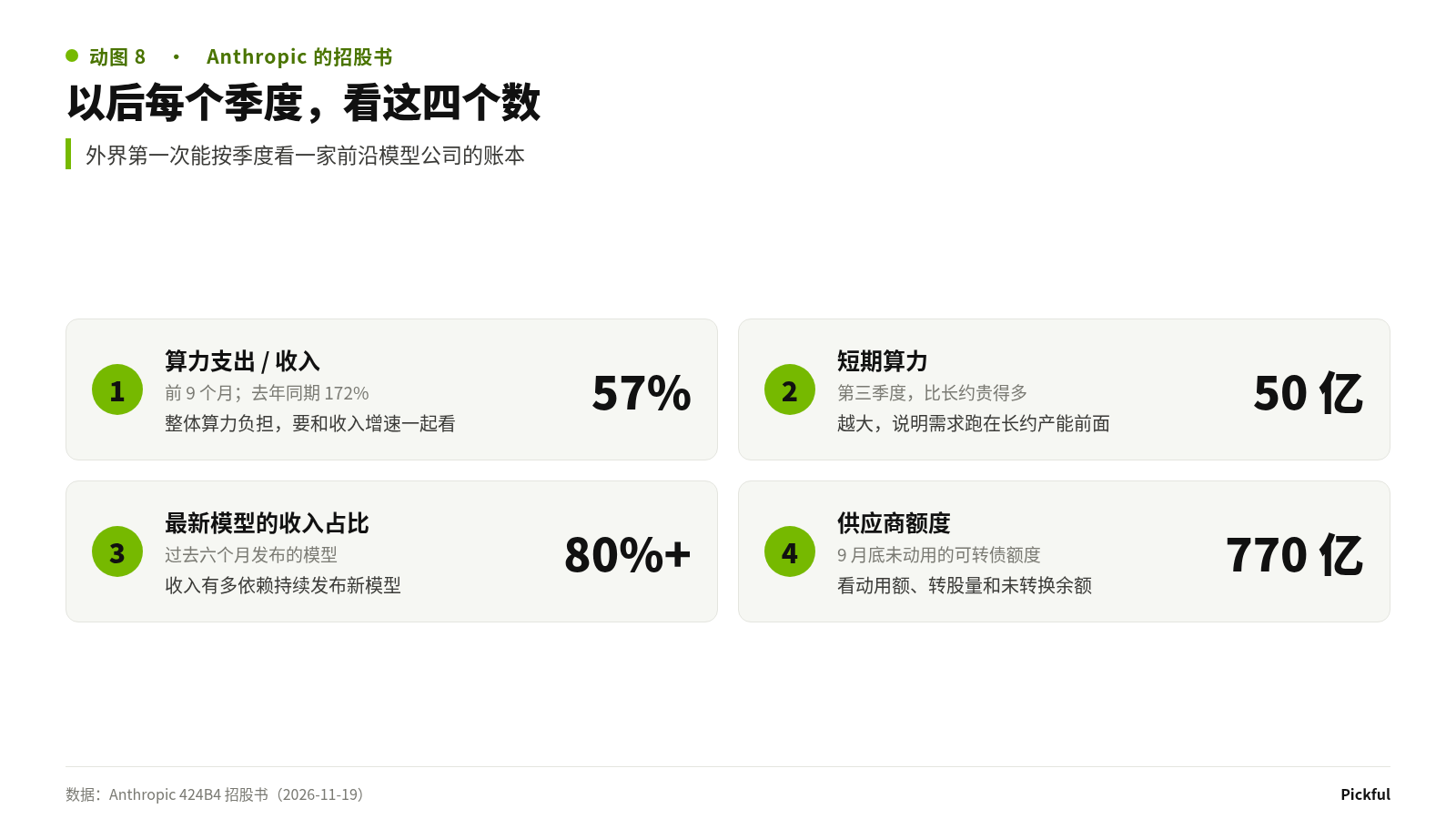
Chart 8 Four numbers to watch every quarter from now on
Claude’s product strength determines how fast revenue can grow; supplier financing determines how much compute capacity can be built; and ANT’s share price affects the cost of that financing. These three are intertwined. From now on, each quarterly report will show which one starts to give way first.
Which of these four numbers do you think will become a problem first?
Sources
Anthropic 424B4 prospectus (2026-11-19): revenue, income statement, cash flow, definition of net revenue retention, $900.9 billion in compute commitments and itemized contracts, convertible note facilities and conversion terms, AMD agreement, Amazon/Google shareholdings, customer and revenue concentration, short-term compute, cash and credit facilities.
Anthropic pricing announcement FWP (2026-11-19): $83 offering price, 980 million shares, $81.34 billion, $26 billion private placement (313,253,007 shares).
$70–$78 range, “largest IPO in history,” opening price of $111.50: reports published that day by CNBC, CNN, StockTitan, and Fortune.
Shareholding percentages are calculated using the post-listing share count in the prospectus (7.583 billion Class A shares + 5.637 billion Class N shares, excluding the overallotment option). These are percentages of issued economic ownership, not voting rights or a fully diluted basis.
The 1-to-4.8 ratio is our own calculation: on the procurement side, Google cloud hosting 121.3 + Amazon 110 + Microsoft 47.2 (using the lower bound) + Broadcom rent 161.2 + AMD 20 (projected lower bound); on the capital side, private placement 26 + remaining convertible note capacity 67 + AMD’s remaining equity commitment 2.5. The two sides differ in scope, conditions, and time periods.