
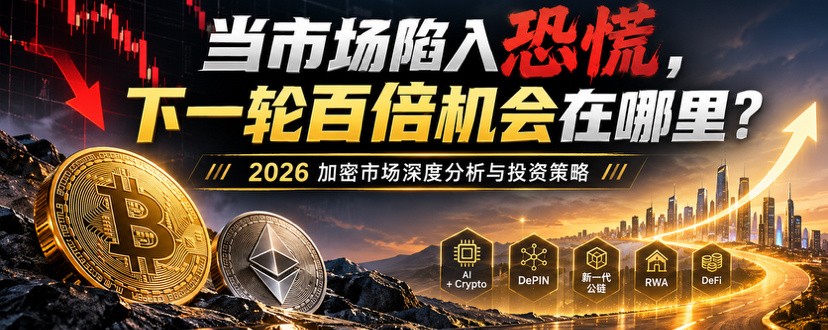

I. Market overview: From liquidity-driven growth to structural competition
In 2026, the crypto market is undergoing a major structural shift.
In the past, market rallies were often led by BTC, with capital gradually spreading to ETH and altcoins. But as institutional participation grows, market liquidity diverges, and the supply of projects continues to expand, broad rallies driven purely by market sentiment may become increasingly difficult to sustain.
Going forward, the market’s core competition will gradually shift to three areas:
The direction of capital flows.
The real value of projects and ecosystem growth.
Token supply and demand, and the structure of circulating holdings.
The market is not short on narratives; high-quality assets that can consistently attract capital are what's truly scarce.
II. BTC and ETH: Key Indicators for Gauging Market Direction
BTC remains the most important risk-pricing asset in the entire crypto market.
When analyzing BTC, don't just look at price movements; also consider:
Net inflows and outflows for spot ETFs.
Net BTC inflows to exchanges.
Changes in long-term holder positions.
Perpetual futures funding rates and open interest.
Spot trading volume and price trends.
If a price increase is driven mainly by leveraged futures positions, without support from spot capital, the sustainability of the rally warrants caution.
For ETH, pay close attention to on-chain activity, stablecoin supply, DeFi total value locked, Layer 2 ecosystem development, and institutional demand.
III. Five Sectors to Research Closely in the Next Cycle
I believe the areas worth following closely include:
1. AI Agents + Crypto
AI agents, on-chain automation, intelligent trading infrastructure, and decentralized computing power.
Key research metrics: real users, agent calls, protocol revenue, and actual token demand.
2. DePIN
Decentralized physical infrastructure, including computing power, storage, communications, and data networks.
Key research metrics: number of actual devices, network utilization, customer demand, and real revenue.
3. Next-Generation Public Blockchains
Focus on technical architecture, performance, developer ecosystems, cross-chain capabilities, and ecosystem funding.
A public blockchain with real potential needs to sustain developer growth and application demand, rather than relying on short-term incentives to maintain activity.
4. RWA
Tokenization of real-world assets, connecting traditional finance with blockchain infrastructure.
Key areas to research include asset quality, compliance frameworks, issuance scale, and actual liquidity.
5. DeFi
Decentralized trading, lending, stablecoins, and on-chain financial infrastructure.
Focus on protocol revenue, real trading volume, capital utilization, and the ability to capture value for token holders.
IV. Small-Cap Projects: How to Find Potentially Undervalued Opportunities
Small-cap projects are worth researching, but a low market cap does not necessarily mean an asset is undervalued.
I focus more on six key dimensions:
Token distribution: Distribution among the top 100 holder addresses, identifying exchanges, contracts, and actual large holders.
Capital flows: Whether large wallets are accumulating steadily or gradually distributing their holdings.
Wallet connections: Funding sources, shared transfer paths, and linked accounts.
Tokenomics: Circulating supply, fully diluted valuation, and unlock schedules.
Liquidity: Order book depth, trading volume, and changes in exchange balances.
Fundamentals: Development progress, ecosystem growth, and real-world applications.
It is especially important to note that multiple wallets do not necessarily represent multiple independent investors. Only by considering funding sources, trading behavior, and changes in holdings can we assess token distribution more accurately.
V. Three Possible Paths for the Market Ahead
Scenario A: The market resumes its uptrend
BTC stabilizes, spot capital flows return, ETH gradually strengthens, and capital begins spreading to high-quality altcoins.
Scenario B: The market remains range-bound
Major assets lack direction, capital rotates between sectors, and select projects see independent rallies.
Scenario C: The market continues to correct
Macroeconomic liquidity tightens, ETFs see sustained outflows, leveraged positions are liquidated in concentrated waves, and altcoin liquidity declines further.
All three scenarios require ongoing data monitoring; we should not assume in advance that the market will follow any one of them.
VI. My Trading and Research Strategy
At this stage, I care more about risk-reward than blindly chasing gains.
Major assets: Wait for confirmation from the trend and trading volume.
Small- and mid-cap assets: Prioritize research into token distribution and liquidity.
Emerging sectors: Look for projects whose fundamentals have not yet been fully priced in.
High-volatility assets: Manage position sizes strictly and avoid excessive concentration in any single project's risk.
Token unlocks: Assess in advance the potential market impact of newly circulating supply.
VII. Final Key Takeaways
In the next crypto market cycle, what truly deserves attention may not be who tells the best story, but who can consistently attract real capital.
BTC determines the market's risk appetite, ETH reflects the development of financial infrastructure across its ecosystem, while AI, DePIN, RWA, and next-generation public blockchains may become new battlegrounds for capital.
I prefer to view the current phase as a process of reassessing and filtering assets.
Market conditions can shift repeatedly and capital will continue to rotate, but truly competitive projects ultimately need to prove themselves with data and real-world applications.
Which sector do you think has the best chance of seeing an independent rally in the next cycle?
Join the discussion in the comments.
#Binance #BTC #ETH #Crypto #AI Agent #DePIN #RWA #DeFi #CryptoMarketAnalysis #Altcoins