
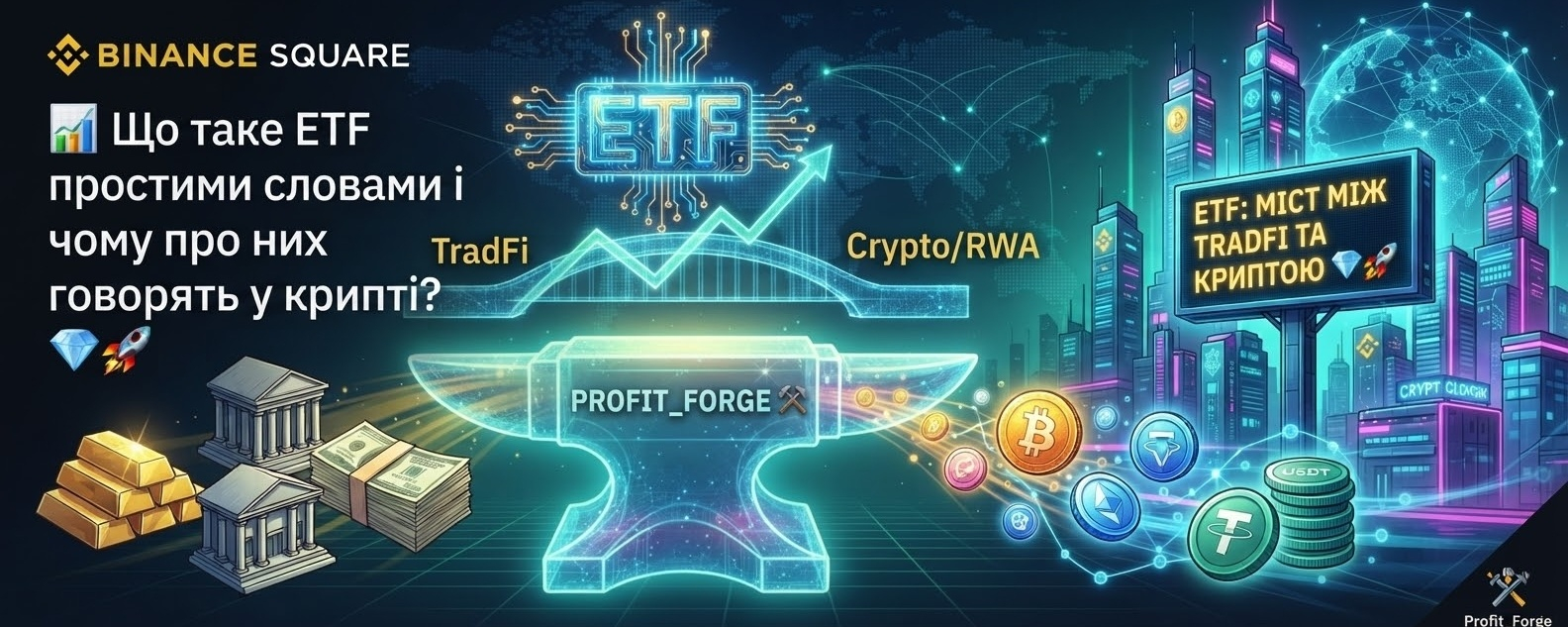

Hello, Profit_Forge community! ⚒️🔥 Today, we’re looking at one of the most important terms at the intersection of traditional finance and the crypto market — ETF!
Many people have heard this acronym in the news, seen it in Binance’s “Word of the Day” section, or come across it during listings of tokenized assets. But what do these three letters actually stand for, and how does it work in practice? Let’s break it down! 👇🧠
🔍 What is an ETF in simple terms? 🧩📈
An ETF (Exchange-Traded Fund) is a ready-made “basket” of stocks, bonds, commodities, or other assets that trades on an exchange as a single instrument.
Imagine you want to invest in dozens or even hundreds of large companies, or an entire sector of the economy, all at once. Buying each stock separately is time-consuming, expensive, and complicated. An ETF solves this in one move:
You buy one asset, and inside it is already a whole collection of companies or an index.
Built-in diversification 🛡️ — if one company in the basket declines, the others can help balance things out.
Transparency and convenience ⚡ — an ETF’s price changes throughout the trading day right on the exchange, just like an ordinary asset.
🌐 What types of ETFs are there, and what do they have to do with crypto? 🪙🔗
Traditional finance offers funds tracking stock indexes, gold, oil, government bonds, or entire countries (for example, Japan or the US).
In recent years, ETFs have also become a true bridge between TradFi and the crypto world:
Spot crypto ETFs ₿ — let large institutional players and traditional investors gain exposure to cryptocurrencies through familiar exchange-traded instruments.
Tokenized funds and RWAs 🌍 — real-world assets and funds are brought onto the blockchain, making them more accessible to the crypto community through convenient trading pairs such as EWJB/USDT.
⚠️ Why shouldn’t you mistake an ETF for a “free money button”? 🛡️📋
Even the most convenient instrument requires you to keep your wits about you:
The market can still move in either direction 📉📈 — an ETF protects you from the risk of a single company, but it won’t shield you from a broader market or sector downturn.
Fees and liquidity matter ⚙️ — funds differ in their management costs, trading volumes, and how they operate.
Always check the details of an asset 🔍 — what exactly underlies the instrument, how it’s structured, and what risks it carries.
💡 An interesting fact from Profit_Forge 🧠✨
The world’s first exchange-traded fund to trade on an exchange using the modern ETF model — the SPDR S&P 500 ETF (known as SPY) — was launched in 1993. It tracks the S&P 500 index (the 500 largest publicly traded US companies) and remains one of the world’s largest and most liquid ETFs, with billions of dollars’ worth traded every day! 📊🔥
💬 What role do ETFs play in your investing? ⚒️👇
Tell us in the comments:
Have you used ETFs (traditional or crypto/RWA-based) in your strategies yet? 🤔📊
Which area interests you most: traditional indexes, gold, or crypto instruments? 🚀💎
Tap 👍, follow Profit_Forge, and build your financial literacy with us every day! 🔥⚒️💎
#ETF #RWA #TradFi #Binance #ProfitForge


