

The market had been anticipating rate cuts by the Federal Reserve, but now the policy outlook has taken a new turn.
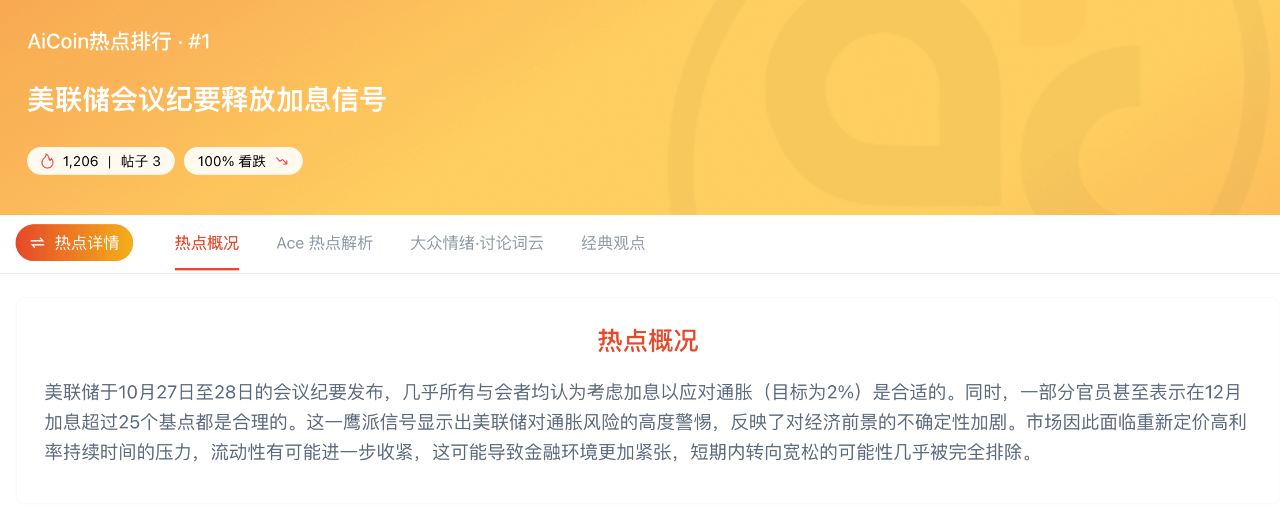
The minutes from the October meeting, released recently, show that concerns about inflation remain pronounced within the Federal Reserve. Some officials even believe further rate hikes may still be necessary.

This means the rate-cut path the market had previously expected may face greater uncertainty.
What does this mean for people holding BTC and ETH? Why has the AI industry also become a focus for the Federal Reserve?
I. Why is the Federal Reserve suddenly discussing rate hikes again?
At the October 27–28 FOMC meeting, the Federal Reserve voted 10–2 to keep interest rates at 3.75%–4.00%.
However, the meeting minutes revealed that concerns about inflation persist within the Fed. Some officials believe that if inflation remains above target, further monetary tightening may be needed in the future. Some even thought rates should have been raised in October.
The main reason behind this is that inflation remains elevated.
Fed staff estimated that U.S. PCE inflation was around 3.6% in September, while core PCE inflation was around 3.1%—both above the Fed’s long-term 2% target.
This means the Fed is unlikely to pivot to an accommodative stance anytime soon. Even without further rate hikes, keeping interest rates high for longer could put pressure on the market.
II. Why is the Fed more concerned as AI heats up?
The meeting minutes also specifically mentioned the development of the AI industry and its potential impact.
Expanding the AI industry requires large quantities of chips, servers, electricity, and data centers. Tech companies’ concentrated investment in infrastructure could increase demand for related equipment and energy, putting upward pressure on the prices of some commodities.
The Fed is also monitoring the financial risks associated with AI investment.
Some companies are investing huge sums to build data centers and gain a competitive edge. If AI commercialization falls short of expectations and returns fail to cover costs, these companies could face financing and debt pressures.
The AI investment boom is still underway, but its impact on inflation, corporate financing, and financial stability has become a factor the Fed needs to monitor.
III. Why do Fed rate hikes affect your BTC?
It comes down to the cost of capital and market liquidity.
When U.S. interest rates remain high, dollar deposits and U.S. Treasuries may become more attractive, leading some investors to reduce their allocations to higher-risk assets.
BTC and ETH are particularly sensitive to market liquidity and investor risk appetite.
If expectations of rate hikes continue to build, there could be three effects:
A stronger dollar: This could put some pressure on BTC, which is priced in U.S. dollars.
Shifting capital flows: Some funds may move from crypto markets into dollar-denominated assets.
Increased market volatility: If market expectations change suddenly, liquidations in the futures market could further amplify price swings.
Of course, rising expectations of rate hikes do not mean BTC will necessarily fall. ETF flows, institutional buying, and market sentiment can also influence the short-term direction of crypto assets.
IV. Four signals to watch before December
Before the Fed’s December policy meeting, several key data points are worth monitoring:
CPI and PCE: Whether inflation continues to cool will directly influence the Fed’s policy decisions.
U.S. employment data: Whether the labor market remains strong will affect the Fed’s policy flexibility.
The U.S. Dollar Index and Treasury yields: If they continue to rise, they could put pressure on risk assets.
BTC ETF flows: Watch whether institutional funds continue to flow in and whether leverage in the futures market is excessive.
Taken together, these signals can help provide a clearer picture of upcoming changes in market liquidity and BTC’s trajectory.
Over the next few weeks, the market will see several key data releases and Fed policy milestones. Meanwhile, with Black Friday approaching, Binance has also launched a limited-time rewards campaign.
New users who register and complete the designated tasks will have the chance to share rewards worth up to $140,000 in total:

Campaign period: November 18, 2026, at 16:00 to December 2, 2026, at 07:59 (UTC+8).
Rewards are available on a first-come, first-served basis. Please refer to the official Binance campaign page for eligibility and task requirements.
Conclusion
The signals in these meeting minutes warrant caution: inflationary pressures in the U.S. persist, and the Fed may not be quick to pivot to an accommodative stance in the near term.
For BTC, the key question is whether high interest rates will persist longer than the market expects, and how this could affect capital flows and investor risk appetite.
Looking ahead, the Fed’s December meeting, inflation data, and employment reports could all be important factors shaping the market’s direction.
When the market outlook is unclear, managing leverage and monitoring capital flows are more important than blindly chasing rallies.
Risk warning: This article is for informational purposes only and analyzes macroeconomic and crypto market developments. It does not constitute investment advice. Crypto assets are highly volatile; please be aware of the investment risks.