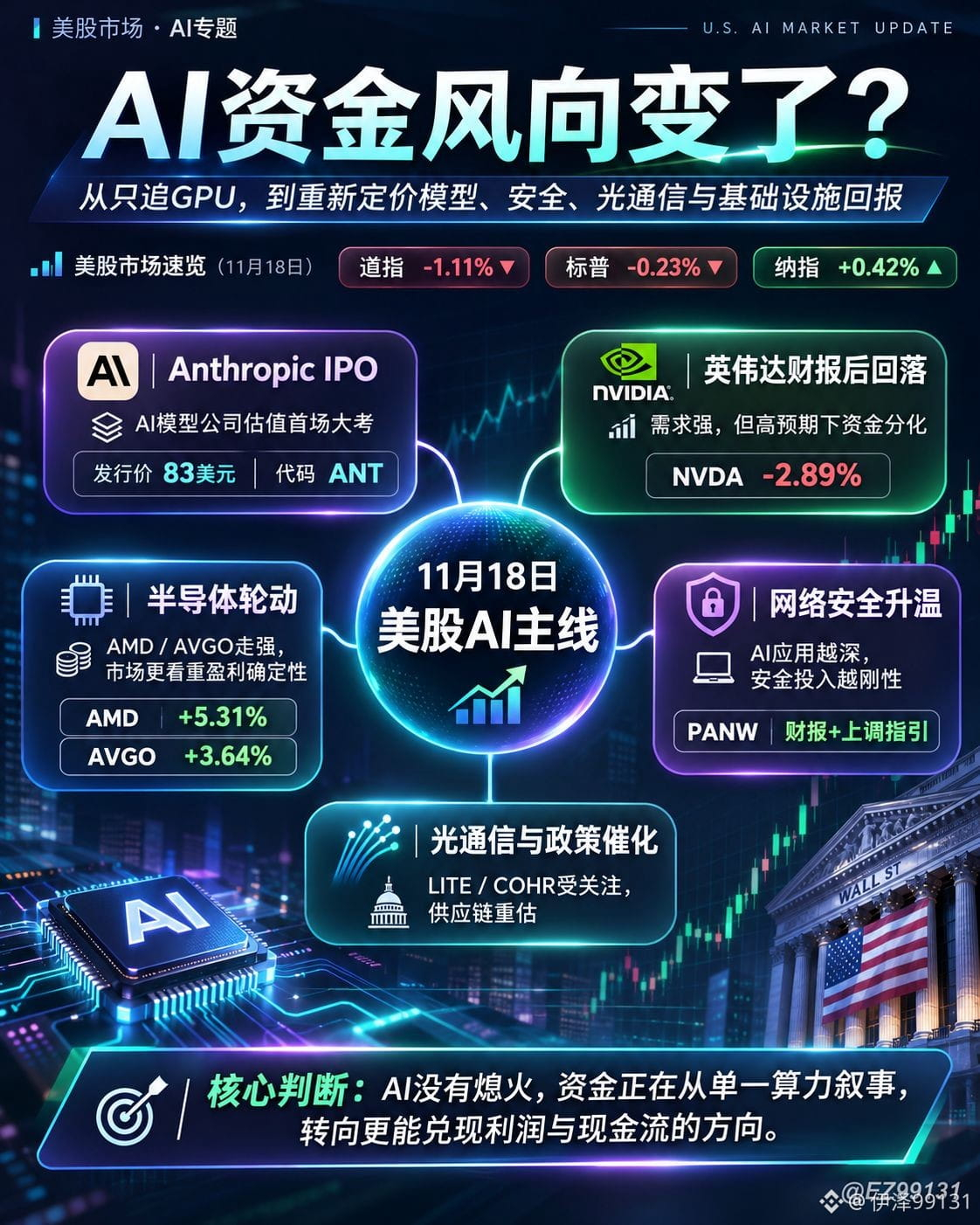
Anthropic is going public, and Nvidia’s blockbuster earnings still couldn’t stop its stock from falling. The flow of capital in U.S. AI stocks may really be shifting.
The market isn’t bearish on AI—it’s just no longer willing to pay equally high valuations for every AI company.
1. Anthropic goes public, putting AI model companies to the valuation test
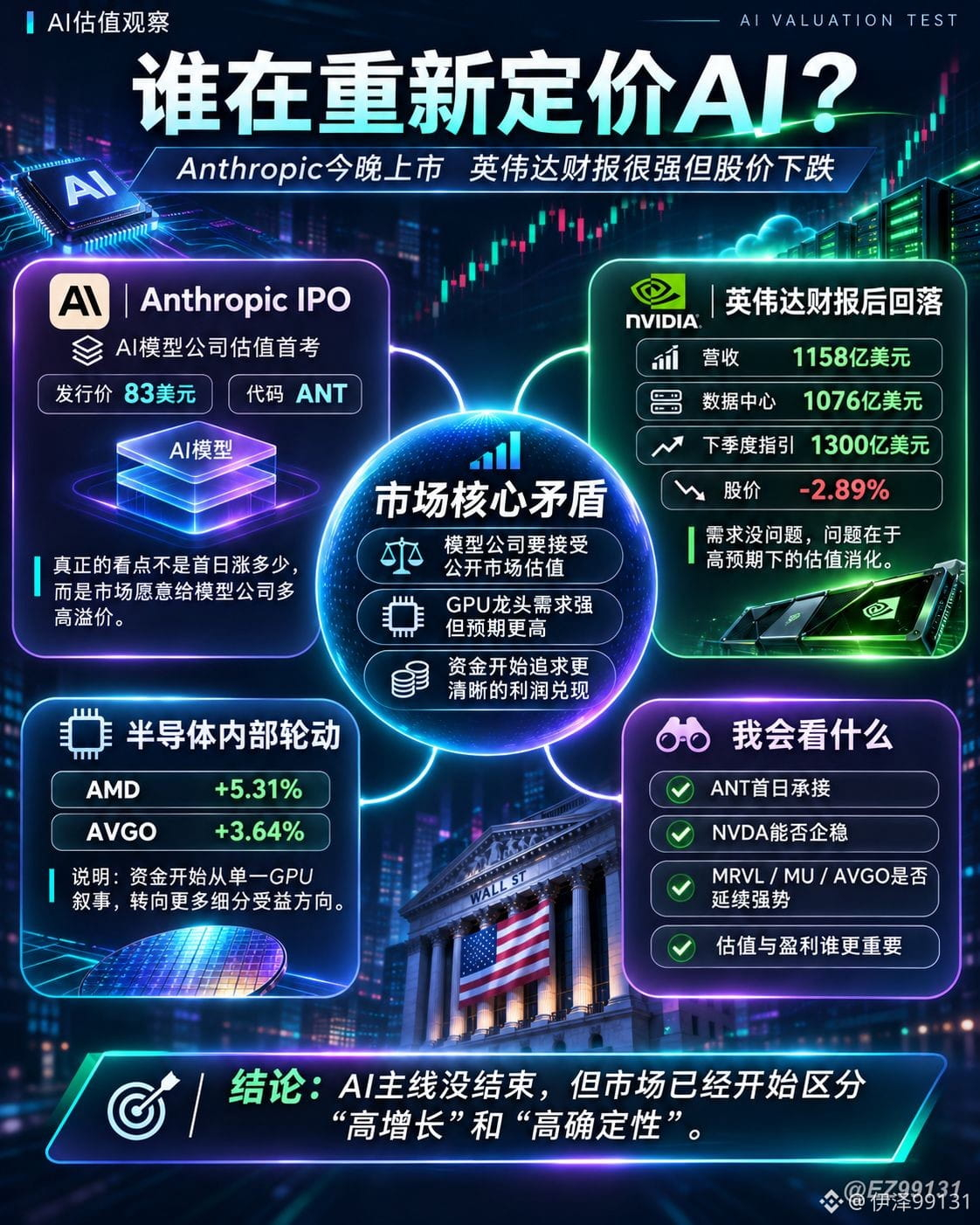
Anthropic priced its IPO at $83 per share, above the previous range of $70–$78. It is offering 980 million shares, for a total deal size of about $81.3 billion. Trading under the ticker $ANT, it is expected to list on Nasdaq on November 19.
The key question isn’t how much the stock might rise on its first day, but how much the public markets are willing to value a top-tier AI model company at.
For the past two years, capital has chased GPUs and data centers. Now, AI model companies themselves are finally facing the market’s judgment.
2. Nvidia posts strong earnings, but the stock fails to respond
AI demand remains strong, but expectations for NVDA are already very high, and investors are starting to look elsewhere for growth.
Custom ASICs, connectivity, and storage could continue to see capital rotate their way.
Next, keep an eye on order fulfillment and earnings estimate upgrades for $MRVL, $AVGO, and $MU.
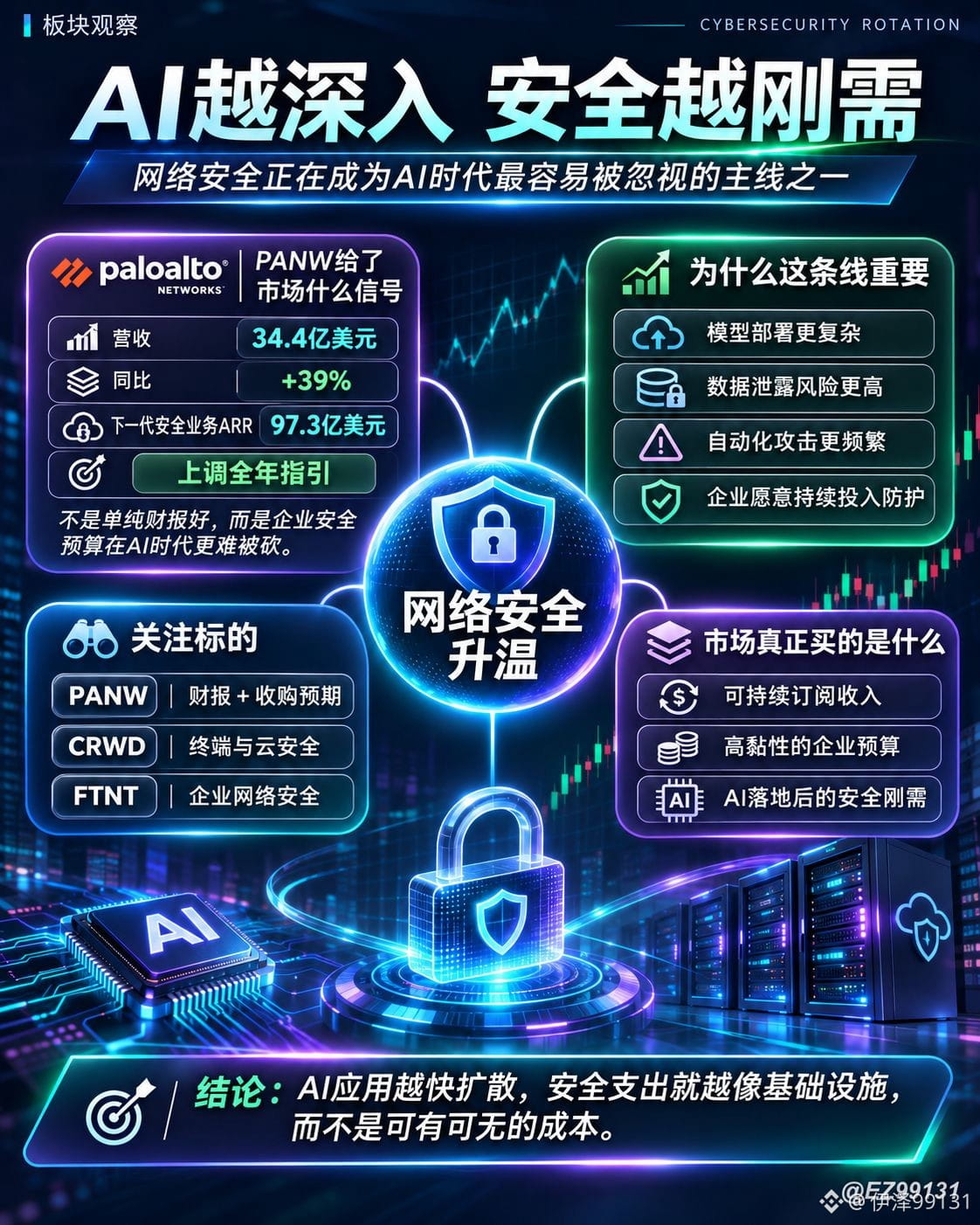
3. Cybersecurity may be an overlooked opportunity in the AI era
In its latest quarter, $PANW reported revenue of $3.44 billion, up 39% year over year. Annual recurring revenue (ARR) for its next-generation security business reached $9.73 billion, up 66%.
The company raised its full-year guidance and also plans to acquire Applied Compute for $4.5 billion.
As AI applications become more widespread, businesses need not only more powerful models but also protection for their data, models, and systems.
The deeper AI penetrates business operations, the harder it will be to cut cybersecurity spending.
Keep watching $PANW, $CRWD, and $FTNT.
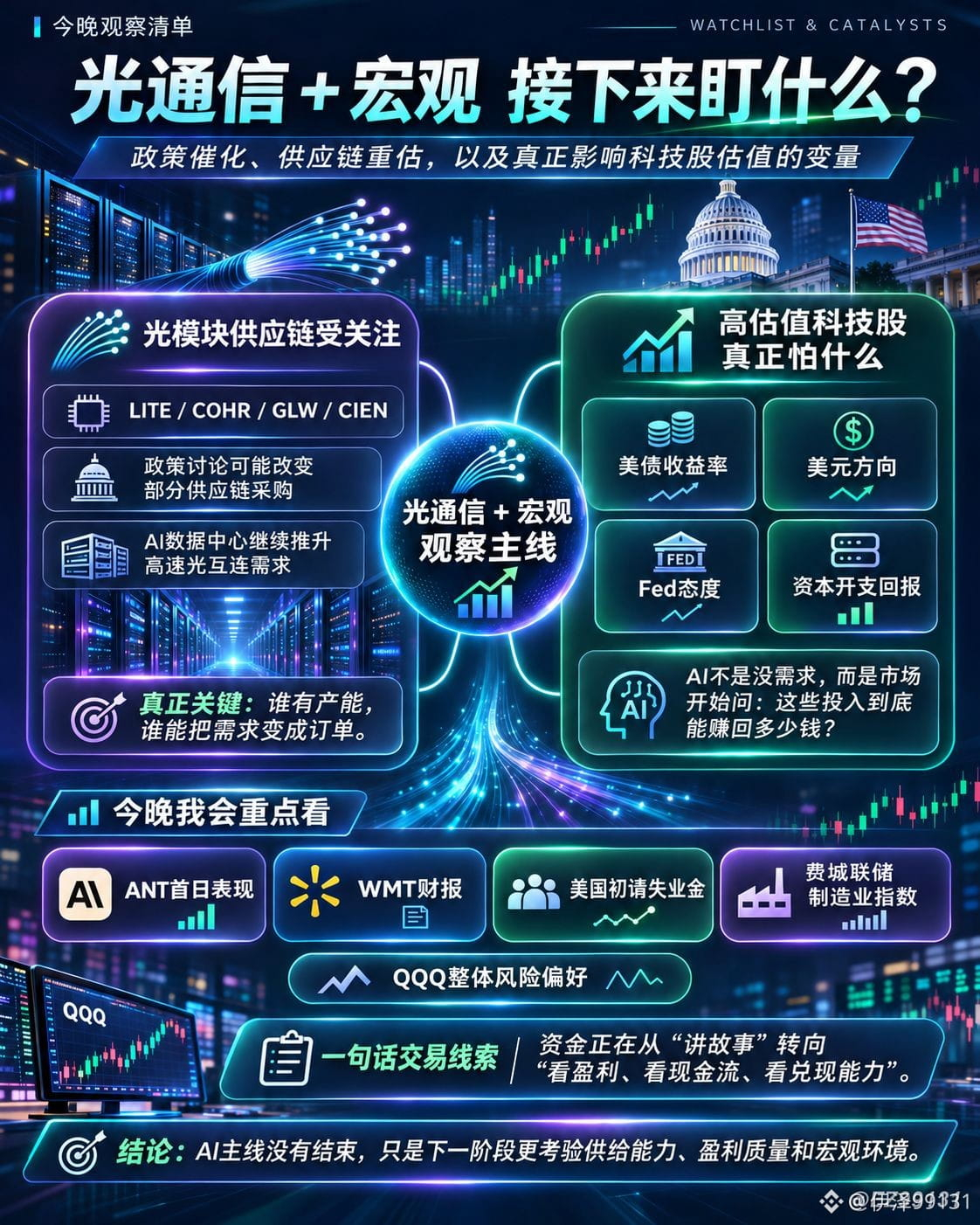
4. New policy catalyst for optical communications
The U.S. is discussing further restrictions on imports of certain Chinese optical transceiver products.
If the policy is ultimately implemented, it could prompt U.S. data centers to adjust their supply chains, potentially benefiting companies such as $LITE and $COHR.
However, the restrictions have not yet been formally implemented, and replacement capacity may be limited in the short term.
Especially after MRVL’s planned acquisition of LITE, the importance of lasers, CPO, and high-speed optical interconnects is growing further.
In the past, many companies could see their stocks rise simply by being associated with computing power and data centers.
Now, investors are paying more and more attention to earnings quality, order fulfillment, and returns on capital.
The companies that truly outperform in the future may not be those with the biggest AI stories, but those that are first to turn AI demand into sustained profits and free cash flow.