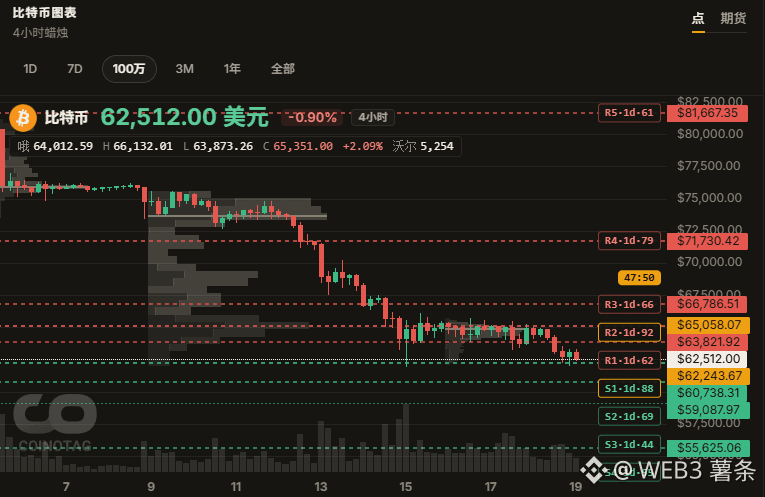
Bitcoin’s recent decline has continued to deepen, with selling pressure clearly increasing. On October 6, 2025, Bitcoin hit a record high of $126,198. But as of November 18, 2026, its price had fallen to around $62,428—down approximately 50.5% from its all-time high, erasing nearly half of its previous gains.
Selling pressure remains dominant, repeatedly stalling rebounds
Recent trading shows Bitcoin fluctuating between $63,284 and $65,365. It made several attempts to break higher, but each time the price approached $65,000, it encountered significant selling pressure.
Meanwhile, buying support briefly emerged near $63,000, but ultimately failed to hold, and the price fell further to $62,428. This indicates that sellers remain relatively strong, while buyers are currently struggling to drive a sustained rebound.
Market conditions remain weak
Bitcoin’s market capitalization is currently around $1.25 trillion, with 24-hour trading volume close to $28.85 billion. Trading remains active, but high volume does not necessarily mean prices will rise.
Notably, Bitcoin has fallen below its price at the time of the halving and has once again slipped below its 200-week moving average, reflecting significant pressure on its long-term trend as well.