
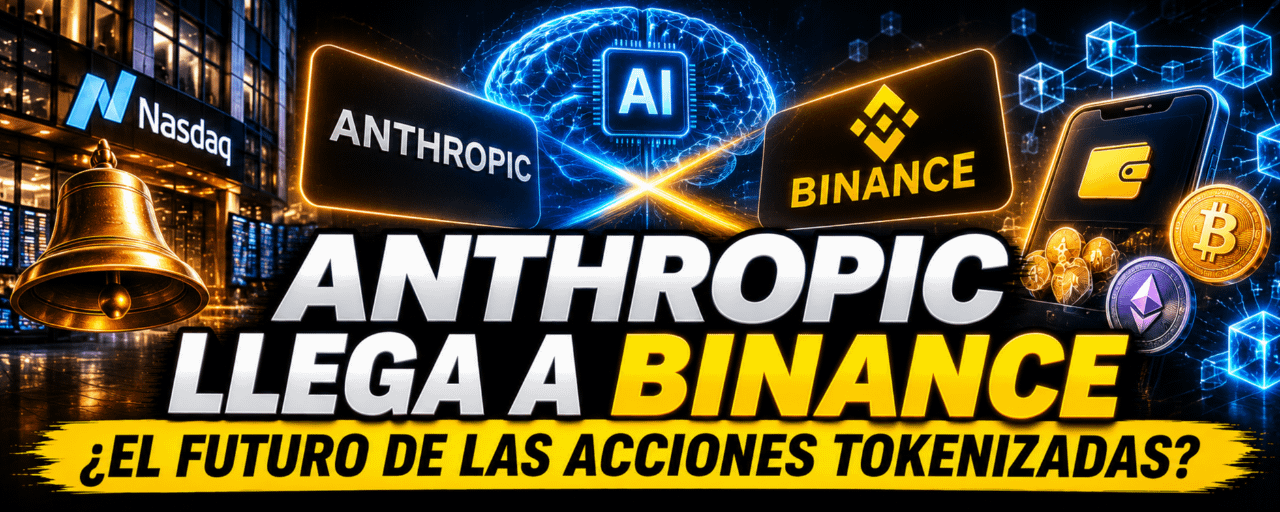

🚀 One of the world’s most important artificial intelligence companies has just made headlines with an event that could mark a new chapter in the connection between Wall Street and the crypto ecosystem.
Anthropic, the company behind Claude, priced its IPO at US$83 per share. But what’s drawing particular attention in the crypto world is something else: Binance Wallet launched a campaign to access exposure to this IPO through xStocks tokenized instruments.
The offering had a subscription cap of US$500 million in USDC. And there is an even more striking detail: the cap was reached before the scheduled participation window ended.
Are we seeing a new opportunity to connect traditional markets with blockchain? Or are there still differences and risks that many investors are overlooking?
There is much more to this news than meets the eye.
1. Anthropic sets its IPO price at US$83: a historic debut
On November 18, Anthropic officially announced the final price of its initial public offering.
The key details are:
Offering price: US$83 per share.
Shares included in the offering: 980 million.
Shares sold by Anthropic: approximately 956.35 million.
Shares sold by existing shareholders: approximately 23.65 million.
Market: Nasdaq.
Ticker: ANT.
Trading scheduled to begin: November 19.
The final price exceeded the initial indicative range of US$70 to US$78 per share.
This reflects very strong demand during the placement process.
There is also an interesting detail: Anthropic is becoming one of the first major companies developing advanced artificial intelligence models to take this step into the public markets.
The offering is not just an event for the technology sector. It also creates a new opportunity to examine how financial and blockchain platforms are trying to connect investors with companies that have so far been beyond the reach of many retail participants.
2. Binance and US$500 million: what actually happened?
Here is the detail that makes this news particularly interesting for the crypto ecosystem.
Binance Wallet announced an IPO Access campaign through xStocks, allowing eligible users to apply for an allocation of tokenized exposure to Anthropic.
The published terms were:
Minimum subscription: 100 USDC.
Indicative price: US$70–78 per token.
xStocks service fee: 5%.
Total subscription cap: US$500 million.
Currency used: USDC.
Allocation: not guaranteed.
The application window was scheduled for November 18, from 06:00 to 14:00 UTC.
However, Binance Wallet closed the campaign early after reaching the US$500 million cap.
This is important, but the figure needs to be interpreted correctly.
Reaching US$500 million in applications does not mean that US$500 million worth of tokens was distributed or that every participant received an allocation.
The mechanism allowed for full, partial, or even zero allocations, with unused funds returned.
Even so, reaching the cap before the scheduled closing time demonstrates considerable interest in participating in this new way to access an IPO through the blockchain ecosystem.
3. What are users actually buying?
This is probably the most important part of the entire analysis.
When we talk about tokenized stocks, it is easy to think that we are buying exactly the same thing as a traditional stock.
But that is not the case.
A tokenized stock is a digital instrument that aims to provide economic exposure to the performance of a stock or financial asset using blockchain technology.
In this case, eligible users could apply for instruments linked to Anthropic through the xStocks structure.
However, Binance's terms expressly state that these tokens:
Do not represent direct ownership of Anthropic shares.
Do not grant voting rights.
Do not grant dividend rights.
Do not automatically make the holder a shareholder in the company.
In addition, the documentation itself clarifies that Binance Wallet acts as an interface and infrastructure provider and does not determine allocations or issue the instruments.
There is another important point: the campaign terms do not promise that each token is individually backed 1:1 by an Anthropic share. The documentation provides for structures and backing assets defined by the parties responsible for issuance and distribution.
That is why we should not confuse economic exposure to a stock's price with ownership of that stock.
The difference can be crucial in the event of a custody, liquidity, or counterparty issue.
4. Why could this change the future of crypto?
This is where the real potential of the news lies.
For years, much of the crypto market has focused on Bitcoin, Ethereum, stablecoins, and projects built directly on blockchain.
But one category is gaining prominence: RWAs (Real World Assets), or tokenized real-world assets.
The idea is to represent traditional assets and financial instruments using tokens that can be used on blockchain infrastructure.
Possible applications include:
Company shares.
Bonds.
Money market instruments.
Commodities.
Other financial assets.
Why might this matter?
Because blockchain enables new ways to distribute, transfer, and integrate financial instruments.
In theory, this kind of infrastructure could facilitate international access, enable digital transactions, and connect traditional assets with applications in the Web3 ecosystem.
But significant challenges remain around regulation, custody, liquidity, interoperability, and holder rights.
Tokenization does not automatically eliminate the problems of the traditional financial system: it changes the infrastructure and also introduces new risks.
5. A detail many may be overlooking: not all tokens are the same
There is something especially interesting about this offering.
Kraken also offered access to Anthropic's IPO through ANTx, another xStocks instrument.
But its published terms describe a different structure: Kraken says that ANTx is backed 1:1 by underlying shares held in custody by Backed Assets.
By contrast, the terms of Binance's campaign clarify that the tokens do not represent direct ownership of the shares and do not promise individual 1:1 backing.
Why does this difference matter?
Because two instruments linked to the same company can have different legal structures, backing mechanisms, and risks.
It is not enough to look at the asset's name or check whether it tracks a stock's price.
You also need to research:
Who issues the instrument.
Which assets back its value.
Where those assets are held.
What rights the holder actually has.
How it can be sold or transferred.
What happens if the intermediary or issuer runs into problems.
This distinction is essential to properly assess any tokenized product.
6. Where could the opportunity lie for the crypto ecosystem?
Personally, I think the most interesting part is not just Anthropic's IPO.
It is the business model that could develop around tokenization.
If more and more investors seek access to traditional financial instruments through digital platforms, demand could grow for infrastructure capable of connecting both markets.
This opens up several areas to watch:
Stablecoins: USDC and other assets can serve as funding and settlement methods within these mechanisms.
Blockchain infrastructure: networks that offer security, efficiency, and the capacity to manage tokenized instruments could benefit from wider adoption.
RWA protocols: projects developing infrastructure to represent, distribute, and manage financial assets could gain relevance.
Distribution platforms: exchanges and wallets that manage to offer regulatory-compliant products with a good user experience could play an important role in this market.
But there is a caveat: increased tokenization activity does not automatically mean that the price of BNB, ETH, SOL, or any other token will rise.
For there to be a genuine investment opportunity, we need to establish what economic relationship each project has to that activity and how it captures that value.
7. My conclusion: are we seeing the beginning of a new phase?
There are three things about this development that I find especially significant.
First, one of the world's leading artificial intelligence companies is making a major IPO debut.
Second, Binance Wallet managed to reach the US$500 million application cap for its tokenized exposure campaign before the scheduled deadline.
And third, this shows there is interest in exploring new ways to connect traditional markets with the blockchain ecosystem.
However, I do not yet believe that tokenized stocks have demonstrated their full potential.
Liquidity, backing structure, holder rights, and regulation will be decisive factors in whether this category can grow sustainably.
My take is that the great opportunity may not necessarily lie in buying the next Anthropic-related token, but in identifying which infrastructure projects could truly benefit if the tokenization of financial assets becomes an important part of the market.
Because if blockchain becomes a mainstream infrastructure for trading traditional assets, the impact could go far beyond a single IPO.
💬 I’d love to hear your thoughts:
Would you buy exposure to companies like Anthropic directly from a crypto wallet?
Do you think tokenized stocks could become one of the most important categories in the Web3 ecosystem?
Or do you think there are still too many risks compared with buying traditional stocks?
I'm reading your comments. 👇
For informational and educational purposes only. This is not financial advice. Tokenized instruments involve market, liquidity, counterparty, custody, and regulatory risks.