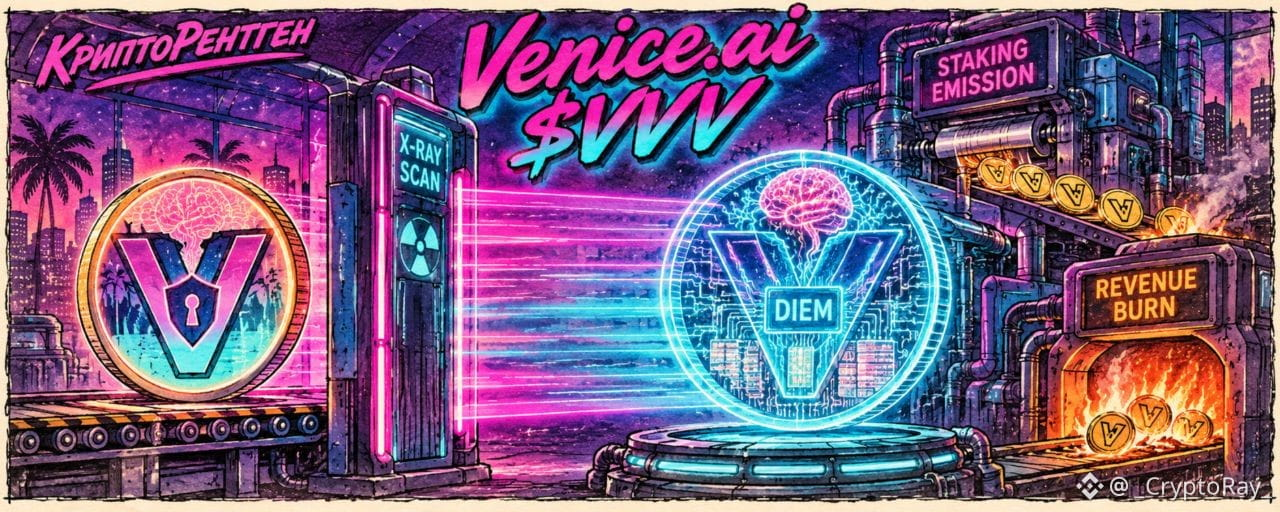
Venice.ai is an app and API for accessing generative AI models, with a focus on privacy. The $VVV and DIEM tokens run on Base. Market cap is around $1.04 billion, the price is around $21.3, and approximately 49.01 million VVV are in circulation. The main conflict: the token has a real connection to the product, but there is no hard cap on supply. Staking continuously issues new coins, while revenue is used in part to buy them back and burn them. Which side comes out ahead depends on the time period and the numbers.
Technology and product
Venice is not building its own blockchain. It is an AI service, and the tokens are only its payment and computing layer. The official FAQ describes privacy in terms of distinct modes: Anonymized (the provider cannot see the user's identity), Private (processing with zero data retention), TEE (execution in a secure hardware environment), and E2EE (encryption on the device). These offer different guarantees, and the highest level of protection should not be assumed to apply to all models.
The token's connection to the product works as follows. VVV is staked and converted into sVVV. Locked sVVV allows DIEM to be minted. Staked DIEM provides a daily API limit: 1 DIEM equals $1 worth of computing credits per day. This is not free, unlimited access; requests are charged according to the model. The service can also be used without tokens: through a subscription, dollar-denominated credits, or USDC.
According to the company's own figures for July, the service had 3.5 million registered users, processed about 1.3 trillion tokens per month, and handled roughly 2 million API calls per day. These are company disclosures, not an independent audit.
Tokenomics
Initial issuance: 100 million VVV. Allocation: 50% to users and AI communities, 35% to Venice.ai for development, 10% to the incentive fund, and 5% to liquidity. Current total supply is about 81.26 million because some tokens have been burned.
There is no hard maximum. Staking issuance was 14 million VVV per year at launch; following several reductions, it has been 2 million VVV per year since October 1, 2026. That is about 5,479 tokens per day, or roughly 4.08% of current circulating supply before accounting for burns.
There are two types of burns. On March 12, 2025, two large burns totaling 33,539,739 VVV took place, but a significant portion came from the initial allocation and unclaimed tokens; these were not the result of business activity. Separately, a revenue-based program is in place: a portion of subscriptions and $5 out of every $100 spent on API credit purchases goes toward buybacks and burns. The company has an official tracker. The net result should be calculated as “issuance minus burns” over the same period.
Investors
On July 1, 2026, Venice announced a $65 million Series A at a $1 billion equity valuation. The round was led by Dragonfly, with participation from Coinbase Ventures, F Prime, North Island Ventures, and other funds. According to the founder’s disclosure, investors received 8.98% equity, a vesting grant of 1.5 million VVV, and the right to purchase another 5 million VVV over eight years. Series A tokens have a one-year lockup, followed by three-year linear vesting, expected to begin around mid-2027. Important: VVV does not confer shareholder rights and is not an ownership stake in the company.
In July, the founder reported that the company held more than 30 million VVV and that the company and team had not sold any tokens. This is a historical statement, not a recent on-chain audit.
On-chain and market metrics
Conventional TVL is not a key metric for Venice. More useful metrics are paying users, revenue, computing costs, the amount of sVVV backing DIEM, and burns relative to issuance. DefiLlama publishes quarterly revenue figures: Q3 2026 shows $1.98 million in gross protocol revenue, but this should not be added to buybacks a second time and treated as net profit.
Market as of November 18: market capitalization of about $1.04 billion, valuation based on current total supply of about $1.73 billion, and daily trading volume of about $34 million to $54 million. The all-time high was $34.53; the current price is about 38% below it.
The inside story
Facts
A $65 million Series A was announced on July 1, 2026.
Staking issuance was reduced to 2 million VVV per year starting October 1.
There is an official buyback tracker and a documented revenue-based burn model.
DIEM is a separate token for computing credits, not a stablecoin.
Rumors and insider claims
“Hayes guarantees $40”: unconfirmed; there is no primary-source statement.
“Millionaires are exiting en masse” and “retail is buying up all the supply”: unconfirmed; there are no labeled addresses or methodology.
“Maximum of 80 million VVV”: disproven; 80 million is an approximate balance as of a particular date, not a cap.
Strengths
A working AI product and API with a real user base.
Concrete utility: VVV, sVVV, and DIEM are linked to access to computing.
An officially documented buyback and burn funded by a portion of revenue.
Issuance was cut from 14 million to 2 million VVV per year.
Series A terms have been disclosed, and there are institutional investors.
Weaknesses
There is no hard cap on supply.
Staking yield is mostly inflationary, meaning it is paid in newly issued coins.
A significant share of tokens is held by the company, and governance is centralized.
The investor grant and warrants are yet to vest.
The net effect of burns over a comparable period has not been established.
The level of privacy depends on the mode and the specific model.
Sources
Official Venice documentation and tracker, DefiLlama, Tokenomics.com.