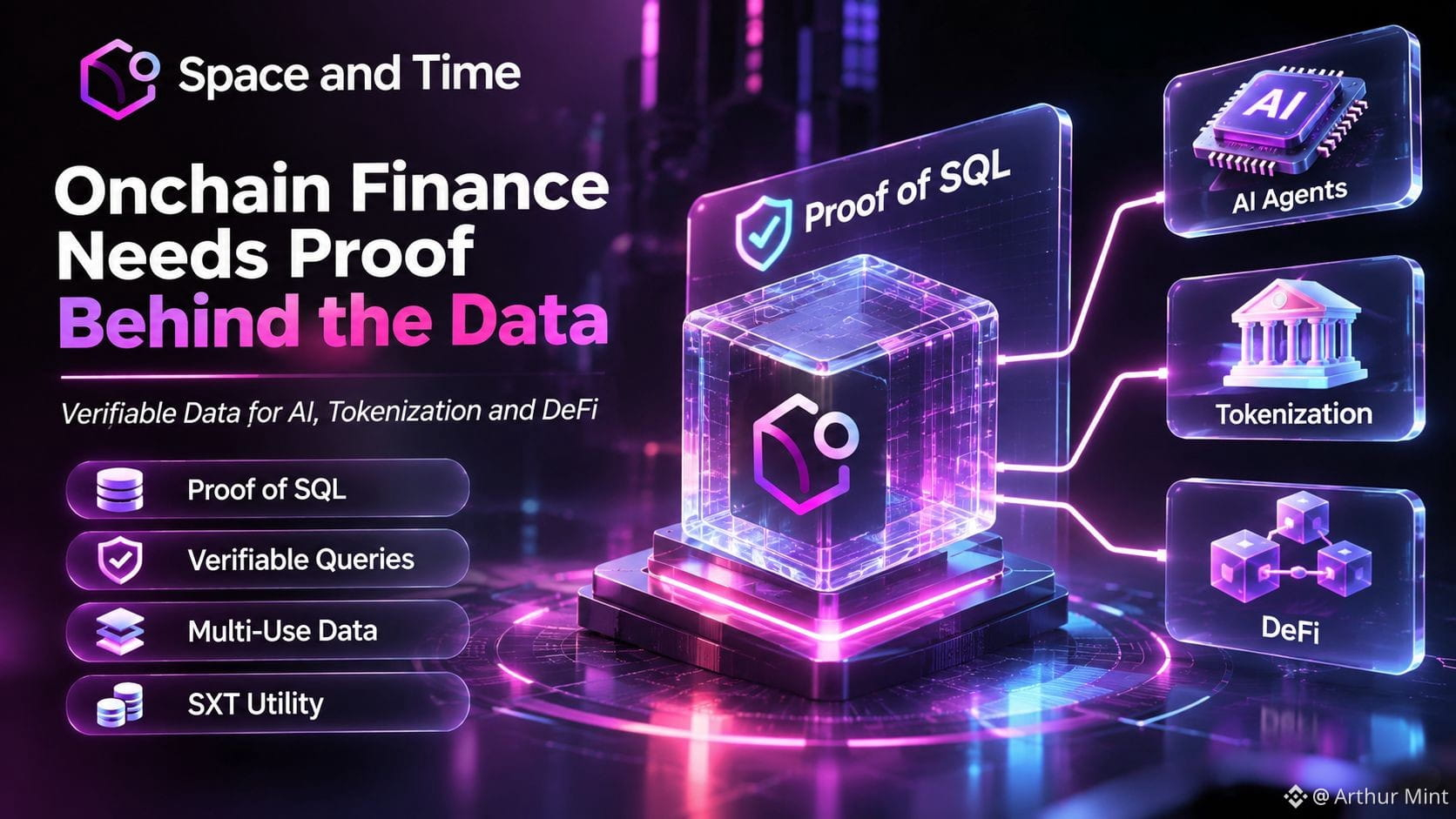

Onchain Finance Needs Proof Behind the Data.
A tokenized asset may live onchain, but the facts shaping its value often do not: repayments, reserves, portfolio records or cross-chain activity. If a contract or AI agent relies on centralized data, its execution may be automated while the inputs remain a trust assumption.
Space and Time addresses this gap with Proof of SQL.
Validators maintain cryptographic commitments to structured data tables. Prover nodes run SQL queries off-chain and return a zero-knowledge proof that the committed data was not altered and the calculation was correct.
An EVM contract can verify that proof without processing the full dataset.
This creates building blocks for DeFi risk checks, tokenized-asset valuations and AI agents that need historical or cross-chain data before acting. It does not prove that an original real-world input is true, or that an AI decision is sound.
SXT pays for data-insertion and query workloads, tying token utility to verifiable computation.
#sxt $SXT @SpaceandTime