


The past couple of years have been pretty interesting: Web2 insiders have been calling it a sunset industry, while Web2 giants have been actively getting involved.
However, Web2 companies are mainly participating in Web3 through the RWA sector, tokenizing financial assets such as U.S. Treasuries and securities.
But Space and Time (SXT), backed by Microsoft’s venture capital arm M12, is a little different.
┈➤ Data Indexing Ecosystem
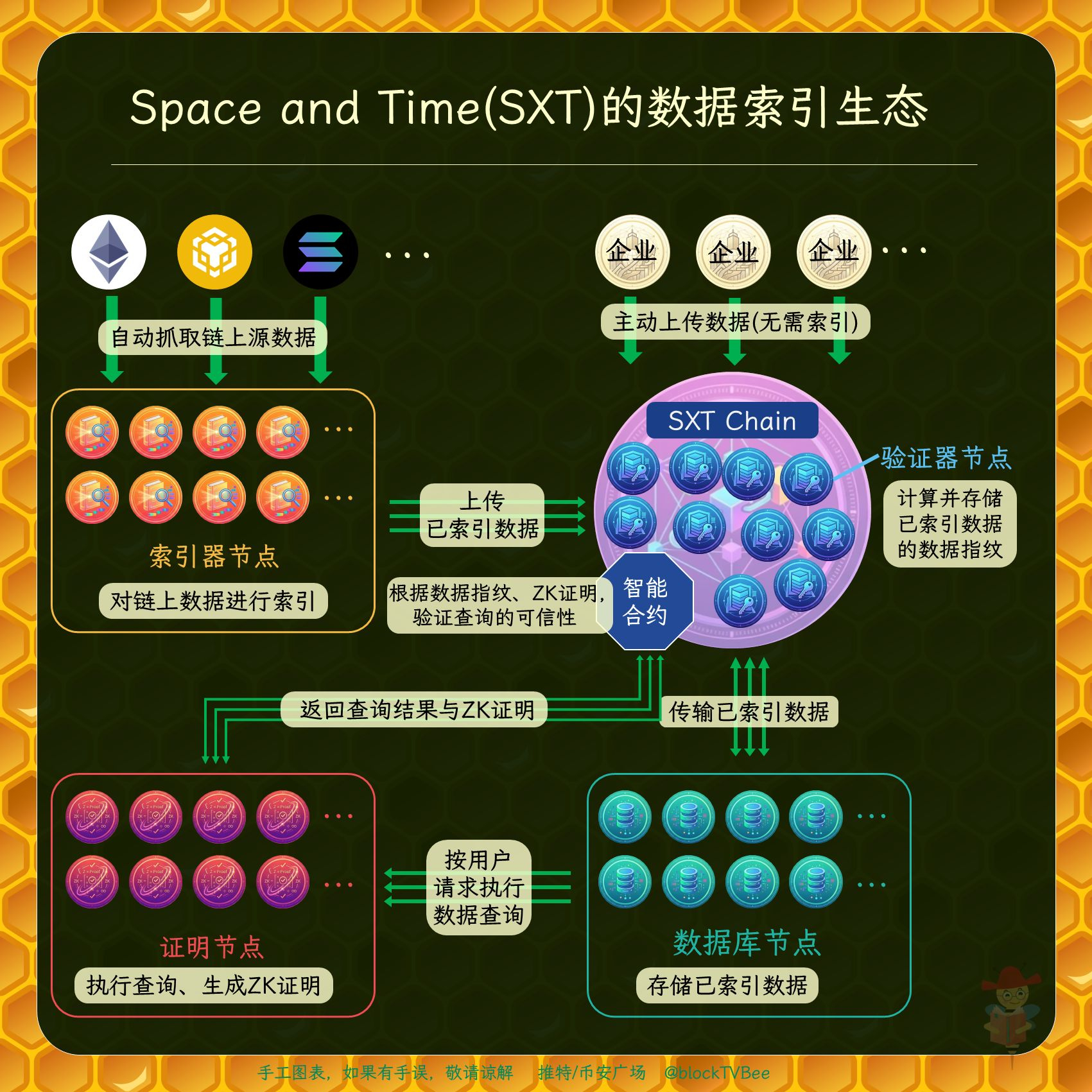
SXT is a data indexing ecosystem that provides trusted data indexing services for smart contracts and enterprise users.
Indexer nodes are responsible for automatically retrieving on-chain data and indexing it. The indexed data is structured as relational tables, allowing users to quickly find the corresponding data in one or more columns of a specific row or rows using SQL queries.
Validator nodes calculate cryptographic hashes of indexed data and use them as data fingerprints, which are stored on SXT Chain.
Database nodes are responsible for storing indexed data.
Proof nodes process query requests issued by smart contracts, compute the query results, and generate ZK proofs. Smart contracts can then verify the trustworthiness of the query results using the relevant data fingerprints, query results, and ZK proofs.
┈➤SXT vs. The Graph
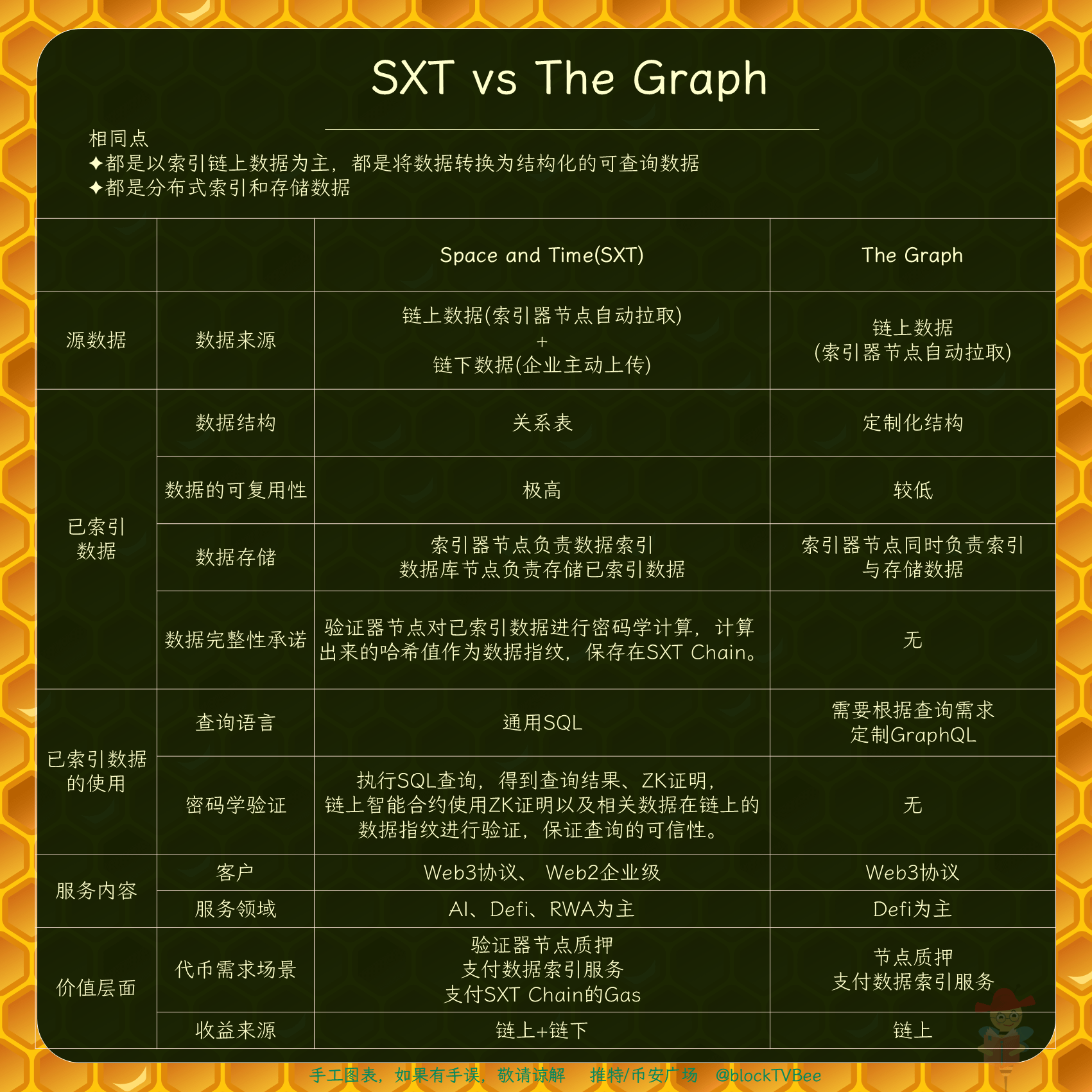
SXT and The Graph are somewhat similar: both provide data indexing services and can convert on-chain data into structured data. Both also use multi-node protocols to index data in a distributed manner.
However, they differ significantly in the details. To better understand SXT, Brother Feng compared it with The Graph.
First, The Graph sources data only from on-chain data.
SXT, on the other hand, sources data both from on-chain data and from data actively uploaded by off-chain enterprises. Therefore, SXT can also provide data services for RWA applications, which need both on-chain and off-chain data.
Second, The Graph's indexed data is non-relational, so it can only be queried using its custom GraphQL.
SXT's data indexing, by contrast, converts on-chain data into relational tables that can be queried using the widely used SQL language.
Select * From XXX Where... Group by... Order by...
This is a query format that most people are familiar with. If Web3 projects can query data using SQL, their transparency, visibility, and even participation may all increase. So SXT's data indexing service could be one of Web3's essential needs.
Third, The Graph's indexing nodes both index the data and store the indexed data.
SXT, by contrast, keeps data indexing and storage separate, making the SXT data-indexing ecosystem less risky.
Fourth, The Graph makes no guarantees about the integrity of indexed data.
SXT, by contrast, calculates hashes of indexed data tables as data fingerprints, which are used to verify the integrity of indexed data.
Fifth, The Graph does not verify the trustworthiness of queries.
SXT applies ZK technology to queries. ZK proofs and data fingerprints can verify that query results were indeed computed from the relevant indexed data using the corresponding query algorithm.
This is why enterprise customers choose SXT: when external auditors need data, SXT provides them with trustworthy data queries in a verifiable form.
Sixth, The Graph primarily serves on-chain smart contracts.
SXT, on the other hand, can serve both on-chain smart contracts and enterprise customers.
SXT's announced launch partners include:
✦ DeFi products: Maple Finance, an institutional lending protocol,
✦ Enterprise customers: Indomobil, a major Indonesian automaker, and Trenez, an Oracle-related consulting firm
✦ Nonprofit data organization: The Data Foundation
Seventh, The Graph's indexed data is more highly customized and less reusable.
SXT's indexed data, by contrast, is relational and stored on data nodes, making it more reusable. This means SXT can serve not only on-chain DeFi applications, but also AI products with large-scale, high-efficiency data needs.
Eighth, demand for The Graph (GRT) tokens comes from node staking and paying for services.
With SXT, in addition to staking SXT as a validator node and using SXT to pay for services, the ecosystem is centered on SXT Chain, where gas fees are also paid in SXT.
Ninth, all of The Graph's revenue comes from on-chain activity. This means that when the Web3 ecosystem is in a downturn, project demand and revenue are likely to be affected by unfavorable market conditions.
Since SXT also has enterprise customers, its cash flow may be relatively stronger. (SXT may not necessarily need to rely on token sales to generate revenue.)
┈➤Final thoughts
Why compare it with The Graph? One reason is to better understand this project, which received a $20 million lead investment from Microsoft's M12.
Another reason is that The Graph has achieved some results in data indexing. According to official figures, The Graph has served over 75,000 projects, with more than 1.27 trillion queries in total.
Although SXT is not as mature as The Graph, that is precisely where its potential lies. SXT's current circulating market cap is one-tenth that of The Graph (GRT), and its FDV is one-fourth its size.