

Nvidia breaks records after Jensen Huang’s departure: can it drive a rally in the crypto market?
The global financial ecosystem is going through one of the most volatile weeks of 2026. After Wall Street closed on Tuesday, November 17, Nvidia reported its fiscal third-quarter 2027 financial results (for the quarter ended October 25, 2026), putting risk appetite to the test in both tech stocks and the cryptocurrency market.
1. What happened at Nvidia: record figures amid a leadership crisis
Nvidia's performance is currently being pulled in two opposing directions, explaining investors' caution:
Revenue and guidance above consensus: The company reported quarterly revenue of $115.8 billion, a 103% year-over-year jump that comfortably exceeded Wall Street estimates (~$109.0 billion). GAAP diluted earnings per share (EPS) reached $2.70 ($2.68 non-GAAP, versus the expected ~$2.47–$2.48), and the GAAP gross margin came in at a solid 74.8%. For the fourth quarter, the company projected revenue of between $126.0 billion and $134.0 billion (midpoint of $130.0 billion), above the analysts' average (~$125.0 billion).
Corporate upheaval and regulatory scrutiny: These figures come just days after Jensen Huang's abrupt resignation as CEO, chairman, and director on November 12, following a personal scandal linked to investigations into national security and chip export controls to China. CFO Colette Kress took over as interim CEO while the board created an export compliance committee and ruled out reinstating Huang, despite his expressed willingness to return.
Market reaction: The leadership crisis and investigations by the Department of Justice (DOJ), the SEC, and the U.S. Senate (which subpoenaed Huang to testify on December 3) wiped out more than $700 billion in market value and brought the stock's decline to nearly 16% so far in 2026. However, after the quarterly results were released, NVDA shares rose more than 2% in after-hours trading.
2. Current snapshot of the stock and crypto markets
Nvidia's report comes amid clear risk aversion and tightening liquidity:
Pullback on Wall Street: Before Nvidia's report, major U.S. indexes closed lower on Tuesday, November 17, amid doubts about the sustainability of AI spending and expectations for interest rates: the Dow Jones fell ~1.5%, the S&P 500 1.3%, and the Nasdaq Composite 1.4%.
Selling pressure in crypto assets: The total crypto market capitalization has stalled at around $2.20 trillion, affected by liquidity outflows from stablecoins. Spot crypto ETFs recorded weekly net outflows of approximately $1.52 billion ($1.07 billion from Bitcoin ETFs and $398.85 million from Ethereum ETFs).
Bitcoin (BTC) technical levels: After falling to an 18-week low of $61,950 over the weekend and losing its 200-week simple moving average ($68,186), Bitcoin is consolidating in the $63,500–$65,500 range.
3. Real analysis: How likely is Nvidia to trigger a rally?
From a strictly fundamental and capital-flows perspective, Nvidia's positive impact has a high probability of triggering a short-term technical relief bounce, but a low probability of starting a sustained bull market on its own.
Catalysts favoring a rebound
Validation of the AI investment cycle: Doubling revenue (+103%) and raising quarterly guidance show that major cloud providers (hyperscalers) are maintaining their infrastructure spending. This eases immediate fears of a collapse in demand across the tech sector, allowing the Nasdaq to stabilize.
Correlation with risk appetite and AI tokens: Historically, when the semiconductor sector absorbs bad political news and confirms financial strength, institutional capital reduces defensive selling, benefiting both risk assets and crypto projects tied to AI and decentralized computing.
Oversold technical positioning in derivatives: Following recent liquidations of long positions and funding rates turning negative in Bitcoin perpetual futures, positive momentum at the Wall Street open could force short positions to close (a short squeeze).
Structural headwinds limiting momentum
Ongoing legal and political issues: The financial results do not put an end to DOJ and congressional investigations into chip flows or the risk of tighter restrictions on exports to Asia, factors that will continue to limit expansion of Nvidia's valuation multiples.
Immediate macroeconomic calendar: On Wednesday, November 18, markets face the release of the Federal Reserve's FOMC minutes amid investor expectations of inflationary pressures and restrictive interest rates (alongside the Japanese yen's weakness near 160 per dollar), which affect global liquidity far more than any single company's results.
Negative institutional flows into crypto: As long as Bitcoin and Ethereum ETFs continue to see weekly net outflows exceeding $1.5 billion and stablecoin supply declines, Nvidia's positive impact is more likely to take the form of a tactical bounce than a structural trend reversal.
4. Market scenarios to watch
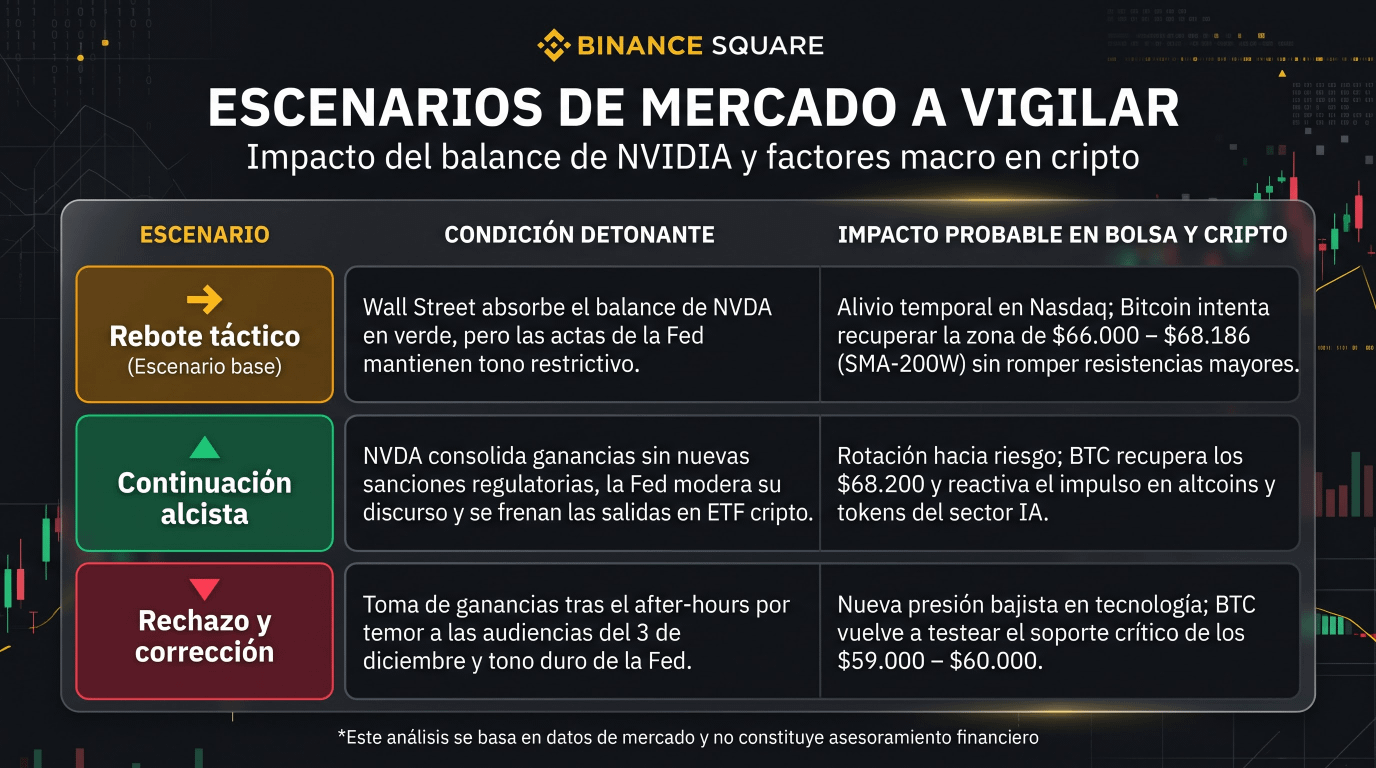
For Binance traders, the coming sessions will require watching not only Nvidia shares at the open, but also bond yields' reaction to the Federal Reserve minutes and the stabilization of spot ETF flows before assuming a confirmed bullish reversal. (This analysis is for informational purposes only, is based on market data, and does not constitute financial advice).
https://youtu.be/gqOXUR7fPko?si=RTl7-AfLu4VkYJ0m
Analysis of Nvidia's results following Jensen Huang's departure
This video takes an in-depth look at how Nvidia's record quarterly results are overshadowed by the leadership crisis following Jensen Huang's departure, a key factor in assessing the true extent of its impact on the markets.
#BinanceSquareTalks , #Write2Earn , #BinanceSquareFamily , #2026withBinance #CryptoNewss $NVDAB