


TL;DR
· Remote computing capacity from some overseas data centers has been brought under licensing requirements, further restricting domestic companies’ access to advanced GPU computing resources.
· Nomura warns that a further shortage of advanced GPUs could pose downside risks to the growth of domestic AI cloud revenue in 2027.
· Adoption of domestically produced AI chips is expected to accelerate. Citing IDC data, Nomura says T-Head, Alibaba’s chip unit, ranked third in the domestic market for related chips in the first half of 2026, with a 6.6% share.
· Alibaba and ByteDance’s existing GPU resources and financial strength can provide a buffer for model development. For Tencent, Nomura is more focused on whether its advanced GPU capacity can continue to expand.
· Independent AI labs may find it increasingly difficult to obtain the computing power needed to train next-generation models, with Nomura viewing DeepSeek as a possible exception.
Tighter access to overseas computing power poses downside risks to AI cloud growth
On November 16, the U.S. government announced an interim final rule covering advanced computing chips, bringing certain cases in which advanced computing power is provided remotely through overseas data centers under licensing requirements. Even if the chips are deployed outside the United States, exports or transfers of the relevant chips and servers may require a license if a data center provides computing power to a specific company above a prescribed threshold.
In a research report published on November 17, Nomura said it may become more difficult for domestic companies to access advanced Nvidia GPU computing power through overseas data centers. Alibaba, Tencent, and ByteDance are all increasing investment in AI infrastructure and foundation models. If supplies of advanced GPUs tighten further, model training could be constrained, potentially affecting the computing power cloud providers can deliver to customers.
Nomura expects domestic AI cloud revenue growth to face downside risks in 2027 if the shortage of advanced GPUs worsens. The report did not provide a specific estimate of the potential adjustment to revenue growth. Nomura said it would monitor Alibaba and Tencent's earnings calls that week to assess how changes in computing power supplies could affect their cloud businesses.
Adoption of domestic chips may accelerate, with Alibaba already having its own in-house capabilities
Greater difficulty accessing advanced GPUs could prompt companies to accelerate the adoption of domestic AI chips. Nomura believes platforms with strong access to computing power and in-house chip development capabilities have more options when adjusting supply arrangements. T-Head, Alibaba's chip unit, is a key example cited in the report.
Citing IDC data, Nomura said Nvidia ranked first in the relevant domestic chip market in the first half of 2026, with a 33.8% share, followed by Huawei at 28.5%. T-Head, Alibaba's chip unit, ranked third with 6.6%. Cambricon and Baidu's Kunlunxin had shares of 4.6% and 4.2%, respectively.
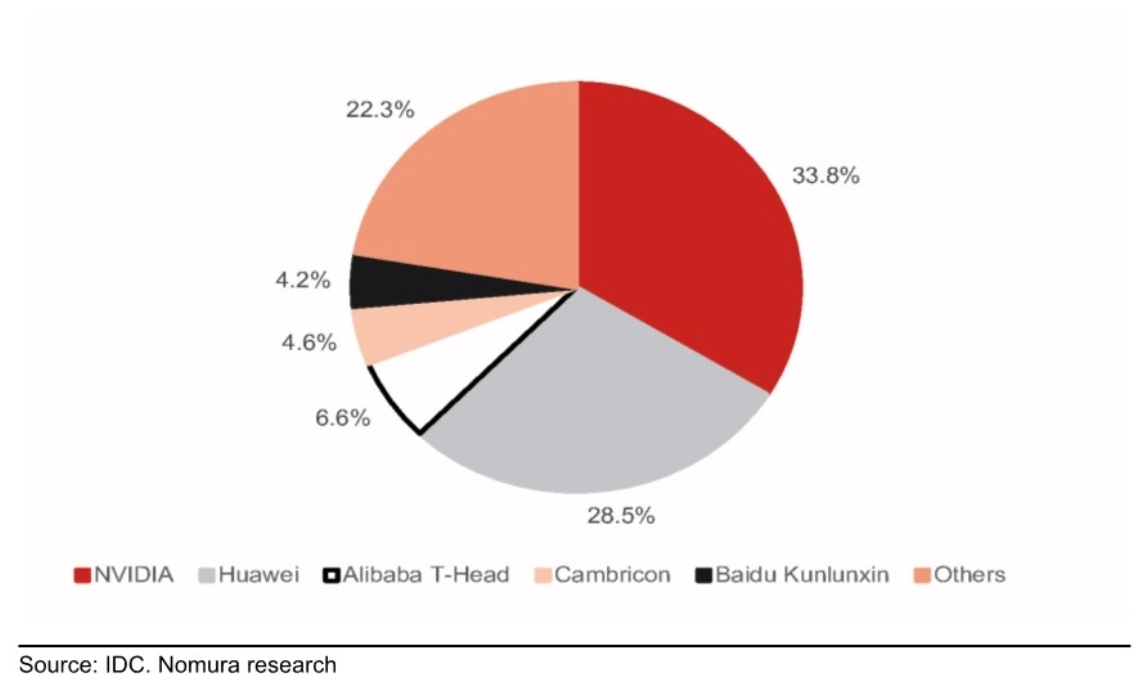
Chart note: Domestic AI chip market shares in the first half of 2026. Source: IDC, Nomura Research.
For Alibaba, T-Head provides an in-house source of computing power and could give the company more options for future infrastructure deployment. Nomura expects adoption of domestic chips to accelerate, but did not quantify the extent to which they could make up for the shortfall in advanced GPU supplies.
Alibaba and ByteDance have computing power reserves, while Tencent faces pressure to expand capacity
Changes in computing power supplies could also reshape competition in the foundation model market. Nomura believes independent AI labs may face greater pressure in accessing the advanced GPUs needed to train next-generation models. The report cites DeepSeek as a possible exception, but does not elaborate on why.
Alibaba and ByteDance's existing GPU resources and financial strength could provide some buffer for future model development. Both companies are also affected by tighter access to overseas computing power, but their existing resources could help them maintain their R&D pace when additional supply is constrained.
For Tencent, Nomura is more focused on whether its reserves of advanced GPUs can continue to grow. If additional computing power comes online more slowly, it could become harder for Tencent to maintain its current pace of AI infrastructure investment, potentially affecting the speed of model iterations and new application launches. In Alibaba and Tencent's upcoming earnings calls, key points to watch include whether additional computing power arrives as planned and whether the companies revise their cloud business growth expectations.