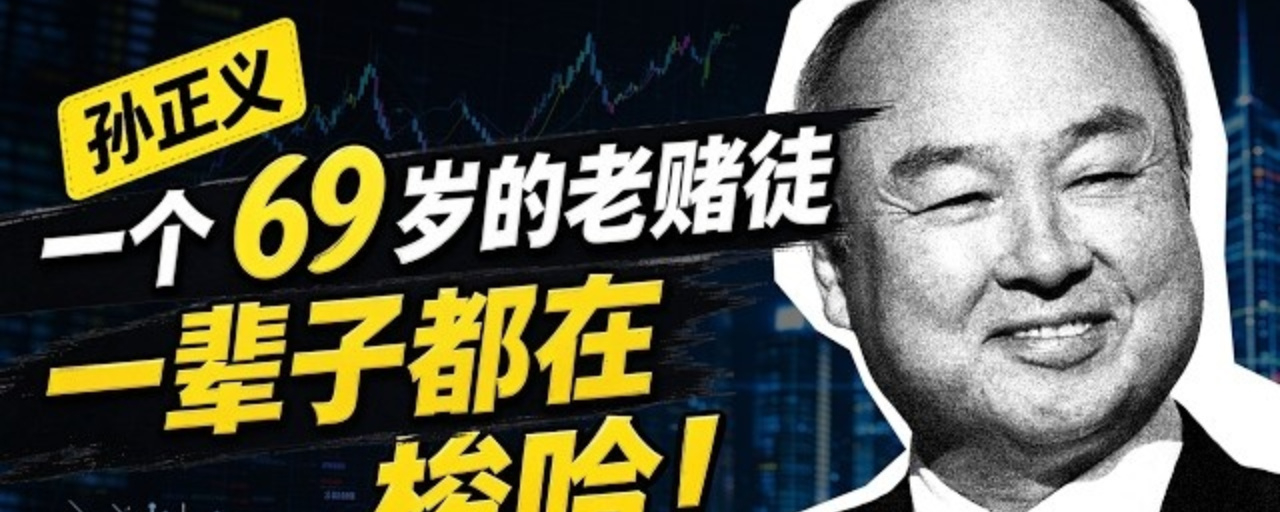



Today, let’s talk about a spectacular wipeout. The legendary investment guru Masayoshi Son made one bad call and lost $90 billion! After hearing the story, I hope you can make peace with your own mistakes. In the end, we’re all pretty much the same.
Recently, Jensen Huang was caught cheating, tech stocks plunged, and Masayoshi Son—who had gone all in on AI—was hit with one misfortune after another. He lost $7 billion in a single quarter, and his stock fell 40%. Everyone is laughing at him.
That’s when Elon Musk piled on, saying Masayoshi Son had terrible judgment. “Back then, I asked you for $12 billion in exchange for a 25% stake in Tesla, and you flat-out refused. Instead, you put that money into WeWork. If you’d invested in me, you’d be up $360 billion by now. You invested in WeWork, lost $14 billion, and became a laughingstock.”
Masayoshi Son was already hurting enough, and then a man named Neumann jumped in and told Musk, “You need to reflect on this. Your sales pitch just isn’t good enough.”
Son’s old wound has been reopened, and his stupidest investment ever is destined to be mocked over and over again.
Who is this Neumann?
He’s the founder of WeWork. His greatest talent is persuading people—he’s such a captivating speaker that once you hear him, you become a fan. That’s how good he is.
WeWork is basically a sublandlord business. It rents properties, renovates them, then rents out desks. But in Neumann’s words, it was about “changing human consciousness and reshaping the way we work.” He never talked about rent or gross margins; he talked about civilization, community, and how people live.
How did he beat out Musk and get Son’s investment?
At the time, Son had just raised $100 billion from the Saudis and was desperate to find the next Alibaba. He liked founders to be extremely ambitious and their stories to be grand enough.
Neumann understood him perfectly. Other founders would talk about three-year or five-year plans; Neumann came in with a 1,000-year plan. The first target year in his business plan was 3016.
Son was completely sold. After chatting in a car for half an hour, Son handed over $4.4 billion and even proposed a grand target: 10,000 salespeople, 10,000 real estate agents, and 10,000 property managers.
He also went around bragging that Neumann was the next Steve Jobs and WeWork was the next Apple.
But Neumann wasn’t just good at persuading people; he also knew how to enjoy himself and make money.
He used company money to buy himself a private jet, outfitted his office with ice baths and hot springs, and threw lavish parties whenever he had nothing else to do.
The most outrageous thing was that he registered the “We” trademark himself, then asked WeWork to pay him $6 million for it.
But the biggest way he siphoned money out of the company was by buying properties all over the world first, then renting them out to WeWork at inflated prices. While others had a rent-to-sale-price ratio of 4%, his was at least 6%. That’s how he funneled the company’s money into his own personal accounts.
So how did this giant bubble burst?
Later, when the company planned to go public, it blew up spectacularly. Neumann had been telling everyone it was a futuristic, high-tech company, but when people looked at the prospectus, they saw it was just a sublandlord.
And his business model was incredibly stupid. When he rented properties, he signed leases for five or even ten years. But when he rented them out to others, he charged by the month and by the desk. His costs were fixed, but his income wasn’t.
This company was valued at $47 billion, but none of Wall Street’s seasoned investors would touch it. So they had to slash the valuation—from $47 billion down to $8 billion—and still nobody wanted it. The IPO failed, Neumann had to resign, and the valuation promptly plunged to $4 billion.
At this point, Masayoshi Son was in an incredibly awkward position. He had already invested $11 billion and lost more than half of it. What could he do?
He had only two choices: cut his losses or double down.
Son compounded his mistake by choosing to double down. He was going to spend $3 billion buying back the other shares.
Then the pandemic hit, and even fewer people wanted shared offices. Son regretted his decision and decided not to buy after all.
That was a problem. Neumann wasn’t having it. He said, “How can you back out of a deal you promised to honor?” You have to spend that money. He sued Son.
In the end, Son completely caved and paid Neumann $780 million to settle.
In 2023, WeWork went under for good. Son lost a total of $14 billion (about 90 billion yuan), the biggest loss ever on a single investment.
Neumann ran the company into the ground, but made $2 billion from the venture, making him the biggest winner.
Son later said this investment was incredibly stupid.
Now he’s gone all in on AI again, so people keep asking whether this could be the next WeWork debacle. That’s why he’s much more nervous than us small-time retail investors. $NVDAB $BNB