


On November 17 Eastern Time, Nvidia released its latest quarterly results, once again pushing revenue to a record. When the conference call moved to the Q&A session, analysts asked not only about chip demand but also about something else: Would Nvidia’s support for customers take effect only after they secured financing?
These quarterly results, for the period ending in late October this year, belong to Nvidia’s 2027 fiscal year. Revenue for the quarter was about $115.8 billion, more than double the figure from a year earlier. At the same time, Nvidia is locking in component supplies ahead of time and providing credit support for some customers building data centers. Sales growth and the financing arrangements supporting those sales appeared in the same earnings report.
Which customers are driving the new revenue?
First, break down data center revenue by customer. NVIDIA divides it into hyperscale cloud providers and AI cloud, industrial, and enterprise customers. The latter category includes both new cloud providers offering GPU computing services and industrial and enterprise demand. Reading this mixed category as if it consisted solely of new cloud providers would give a too-narrow picture of the customer mix.
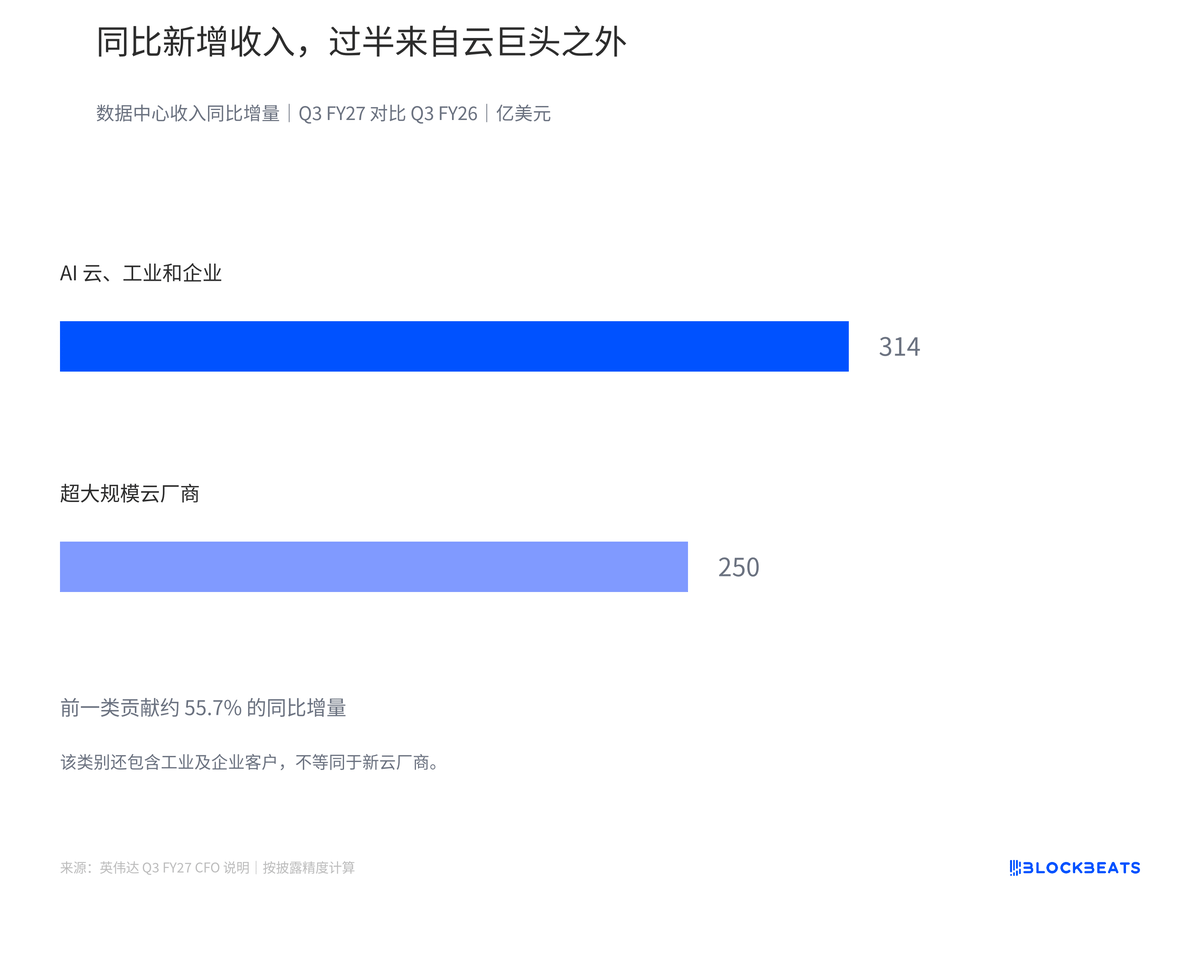
Subtracting the prior-year quarter from the current-quarter figures in the CFO’s remarks, AI cloud, industrial, and enterprise customers accounted for about 55.7% of the increase in data center revenue. In other words, more than half of every additional $100 in sales came from this mixed category. Hyperscale cloud providers remain the larger revenue category, but more of the year-over-year increase has come from outside that group. This calculation measures the increase in revenue; it cannot establish whether any individual customer relies on NVIDIA financing.
The result is different when compared with the previous quarter. Hyperscale cloud providers accounted for about 61.3% of the quarter-over-quarter increase in data center revenue. The longer-term comparison shows that the customer base is expanding, while the shorter-term comparison shows that cloud giants are still driving deliveries in the latest quarter. Both trends are happening at the same time.
On the conference call, interim CEO and CFO Colette Kress said that shipments of the next-generation Vera Rubin platform had begun, and that the AI cloud, industrial, and enterprise category was also benefiting from purchases by new cloud providers and frontier-model labs building their own data centers. For NVIDIA, having more buyers creates more sales opportunities, but it also makes whether customers’ data centers and funding are ready part of the delivery equation.
Kress also raised the next fiscal year’s expected year-over-year revenue growth from about 70% to about 75%, saying the assessment took customer demand, supply, and customers’ ability to obtain financing into account. This is management’s view of the scale of future deliveries, and customer financing conditions are part of its assessment. The forecast should not be treated as revenue already recognized.
Why is gross margin guidance falling even as sales increase?
The midpoint of the company’s revenue guidance for next quarter is $130 billion. However, next quarter has one more week than a typical quarter, so the entire quarterly increase cannot be taken to mean that sales are accelerating over the same amount of time.
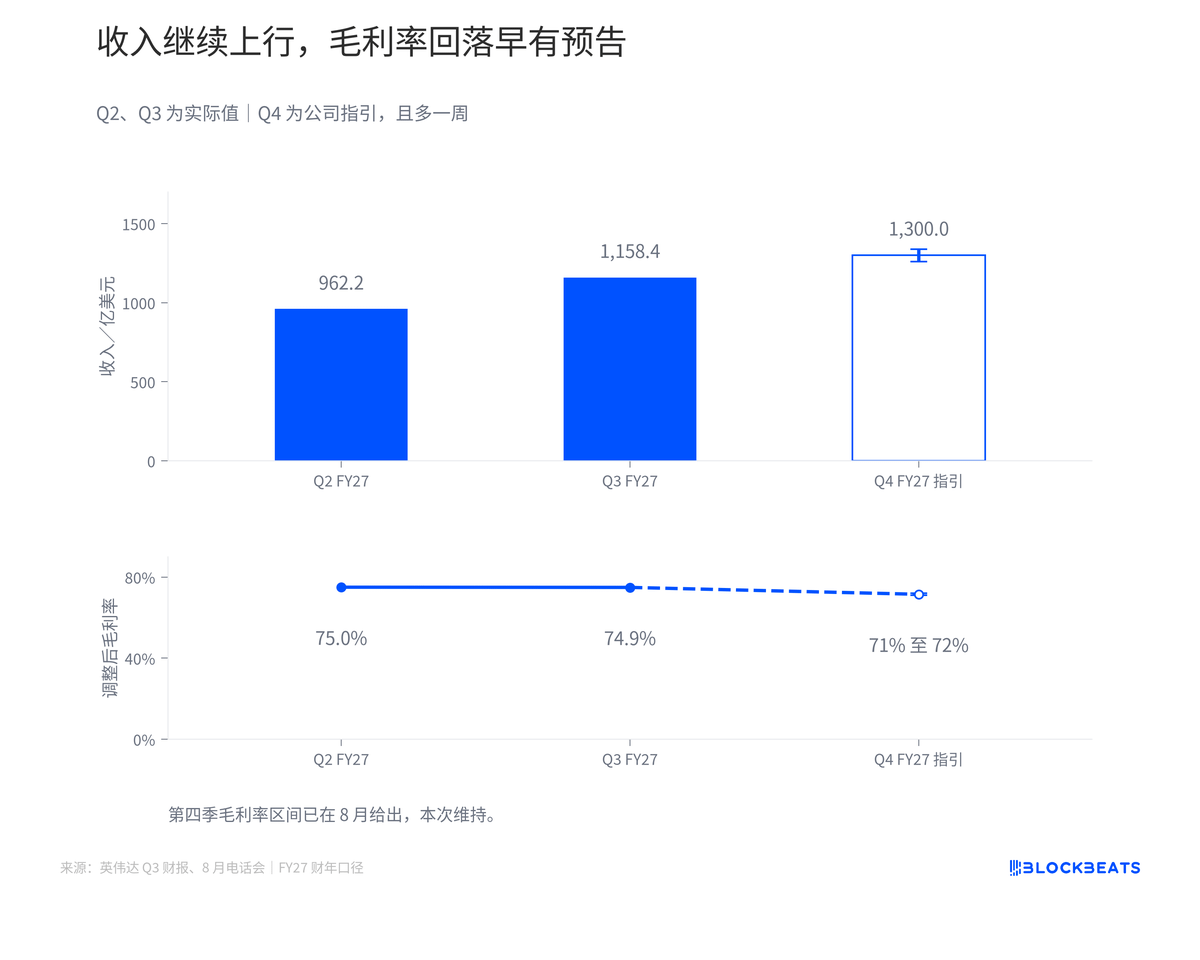
Gross margin is moving in the opposite direction, with next-quarter guidance of 71% to 72%. This range was already given last quarter. According to the edited transcript of the August conference call hosted on NVIDIA’s website, Kress explained at the time that price increases for components such as memory had exceeded earlier expectations, requiring the company to revise its gross margin expectations. Demand growth can boost chip sales while intensifying competition for scarce components, so sales momentum and procurement pressure can rise at the same time.
In this Q&A, Kress again mentioned the time lag between old orders and new pricing. Existing purchase orders still have to be fulfilled, while the effects of price adjustments will show up later. This explains how management views the period of margin changes, but it does not prove that all subsequent cost increases can be passed on to customers.
A decline in gross margin means less gross profit is left for every $100 in sales. Gross profit may still increase if total sales grow enough. To assess changes in profit, we also need to deduct expenses such as research and development, sales, and administration; this percentage alone is not enough.
What does customer expansion require NVIDIA to take on?
To deliver more systems, NVIDIA first has to commit to purchases from suppliers. To help some customers build data centers, it is also involved in another type of arrangement, supporting financing for land, power, building shells, and hardware. All of these matters are related to expansion, but their spending timelines and triggering conditions differ.
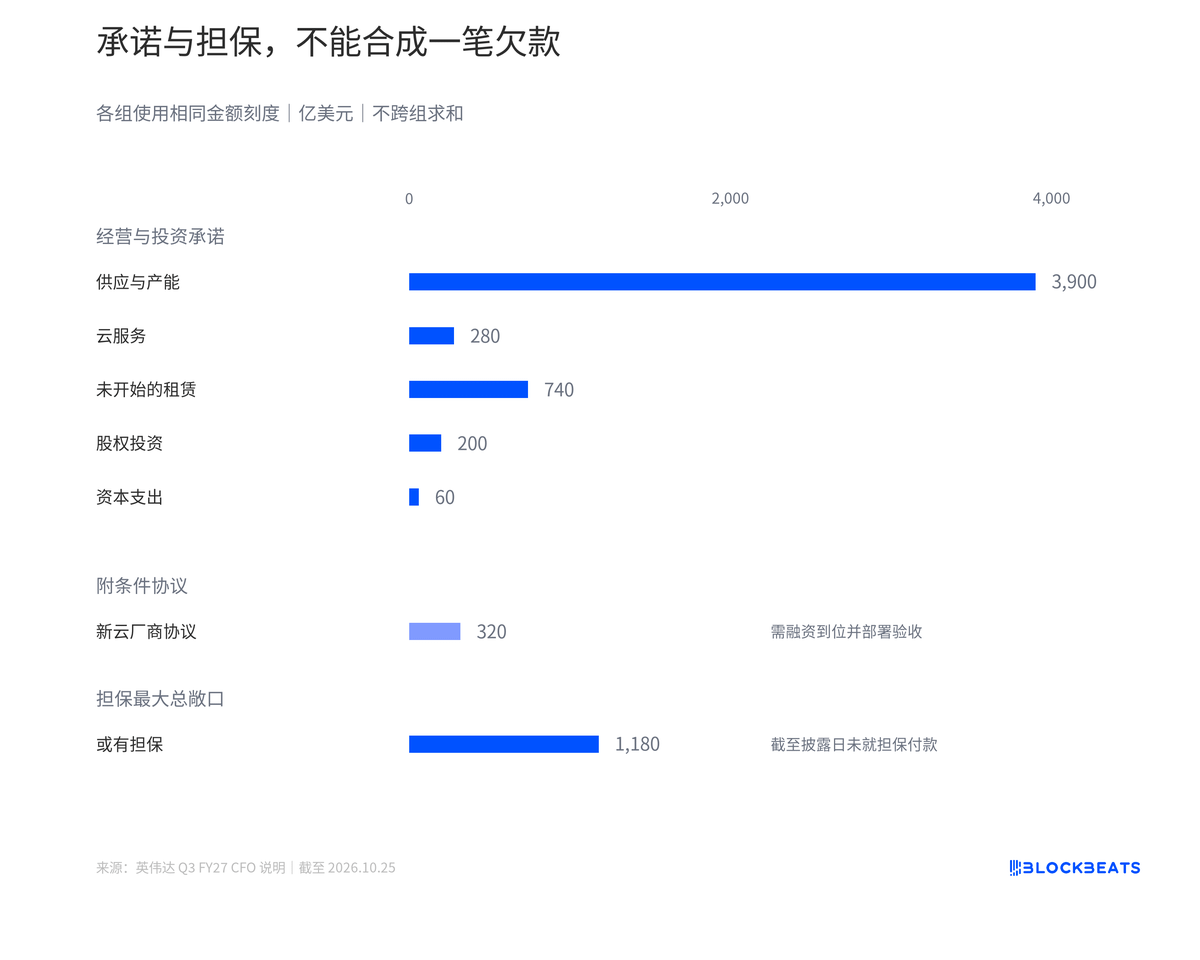
Supply and capacity commitments increased by about 40% in one quarter. The company said the increase mainly came from multi-year storage purchases. Securing supply in advance is preparation for turning future demand into actual shipments, while also tying procurement plans more closely to future sales. Whether orders can be delivered as expected will affect the economics of these arrangements.
The agreements with new cloud providers come with conditions. Customers must first secure financing to purchase infrastructure, and the related computing capacity must be deployed, brought online, and pass NVIDIA’s acceptance checks. NVIDIA’s commitment takes effect only after these conditions are met. The company sells equipment upfront and, when the conditions are met, shares in the revenue customers generate by renting out computing capacity. This creates a deeper link between equipment sales and the subsequent operation of computing capacity.
When analysts pressed on whether this meant the business model had changed, Kress said the relevant conditions had already existed and that this time they had been spelled out more clearly. Based on this response, it is fair to say the company emphasized the financing and delivery conditions; it would not be accurate to say that NVIDIA has comprehensively tightened its support for new cloud providers.
Guarantees are another matter. The company disclosed a maximum total exposure of $118 billion. This represents potential payment obligations that could be triggered if relevant partners default; it is neither cash already spent nor an expected loss. The largest component takes effect in stages as buildings are completed and become available for use. The company said it had made no guarantee payments as of the disclosure date.
The third chart therefore groups different arrangements separately. Purchases are commitments to buy goods in the future, leases relate to the use of infrastructure, and guarantees involve taking on payment obligations for partners if certain conditions are met. All are worth tracking, but they cannot be added across categories and treated as a single debt due immediately.
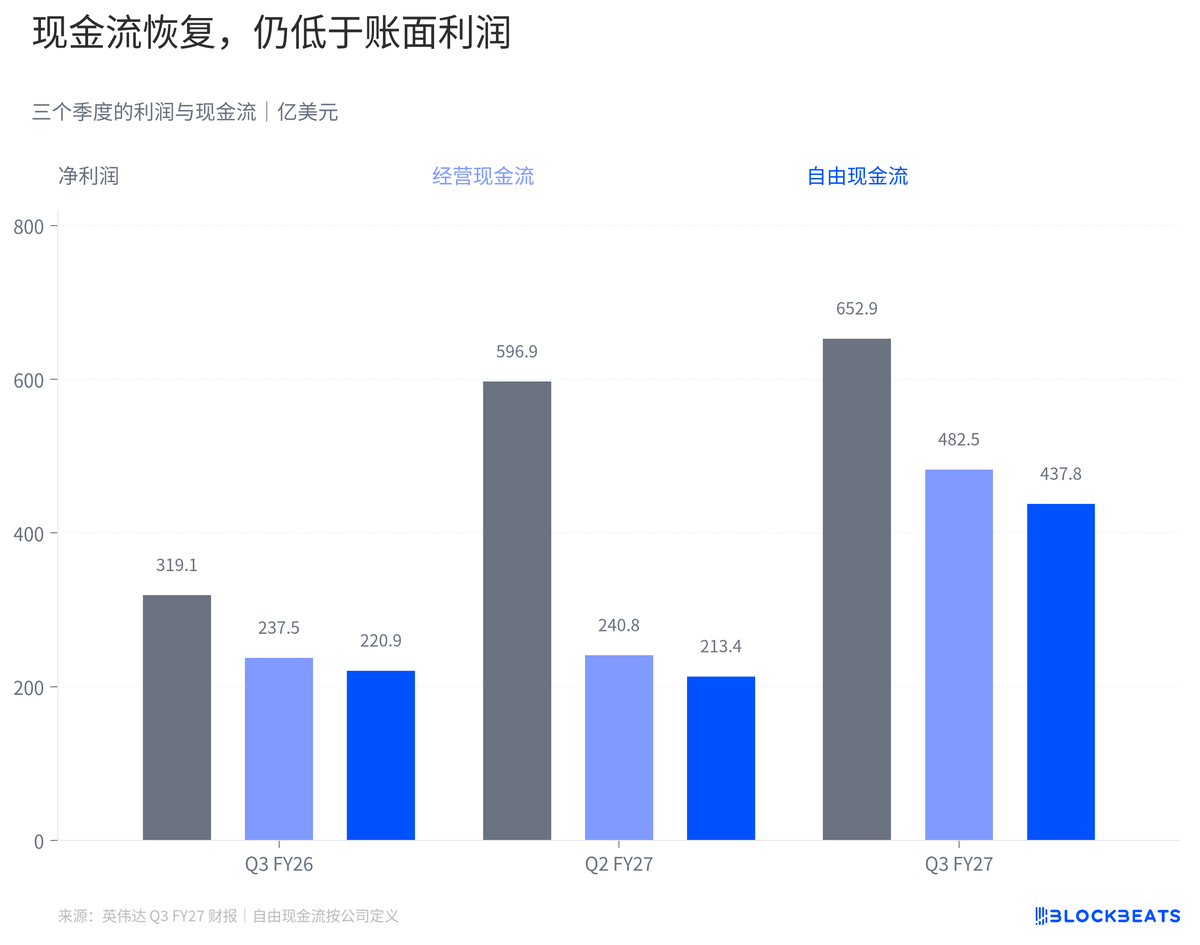
NVIDIA’s own cash flow is also growing. According to the company, free cash flow this quarter was about $43.8 billion, equivalent to roughly two-thirds of net income on the books for the same period. This measure deducts purchases of property and intangible assets, as well as related principal payments, from operating cash flow. It comes closer to representing the discretionary cash generated under the company’s definition, but it is still not the balance remaining after all strategic investments.
The gap between cash and profit can also be examined through working capital. Supplemental financial materials show that changes in accounts receivable and inventory both used operating cash this quarter. Cash flow and profit are recognized at different times when equipment has been sold but payment has not yet been collected, or when systems are still in production. The company also noted that the rebound in operating cash flow from the prior quarter was affected by the timing of federal cash tax payments, so the quarterly ratio alone is not enough to assess collection quality.
NVIDIA’s recognized equipment revenue and the obligations it takes on in connection with customers’ future computing operations fall on different timelines.