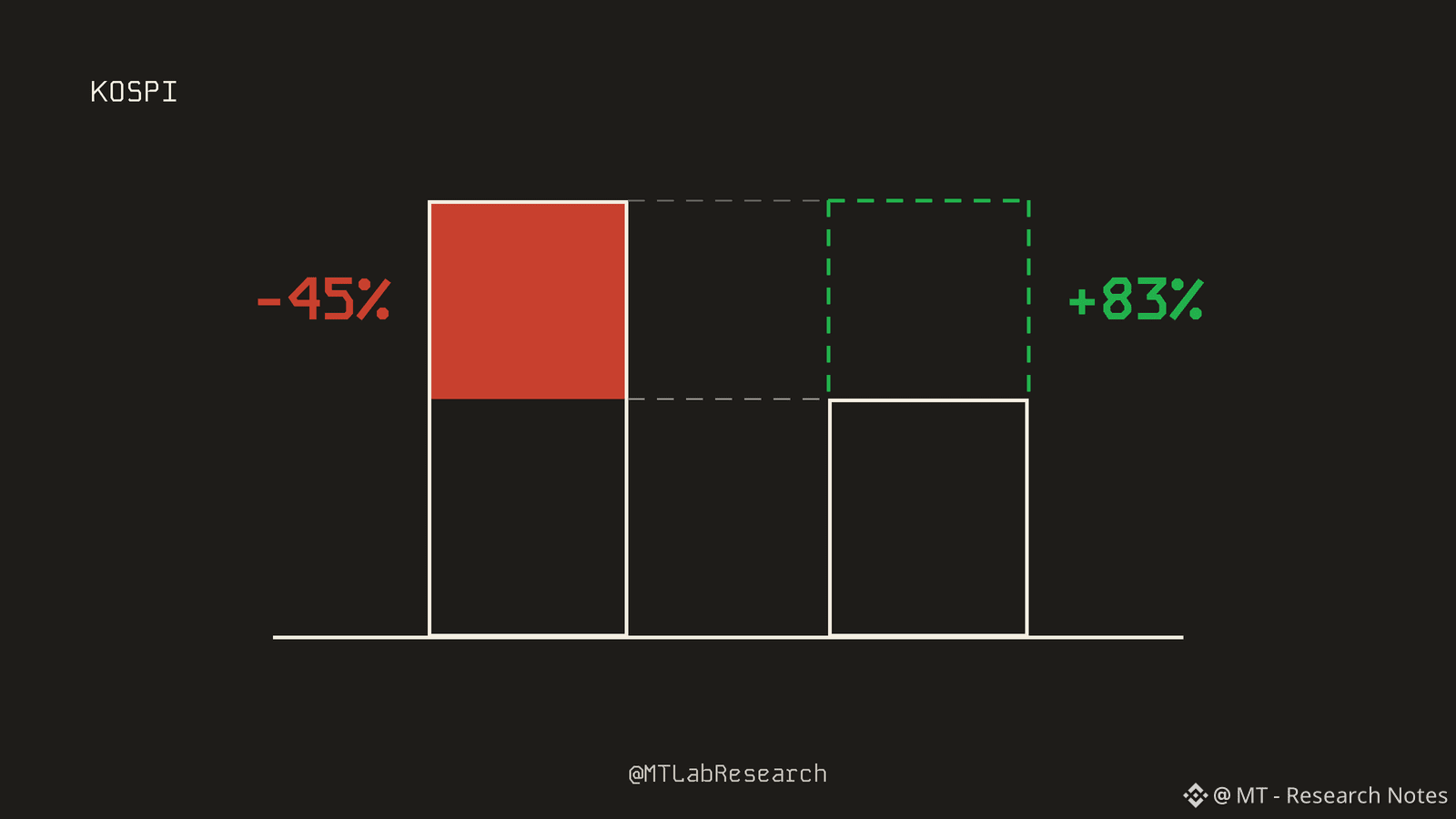
South Korea's stock market has lost almost half its value in 5 months!
On Nov 17 its main index, the KOSPI, closed at 4,968, down 2.59%. It is the first close under 5,000 since Feb 2 and the fourth drop in a row. The record close was 9,114 on Jun 22, so the index is down about 45% (Seoul Economic Daily).
Here is what is pressing on it:
- Foreign investors sold about 1.4 trillion won of shares in one day, roughly $1.1B by my math
- Doubts about AI chip demand, with Samsung down 3.3% and SK hynix down about 2%
- US 10-year yields back above 5%, which pulls money out of riskier markets
- Nvidia's founder-CEO Jensen Huang resigned on Nov 12, and Nvidia reports earnings at about 21:20 UTC on Nov 17, after Seoul closed
Why it is more than a bad day? On paper the market looks cheap: about 3.5 times expected earnings next year (the "forward P/E", price divided by profit forecasts). But that number only holds if the forecasts hold.
The usual dip buyers are running low too. Korean retail cash waiting on the sidelines is about 87 trillion won, down from the 130 trillion range at the peak. And Samsung and SK hynix were about half the index's value in July (Forklog), so two stocks can drag everything.
A 45% drop sounds like a discount. By my math, getting back to the June record needs a gain of about 83%.
What scenarios can we expect?
- If foreign selling slows and US yields ease, the bleeding can slow
- If yields keep rising or AI chip news stays shaky, the pressure stays
- Nobody knows which. Brokers that saw 10,000 in June now mostly target about 8,000 for next year
Three habits I practice from this:
1. Cheap is a forecast, not a floor
2. Ask who is buying the dip, and how much cash they have left
3. When two stocks are half an index, it is really one big bet
Foreign selling, US yields or Nvidia,: which one would you watch first?
Experience, not financial advice.
#KOSPIFalls2.59%ToLowestCloseSinceFebruary