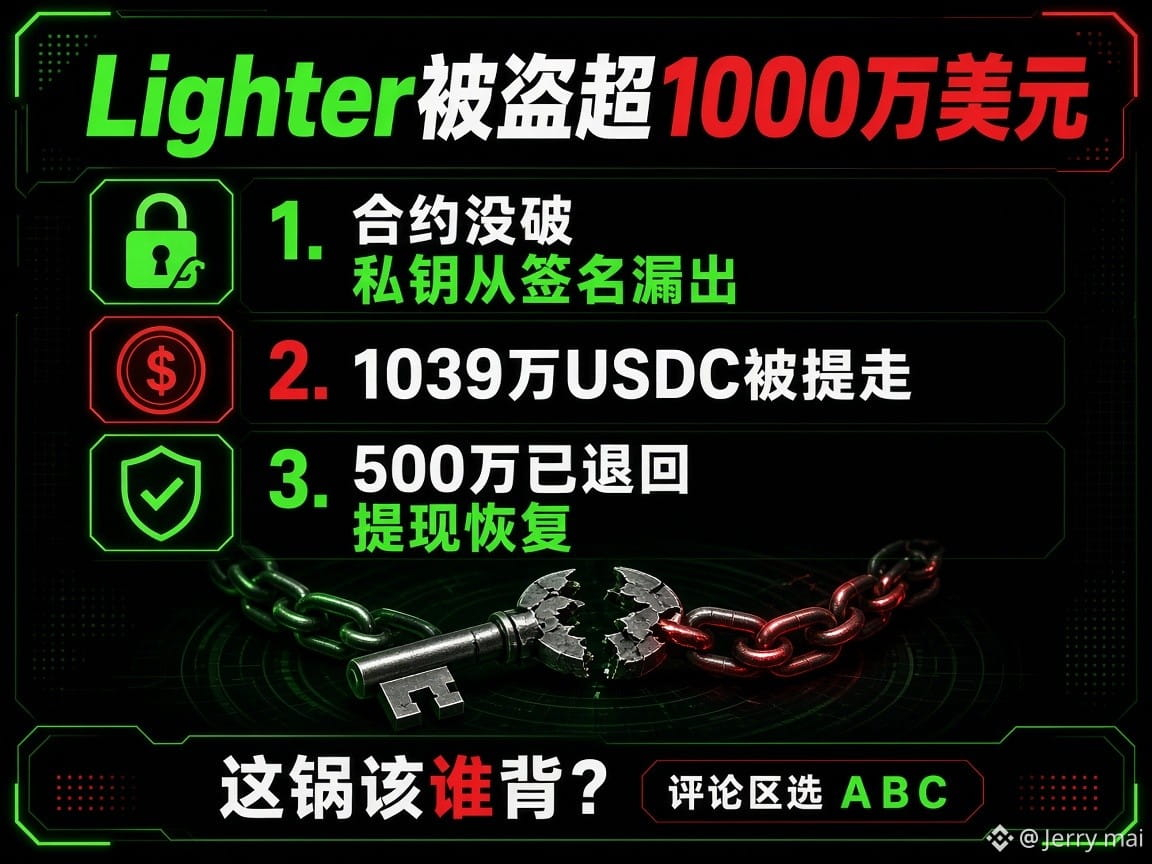
More than $10 million was stolen from Lighter. The contract wasn’t breached—the private key leaked from the platform’s own signatures.
The perpetual DEX Lighter had an incident yesterday.
On November 16, Lighter suspended all withdrawals. The official statement was measured: there was nothing wrong with the protocol, contracts, or infrastructure. A trader’s API key had been leaked, and the team also published a wallet address believed to belong to the attacker.
Third-party data painted a less reassuring picture.
Bitquery tracked about 10.39 million USDC being withdrawn from Lighter’s Ethereum contract and swapped for $ETH within minutes. Then 1,920 ETH was split among 12 wallets and sent to Hyperliquid to buy a token called XMR1.
Some researchers also estimated that two market-making accounts lost a combined total of about $15.48 million—a figure Lighter has yet to acknowledge.
$LIT fell as much as 16% that day, triggering about $3.43 million in liquidations. Upbit and Bithumb suspended LIT deposits and withdrawals.
A later postmortem showed that the incident was more complicated than a simple leak.
The compromised account didn’t use the official SDK. It used custom signing code that repeatedly reused the same nonce. The signatures were publicly visible, so the attacker was able to calculate the private key directly from public data.
A lot of people see the words “the contract is fine” and assume the platform had nothing to do with it.
The contract not being breached doesn’t mean the platform isn’t responsible.
Lighter made several changes afterward. Transfers to public pools now require a wallet signature, API signatures are no longer public, and IP allowlisting and nonce-reuse monitoring are being added. These patches themselves show that the original design had a vulnerability.
What’s been confirmed is that after the Guardian mechanism was triggered, about 5 million USDC was returned to the affected trader, and withdrawals have resumed.
What hasn’t been confirmed is whether the total loss was $10.4 million or $15.48 million, whether the remaining funds can be recovered, or who the attacker was. We’ll have to wait for more information.
DEXs are increasingly starting to look like CEXs: API trading, market makers, and quant bots are all moving on-chain. Things are getting faster, but the boundaries of security responsibility are still very blurry.
If the user wrote bad code and the platform made the signatures public, who should take the blame...?
How do you think responsibility should be divided in this case?
A. The market maker is responsible. They shouldn’t have skipped the official SDK.
B. The platform is also responsible. Signatures should never have been public.
C. Both are responsible, but the platform should cover the losses upfront.
#Lighter #DeFi #加密安全
The perpetual DEX Lighter had an incident yesterday.
On November 16, Lighter suspended all withdrawals. The official statement was measured: there was nothing wrong with the protocol, contracts, or infrastructure. A trader’s API key had been leaked, and the team also published a wallet address believed to belong to the attacker.
Third-party data painted a less reassuring picture.
Bitquery tracked about 10.39 million USDC being withdrawn from Lighter’s Ethereum contract and swapped for $ETH within minutes. Then 1,920 ETH was split among 12 wallets and sent to Hyperliquid to buy a token called XMR1.
Some researchers also estimated that two market-making accounts lost a combined total of about $15.48 million—a figure Lighter has yet to acknowledge.
$LIT fell as much as 16% that day, triggering about $3.43 million in liquidations. Upbit and Bithumb suspended LIT deposits and withdrawals.
A later postmortem showed that the incident was more complicated than a simple leak.
The compromised account didn’t use the official SDK. It used custom signing code that repeatedly reused the same nonce. The signatures were publicly visible, so the attacker was able to calculate the private key directly from public data.
A lot of people see the words “the contract is fine” and assume the platform had nothing to do with it.
The contract not being breached doesn’t mean the platform isn’t responsible.
Lighter made several changes afterward. Transfers to public pools now require a wallet signature, API signatures are no longer public, and IP allowlisting and nonce-reuse monitoring are being added. These patches themselves show that the original design had a vulnerability.
What’s been confirmed is that after the Guardian mechanism was triggered, about 5 million USDC was returned to the affected trader, and withdrawals have resumed.
What hasn’t been confirmed is whether the total loss was $10.4 million or $15.48 million, whether the remaining funds can be recovered, or who the attacker was. We’ll have to wait for more information.
DEXs are increasingly starting to look like CEXs: API trading, market makers, and quant bots are all moving on-chain. Things are getting faster, but the boundaries of security responsibility are still very blurry.
If the user wrote bad code and the platform made the signatures public, who should take the blame...?
How do you think responsibility should be divided in this case?
A. The market maker is responsible. They shouldn’t have skipped the official SDK.
B. The platform is also responsible. Signatures should never have been public.
C. Both are responsible, but the platform should cover the losses upfront.
#Lighter #DeFi #加密安全