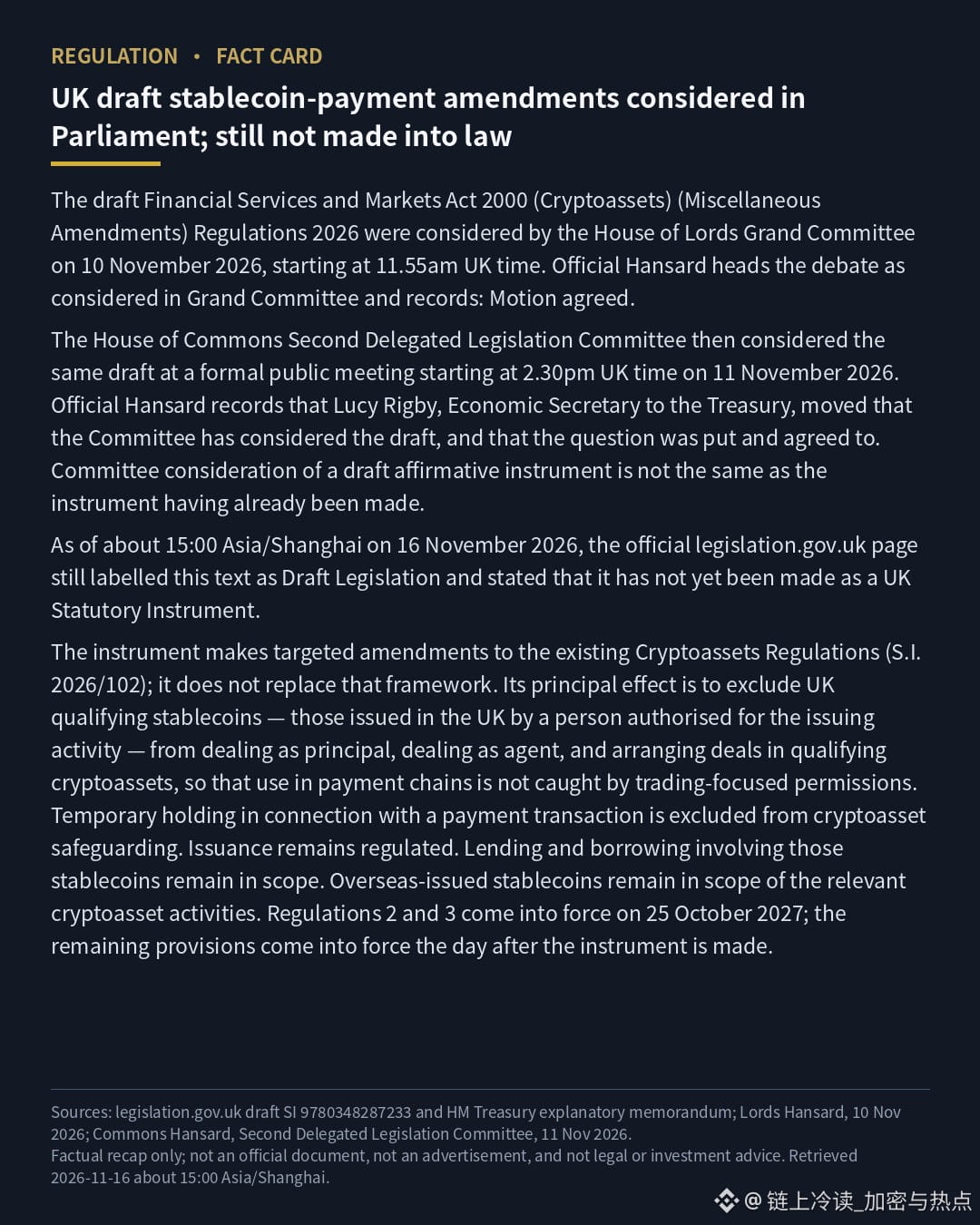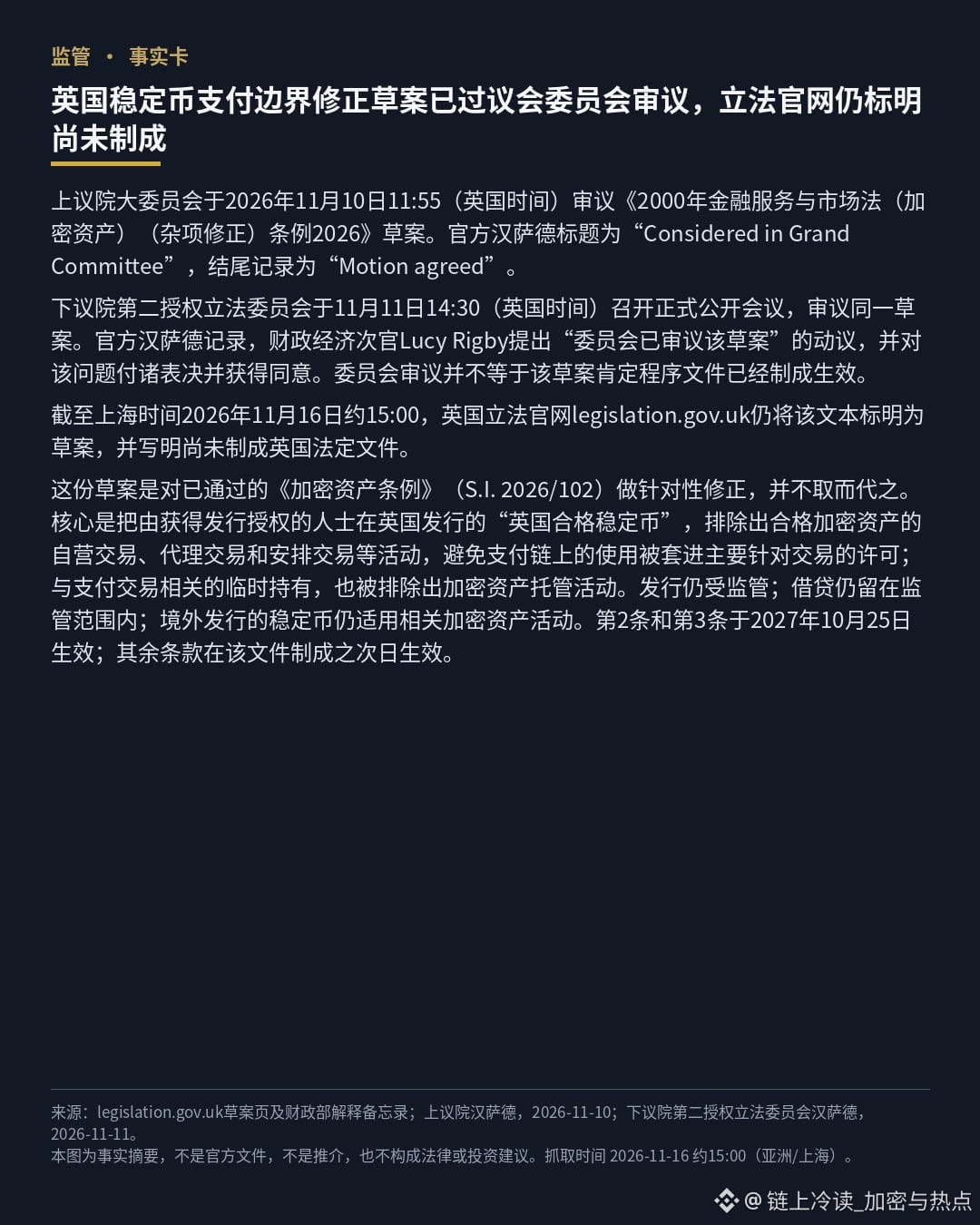
The UK House of Commons Second Delegated Legislation Committee considered the draft Financial Services and Markets Act 2000 (Cryptoassets) (Miscellaneous Amendments) Regulations 2026, submitted by the Treasury, on 11 November at 14:30 (UK time, approximately 22:30 in Shanghai). The official Hansard record shows that the question on the draft was put to a vote and agreed to. Previously, the House of Lords Grand Committee considered the same draft on 10 November at 11:55 (UK time, approximately 19:55 in Shanghai), recording that the motion was agreed to. This is committee consideration under the draft’s affirmative procedure; it does not mean that the instrument has been made or has come into force. As of approximately 15:00 Shanghai time on 16 November, the UK legislation website still lists it as a draft and states that it has not yet been made as a UK statutory instrument.
This draft does not replace the Cryptoasset Regulations approved by Parliament earlier this year; it makes targeted amendments to that framework. The main change is that “UK qualifying stablecoins” issued in the UK by persons with the relevant authorisation will be excluded from activities such as dealing in qualifying cryptoassets as principal or agent, and arranging deals in them. This avoids bringing their use in payment chains within licensing requirements aimed primarily at trading. Temporary holding related to payment transactions will also be excluded from cryptoasset custody activities. The official explanatory material also states that issuance will remain regulated; lending involving these stablecoins will remain within the regulatory perimeter; and the relevant cryptoasset activities will continue to apply to stablecoins issued overseas. The draft specifies that regulations 2 and 3 will come into force on 25 October 2027; the remaining provisions will come into force on the day after the instrument is made.
My view is that this draws a distinction between UK qualifying stablecoins, whose issuance is already regulated, when used for payments and cryptoassets used for trading. It also provides a link to future payment-regulation reforms. It should not be described as the UK having fully liberalised stablecoin payments, nor should it be suggested that overseas stablecoins have received the same exclusion. The next steps to watch are whether both Houses complete formal approval and when the Treasury formally makes the statutory instrument. Are you more concerned about whether payment firms will still need a separate cryptoasset licence after it is made, or whether overseas stablecoins will continue to be regulated as trading-related activities?