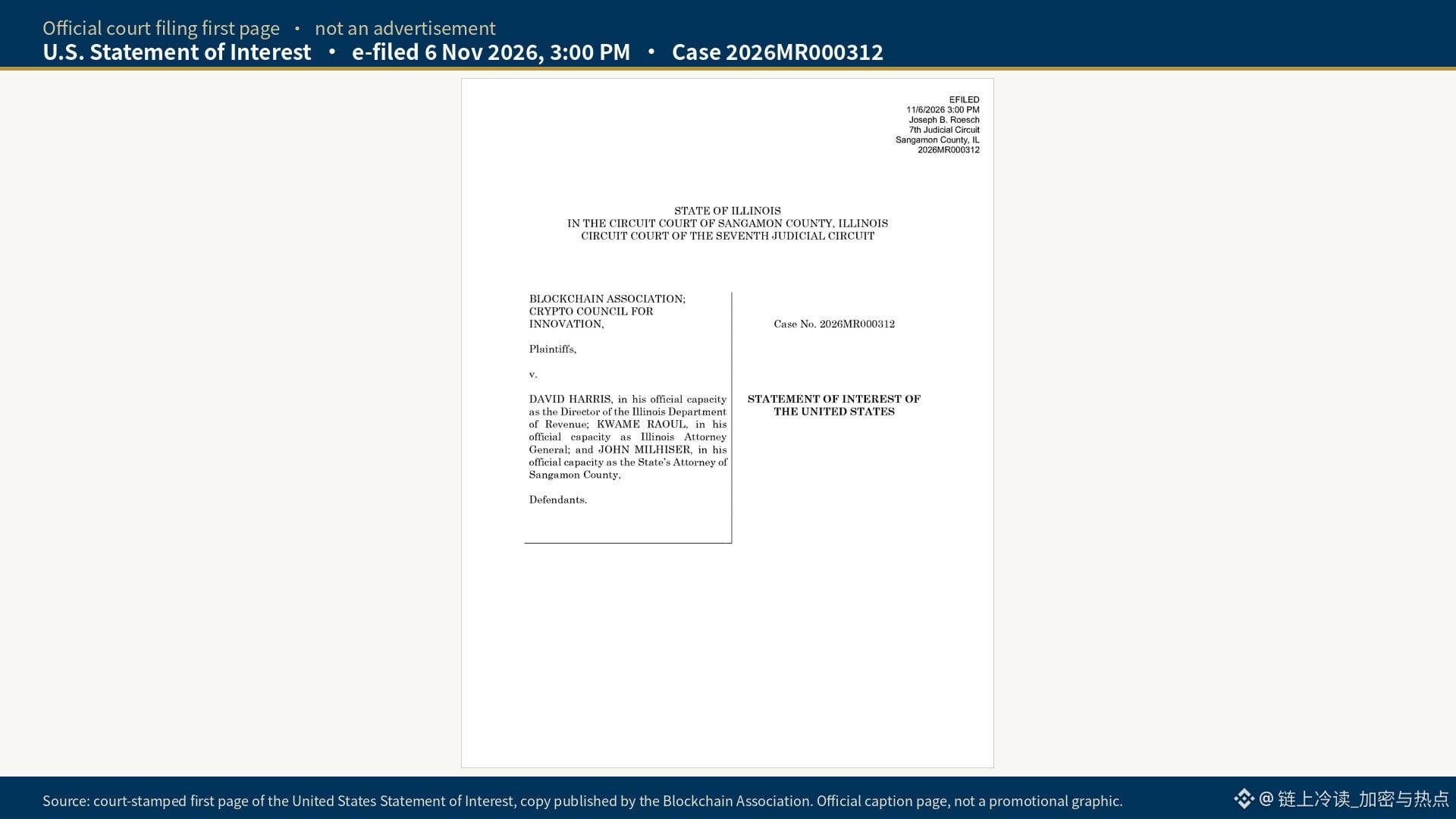
At 15:00 on November 6 (local time), the U.S. Department of Justice electronically filed a Statement of Interest in the Seventh Judicial Circuit Court of Sangamon County, Illinois, in case No. 2026MR000312, supporting the Blockchain Association and the Crypto Innovation Council’s challenge to the Digital Assets Tax Act. The DOJ stated that the law threatens U.S. leadership in digital assets by treating them unfavorably and imposing burdensome and arbitrary liabilities, and asked the court to reject Illinois’s approach. This is a Statement of Interest filed under 28 U.S.C. §517, not a court ruling, and it does not mean the tax has been repealed.
At 15:20 the same day, the U.S. Chamber of Commerce and the Securities Industry and Financial Markets Association (SIFMA) electronically filed motions for leave to file amicus curiae briefs immediately in two related cases (2026-MR-000271 and 2026-MR-000312). A coalition represented by the DeFi Education Fund, Andreessen Horowitz, Paradigm, and Uniswap, among others, also filed a motion for leave to submit an amicus brief dated November 11; its certificate states that it was served the same day. The Blockchain Association publicly announced these filings on November 12.
The statutory text cited by the DOJ states that the Digital Assets Tax Act is Title III of Public Act 104-0468, with a statutory effective date of January 1, 2027. It imposes a tax of 0.2% of the value of the relevant digital assets on commercial activity involving digital assets by customers in Illinois, covering exchanges, transfers, and storage, and requires digital asset brokers to collect the tax; brokers remain liable if they fail to collect it. The DOJ noted that this differs from traditional taxes on income, gains, or sales, and could also tax transfers where no change of ownership occurs.
In a joint scheduling motion filed on October 13, 2026, the defendants agreed to suspend the tax’s effectiveness and enforcement until July 1, 2027. The plaintiffs asked the court to rule by March 1, 2027, if possible; that deadline is still subject to court approval. No decision on the merits has been issued. Do you think that a 0.2% tax on the full asset value, potentially covering storage and transfers, would in practice place more of the burden on brokers or users?