

The only three Latin American economies that are members of Asia-Pacific Economic Cooperation (APEC) will be represented by their respective presidents.
Mexico, Chile, and Peru are attending the upcoming Asia-Pacific Economic Cooperation (APEC) leaders’ summit with the main challenge of navigating trade tensions between the United States and China without losing access to either market.
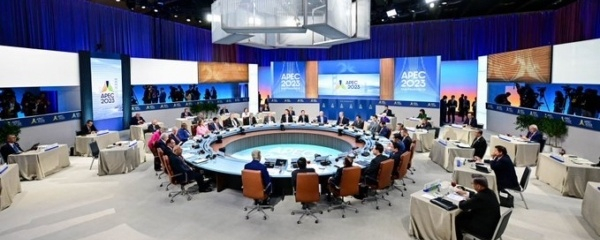
The only three Latin American economies that are members of APEC will be represented by their respective presidents at a summit to be held on November 18 and 19 in the Chinese city of Shenzhen.
Strengthening ties with Asia and becoming the gateway to Latin America for other APEC partners, such as India, Japan, Indonesia and Vietnam, is another challenge facing these three countries, which together account for more than 40% of Latin America’s GDP.
APEC Policy Support Unit Director Carlos Kuriyama told EFE that Mexico, Chile and Peru’s participation «will be very positive» and that the three «want to have good relations with the world’s major economies».
«Peru and Chile have diversified their economies in terms of foreign trade more than Mexico has, and the fact that both presidents are coming is a sign of commitment to APEC», he said.
In Mexico’s case, he added, «it is very positive that APEC is the first major summit attended by President (Claudia) Sheinbaum», since «one of her priorities is to diversify her trading partners».
Mexico seeks to regain prominence
The Mexican president will attend the summit on what will be her first trip to China since taking office in October 2024, as part of her goal of restoring the prominence Mexico lost on the international stage during the isolationist six-year term of her predecessor, Andrés Manuel López Obrador (2018–2024).
Sheinbaum has already confirmed a bilateral meeting with Chinese President Xi J1np1ng and said the China summit is especially significant because Mexico will host the forum in 2028.
«Strengthening trade and investment operations and reducing tensions around the world is what Mexico would like to do, and what we will put on the table [at APEC]», Economy Secretary Marcelo Ebrard told EFE last week.
The meeting between Sheinbaum and Xi will take place amid trade tensions, after Mexico approved tariff increases of up to 50% in 2025 on various products from countries with which it has no free trade agreements, including the Asian giant.
The progressive president, who will also meet with Canada, Vietnam and Australia, has defended relations with Beijing, while stressing that Mexico’s trade is primarily integrated with that of the United States and Canada, its partners in the North American trade agreement (USMCA), which is under review this year.
Kast between China and the US
Chilean President José Antonio Kast will also make his debut at this forum, which brings together 21 economies that account for nearly 67% of Chile’s trade and receive around 75% of exports from the world’s leading copper producer.
It will also be the ultraconservative leader’s first official trip to China since he came to power in March and, although there has been no official confirmation, local media assume he will meet with Xi.
Kast is one of US President Donald Trump’s main ideological allies in the region, and there is great interest in how the American president will respond to a possible bilateral meeting.
Maintaining the delicate balance between China, Chile’s main trading partner, and the United States, its largest foreign investor, is one of Kast’s main diplomatic challenges.
Undersecretary for International Economic Relations Paula Estévez told EFE that Chile seeks to «continue strengthening its trade relationship with Asia-Pacific and, to that end, forums such as APEC are essential».
Chile, one of the countries with the most free trade agreements in the world, will take part in the forum «from a pragmatic and constructive position, focused on identifying areas where collective progress is possible», Estévez noted.
«Amid a reshaping of international trade, Chile will emphasize three principles: promoting an open and integrated Asia-Pacific region; preserving a rules-based multilateral system; and continuing to build cooperation in areas of shared interest», she added.
Peru: new markets
For Peru, the forum is a «fundamental» platform for seeking new markets and increasing trade with APEC’s 21 economies, which account for 67% of Peruvian foreign trade, with China and the United States as its most important partners.
The Peruvian delegation will likely be led by President Keiko Fujimori, whose trip must be authorized by the Senate.
The ultraconservative leader also plans to meet with Xi to discuss the impact of the El Niño climate phenomenon in Peru, as well as with Vietnam’s leader To Lam and Hong Kong’s John Lee.
Fujimori is scheduled to take part in a working meeting with US business leaders organized by the US-APEC Business Coalition.
Peruvian Foreign Minister Carlos Espá reaffirmed last week his country’s commitment to the Putrajaya Vision 2040, which incorporated the themes of digitalization and innovation, inclusive trade and sustainable development, and recognized China’s leadership in guiding the forum’s work under its presidency.