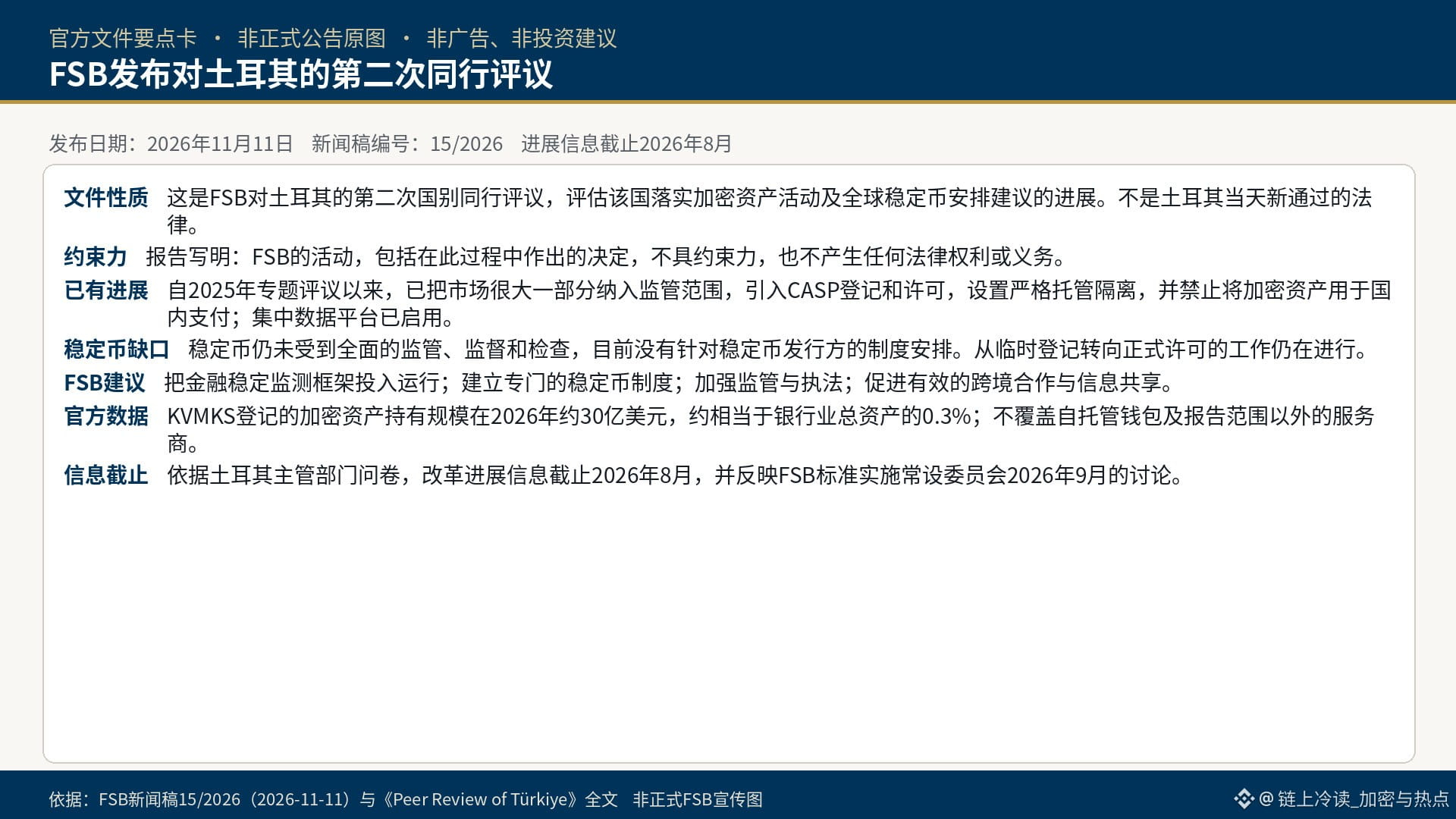
On November 11, the Financial Stability Board (FSB) published its second country peer review report on Türkiye (press release No. 15/2026), assessing the country’s progress in implementing the FSB’s recommendations on crypto-asset activities and global stablecoin arrangements. This is a peer review recommendation, not a new law passed by Türkiye that day, nor does it mean that a dedicated regime for stablecoin issuance is already in place. The report is based on a questionnaire completed by the Turkish authorities; the information it reflects on reform progress is current through August 2026 and also incorporates discussions held by the FSB’s Standing Committee on Standards Implementation in September 2026. The FSB document itself states that its activities, including decisions made in the course of those activities, are non-binding and do not create any legal rights or obligations.
The official press release states that, since the 2025 thematic review, the Turkish authorities have made meaningful progress: they have brought a substantial part of the crypto-asset market within the regulatory perimeter, introduced registration and licensing requirements for crypto-asset service providers (CASPs), put in place structural arrangements including strict segregation of custody assets and a ban on using crypto-assets for domestic payments, and launched a centralized data platform to monitor crypto-asset activity. At the same time, the report itself states that stablecoins are still not subject to comprehensive regulation, supervision, and oversight, and that no regime for stablecoin issuers is currently in place; work to move from provisional registration to full licensing is also ongoing.
The FSB therefore recommends that the Turkish authorities operationalize the financial stability monitoring framework, establish a dedicated stablecoin regime, strengthen supervision and enforcement, and promote effective cross-border cooperation and information sharing. The report cites official Turkish KVMKS data: the value of registered crypto-asset holdings in 2026 was approximately US$3 billion, equivalent to about 0.3% of total banking sector assets. This registration does not cover self-hosted wallets or service providers outside the scope of regulatory reporting. Are you more concerned about the stablecoin issuance regime that has yet to be established, or whether the transition from provisional registration to full licensing can be completed according to a firm timetable?