
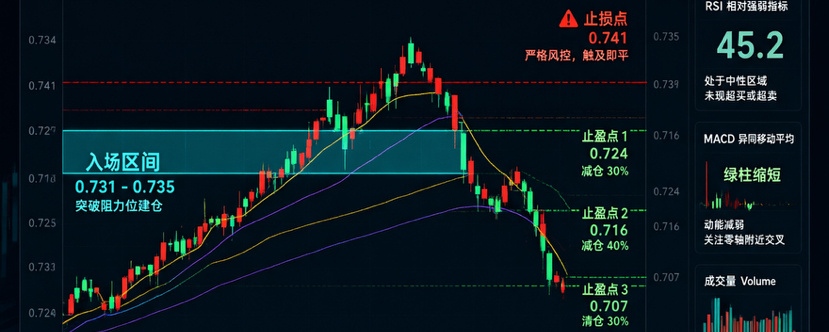

To answer your question directly: as long as there isn’t a 1-hour candle body close above 0.7366, the fourth attempt will most likely get pushed back again—but that doesn’t necessarily mean a sharp plunge. More likely, the price will move sideways until volume dries up, then head lower. The real dividing line isn’t whether it reaches that level for the fourth time, but whether volume and open interest confirm the move when it gets there.
The order book data backs up your observation about that “wall of sell orders.” CoinGlass data shows SUI’s latest price at around $0.7293, with a 24-hour range of exactly $0.6737–$0.7366. In other words, the $0.7356–$0.7366 zone you marked is the absolute high for the day: the price has touched it three times and pulled back three times, hitting the same ceiling each time. More noteworthy is the “makeup” of this rebound: 24-hour contract open interest is around $405 million, the funding rate is −0.0043% (about −4.7% annualized), the taker buy/sell ratio is 0.95, sellers are in control, spot flows show net outflows, and of the $3.01 million liquidated over 24 hours, 87% were long positions. Put simply: price is rising, open interest is falling, funding is negative, and aggressive sellers outnumber buyers. This is a rebound driven by short covering and short position closures, not by new longs entering the market. A typical feature of this kind of rebound is that “there’s no follow-through at resistance.” Getting pushed back after hitting the wall is the norm, not a surprise.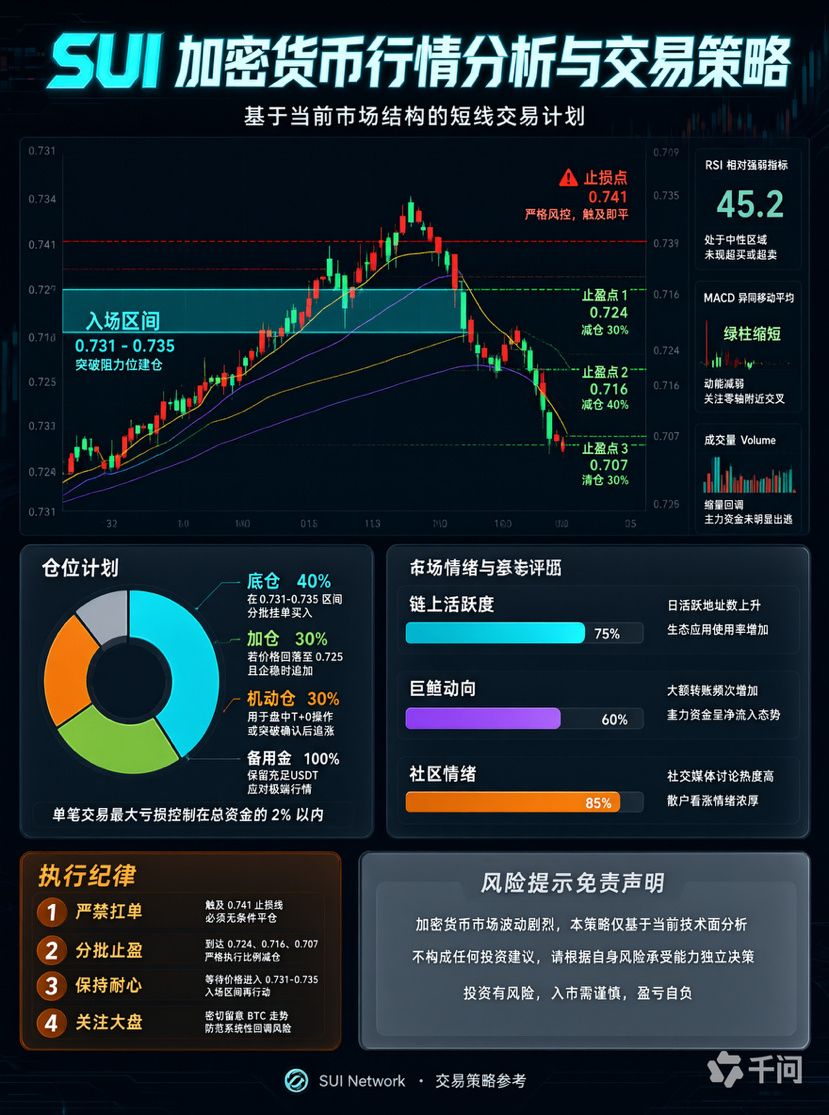
I. Why supply naturally builds up around 0.73
Technically, resistance was already concentrated at this level. One institutional analysis notes that SUI is trading below the MA20 and MA50 on the hourly chart and below the MA200 on the daily chart. The Ichimoku baseline around 0.7306 is the nearest overhead resistance, with support around 0.6726. The short-term trading range is framed at 0.6726–0.7594, and the model puts the probability of a decline well above that of a rise. Your observation that “there are always sell orders above 0.73” overlaps with resistance at the baseline, the intraday high, and a dense trading zone formed during the previous decline—all within the same narrow band. This kind of “triple-confluence zone” usually isn’t taken out in one go.
The medium-term trend isn’t on the bulls’ side either: SUI is down about 10.97% over the past 7 days, about 28.5% over the past 30 days, and about 48% year to date. It is more than 86% below its all-time high of $5.35. In a downtrend, rallies getting capped by selling pressure near previous highs is the default behavior; no additional negative catalyst is needed to explain it.
II. The broader market: the rebound lacks fuel, and altcoins lack it even more
SUI isn’t moving in isolation; it’s floating in a pool that’s shrinking. Bitcoin is currently around $65,000, down about 12.7% over the past 7 days and about 20% over the past 30 days. The Fear and Greed Index reads 11, indicating extreme fear. More importantly, look at the flow of funds: U.S. spot Bitcoin ETFs have seen net outflows for seven consecutive trading days, with cumulative outflows of about $2.1 billion since November. BlackRock’s IBIT has now seen outflows for 11 consecutive trading days. On the macro front, October CPI rose 0.4% month over month and core CPI rose 0.3%, both above expectations. The market is now pricing in nearly a 95% chance of a 25-basis-point rate hike at the December 9 meeting. With “high interest rates + institutional redemptions” as the backdrop, funds are flowing back into major assets or even cash first. Altcoin buying depth is the first layer to be drained.
SUI’s own ecosystem is also weighing on it. The native wallet Suiet announced that it would cease maintenance, and its API service will go offline after November 14. This follows the closure of the hardware wallet Suiball and Phantom ending support for Sui. DeFi TVL has fallen more than 22% in a month to about $413 million, while average daily active users dropped from about 601,000 in November 2025 to about 128,000 this October. There’s been no meaningful relief on the supply side either: SUI remains on a monthly linear unlock schedule, with about 13.15 million tokens unlocked on November 1. Foundation buybacks account for only about 0.02% of circulating supply, nowhere near the same scale as the monthly unlocks.
Of course, there are positive factors too, and it’s important to consider both sides: Sui’s on-chain stablecoin supply has recently recovered about 10% to roughly $538 million. Samsung Wallet plans to integrate USDC on the Sui network, potentially reaching around 82 million devices, and the Verifiable Agent Arbiter, developed in partnership with Google Cloud, has also launched. But these are “medium-term adoption” narratives and have almost no impact on the supply wall capping tonight’s move at 0.7366.
III. I think the logic behind your short setup holds up
Let’s break down the risk-reward of your plan: entering around 0.733, with a stop-loss at 0.741, means about 1.1% risk. The three take-profit levels—0.724 / 0.716 / 0.707—represent gains of about 1.2% / 2.3% / 3.5%, respectively. That means the first target is close to 1:1, the second is about 2:1, and the third is over 3:1. This is a well-structured short: the stop is set just above the level that price has failed to clear three times, placing it where the thesis is invalidated rather than where it feels psychologically comfortable.
I fully agree with several details and want to emphasize them further:
Scaling in is the right approach. Opening with 30% of the position and adding on a bounce near 0.734 is essentially trading “price confirmation” for “position safety.” Placing a limit order below resistance versus waiting for a retest before entering differs in that the latter can filter out some false signals ahead of a direct breakout.
Taking half off at TP1 and moving the stop up to your entry price is the most important part of this plan. 0.724 is only the first target. Once you’ve eliminated the cost risk on the remaining position, the moves to 0.716 and 0.707 are the parts where you’re truly “using the market’s money to take a shot.” In thin weekend liquidity, one wick can erase your unrealized gains, so taking half off first respects the market structure.
Keeping leverage low is essential. The 24-hour range is 0.6737–0.7366, a swing of nearly 9%. With volatility like this, highly leveraged positions have very little chance of surviving, and SUI futures have far less depth than BTC, so slippage will further reduce the precision of your stop-loss.
IV. Two costs to account for and the invalidation boundary
First, shorting with a negative funding rate costs you money. SUI’s current funding rate is negative (about −0.0043%), meaning shorts pay longs, at an annualized rate of about −4.7%. The daily cost is small, but if you plan to hold through the weekend to 0.707, factor this fee into your risk-reward calculation in advance, especially since reaching the third target requires a longer holding period.
Second, follow your invalidation conditions strictly—don’t move the goalposts. Your rule is clear: if the 1-hour candle closes and holds above 0.737, that means price has broken through the level it failed to clear three times, invalidating the short thesis. I’d add an earlier warning signal: if price approaches 0.735 again and volume rises significantly while futures open interest also increases (unlike this time, when open interest fell), that would suggest new longs are pressing against resistance rather than shorts being forced to cover into it. In that case, even without a close above 0.737, you should reduce the test position first. The biggest risk in shorting isn’t breaking through your stop—it’s “the thesis changing before price reaches your stop.”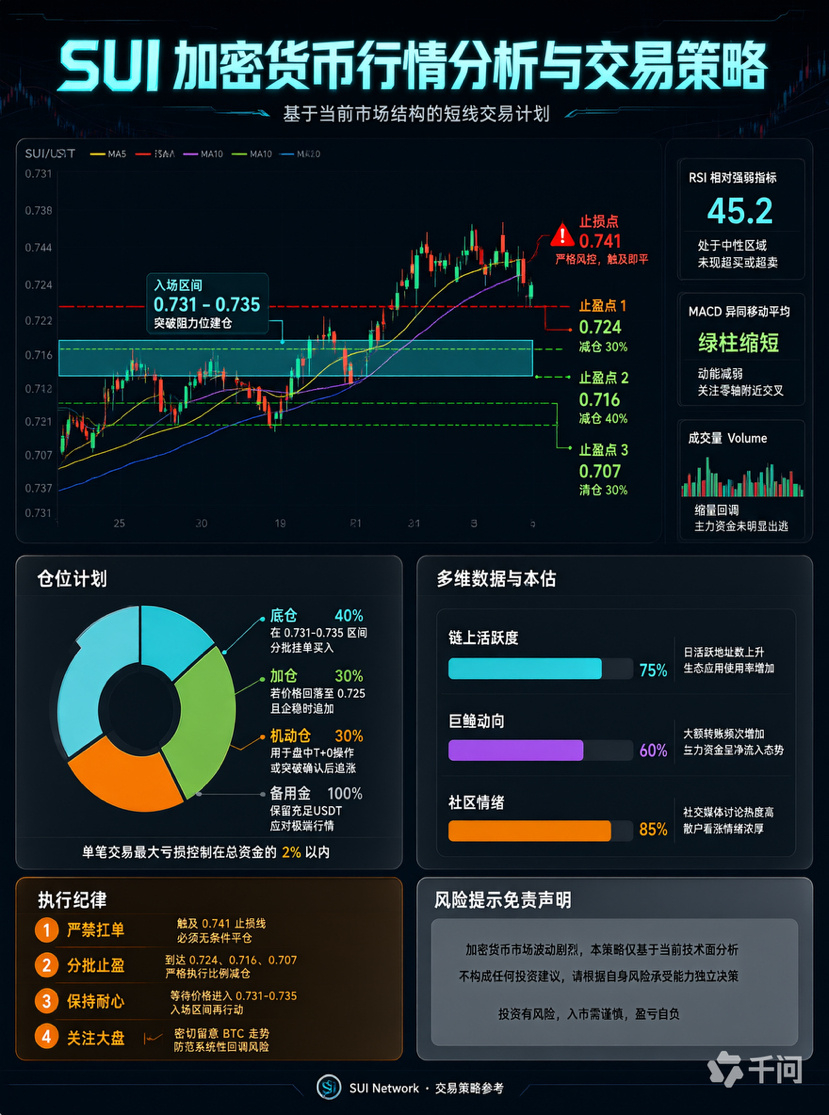
V. Risk analysis: be prepared for both directions
Upside risk (against your position). First, there’s the momentum of an oversold rebound: the market is in extreme fear, and BTC has already had a 2.5% single-day rebound. If major coins continue to recover, SUI could rise even more as a high-beta asset. Second, the combination of negative funding and 80% of liquidations coming from longs suggests leveraged longs have just been flushed out. If the price rebounds sharply, the fuel for a short squeeze is already there. Third, weekend liquidity is thin and one side of the order book may be shallow, so there’s a meaningful chance of a wick piercing 0.741 before falling back. Consider triggering the stop using mark price, or widening it slightly to 0.742–0.743 and using a smaller position to absorb the risk, so a single wick doesn’t knock you out of a sound trade thesis.
Downside risk (in your favor, but don’t get carried away). If 0.707 breaks decisively, the next reference level is around 0.6726, near the day’s low. A break there would put the year’s low back in play. But keep in mind that the first move below key support is often the fastest and most prone to a V-shaped recovery. Don’t get greedy and hold for some imagined “even lower” level beyond your third target.
Execution risk. In extreme conditions, altcoin perpetuals can see widening spot-futures spreads, sudden funding rate shifts, and exchange throttling. Scaling into positions and taking profits in stages are ways to manage these risks. Don’t change the plan to enter or exit all at once just to “make a little more.”
VI. My overall view
On tonight’s fourth test of 0.7366, I lean toward another rejection. The reason is that this rebound is too weak: open interest is falling, funding is negative, aggressive selling is dominant, and spot flows are net negative. Add the medium-term pressure from the ecosystem and capital flows, and what’s missing is “follow-through buying,” not “the courage to try again.” But I wouldn’t treat this as a sure thing. If BTC continues to strengthen during the Asian session, the probability of a SUI breakout will rise significantly. In that case, your 0.737 invalidation line is the most reliable answer.
Your plan is professionally structured in terms of direction, entry levels, timing, and invalidation conditions. What determines success now isn’t your judgment so much as your execution: don’t add if there’s no bounce to 0.734, take half off decisively at 0.724, and don’t hesitate after moving the stop up. Follow the structure as long as the trend hasn’t been disproven, and follow your rules once it has. That matters much more than guessing tonight’s direction correctly.#加密市场大幅回调,多名巨鲸遭遇清算 #美国现货XRPETF周流出创8个月新高 #加息预期仍强,FOMC纪要会否再添鹰派信号? #比特币活跃供应盈利占比跌破45% #Kava称异常跨链活动仅限KavaLend $BTC


