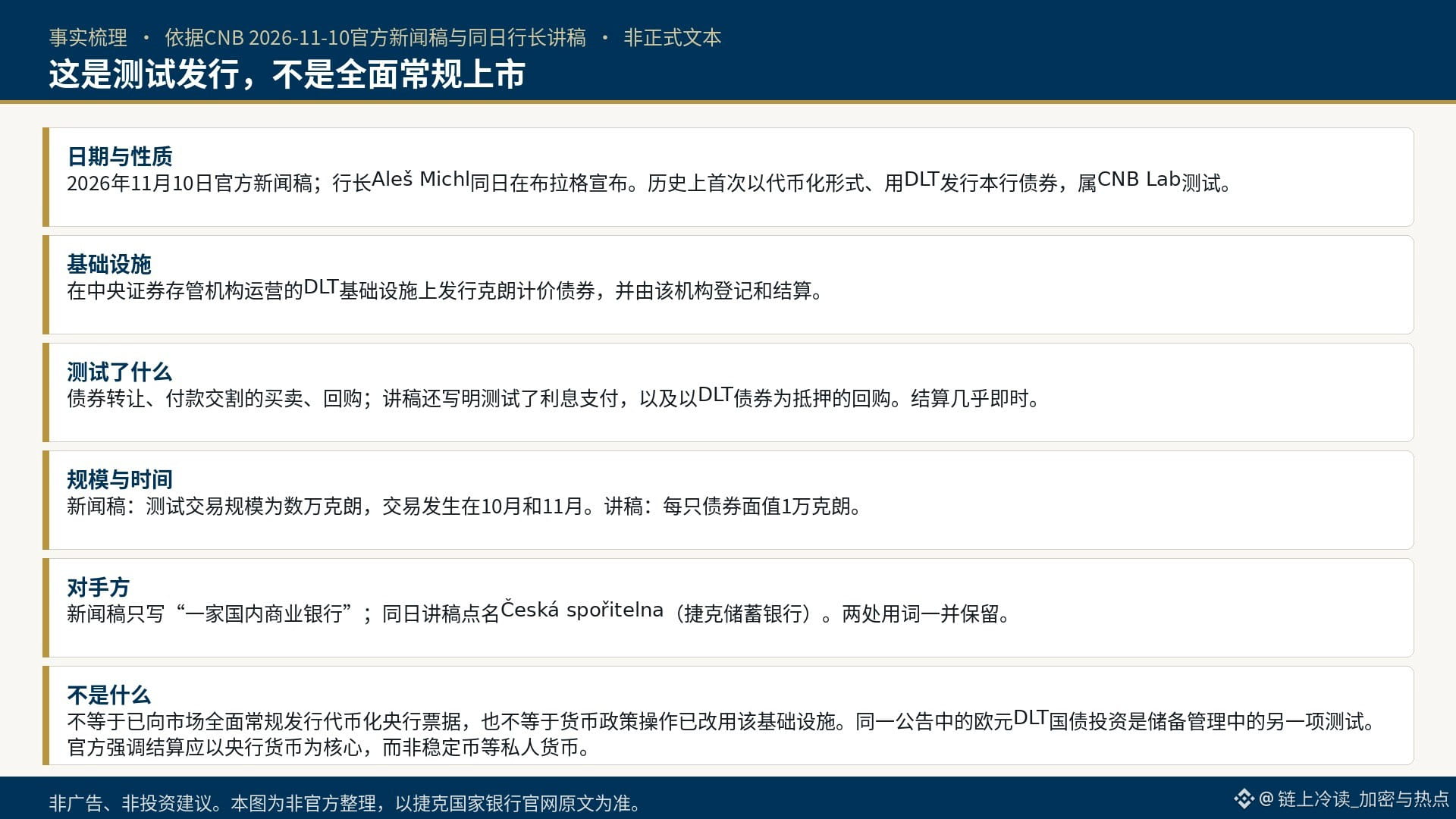
The Czech National Bank (CNB) published a press release on its website on November 10. That same day, Governor Aleš Michl announced at the CzechCrunch Money Maker event in Prague that, for the first time in its history, the bank had issued its own bonds in tokenized form using distributed ledger technology (DLT). The press release states that this was a test issuance conducted at the CNB Lab innovation center, with a test transaction worth tens of thousands of Czech koruna. It does not mean that tokenized central bank bills have already been routinely issued to the market at scale, nor that monetary policy operations have switched to this infrastructure.
The official release states that the koruna-denominated bonds were issued in tokenized form on the DLT infrastructure operated by the Central Securities Depository, which also registered and settled them. The test covered bond transfers, purchases and sales with delivery versus payment, and repurchase transactions, with settlement completed almost instantly. The transactions took place in October and November. The governor’s speech adds that these were test bonds, and that interest payments and repos collateralized by DLT bonds were also tested; each bond had a face value of 10,000 koruna, and the counterparty was Česká spořitelna (Czech Savings Bank). The press release itself mentions only “a domestic commercial bank”; the specific name comes from the governor’s speech that same day and is retained here for completeness.
The governor said in the press release that the bank had verified that this infrastructure could be used for monetary policy operations and international reserve management. The same press release also states that the bank recently invested in a euro-denominated government bond that exists only on DLT, which was a separate test in reserve management and should not be conflated with this issuance of the bank’s own koruna bonds. Both the speech and the press release emphasize that central banks must be involved from the outset, so that settlement is centered on central bank money rather than private money such as stablecoins. The official statement notes that the bank’s debt securities with a term of one year or less are called Czech National Bank bills.
My take: What has been implemented here is a small-scale, verifiable test loop. The key question is whether central bank bills can be transferred, settled, and used in repos on regulated depository infrastructure—not whether a large, freely tradable market for tokenized koruna bonds already exists. Are you more interested in whether tests like this will become part of routine monetary policy operations, or in whether settlement can continue to use central bank money rather than stablecoins?