
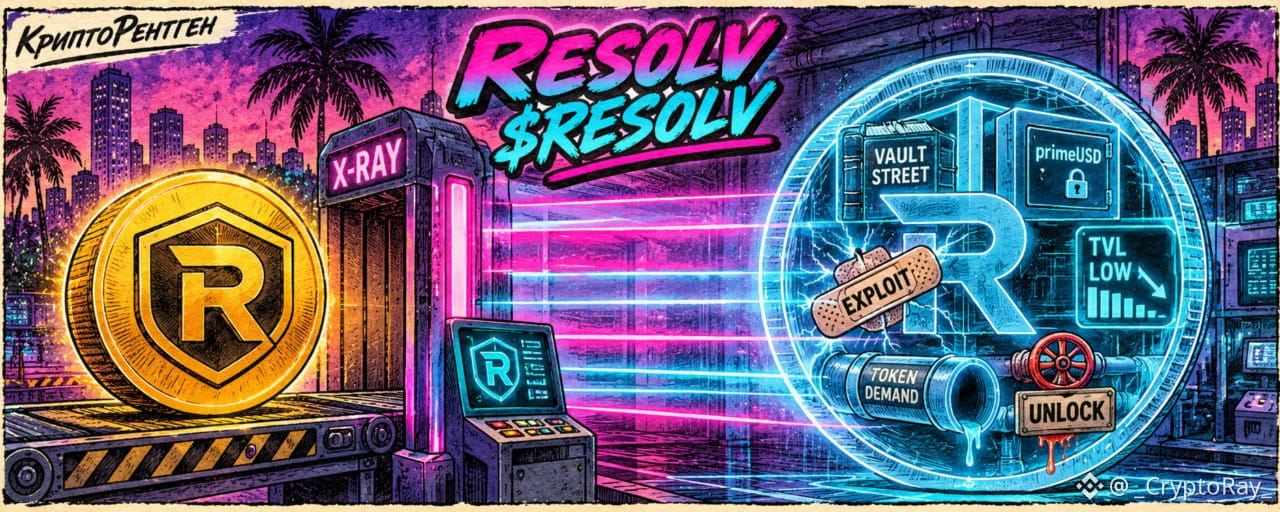
Resolv started as a delta-neutral USR dollar protocol. On March 22, 2026, an exploit brought that model to a halt. The project is now betting on Vault Street, its institutional arm focused on tokenized assets.
The key tension: the business is already measurable (around $7 million in TVL), while the token’s market cap is around $6 million. The link between product growth and demand for RESOLV has yet to be proven. This analysis is for anyone who wants to understand what remains of the project after the incident and where the token derives its value.
Technology and products
USR was a synthetic dollar: crypto collateral combined with hedging through derivatives. RLP acted as a risk pool, absorbing losses when collateral was insufficient. The protocol was suspended after the exploit.
Vault Street is currently the main focus. These are permissioned products based on tokenized assets and yield strategies:
primeUSD: a USDC-based product for approved participants, using strategies backed by fixed-yield investment assets. It is not a freely tradable equivalent of USR.
CARRY: the second product in this business line.
The core infrastructure for the tokens and products is on Ethereum. MixBytes audited Vault Street on August 31, 2026: the independent review was completed with no issues found in the reviewed code. A smart contract audit does not cover risks related to issuers of underlying assets, custodians, or counterparties.
March 22, 2026 exploit
The attack did not exploit a bug in a user-facing contract. The signing infrastructure was compromised, giving the attacker a privileged role. The attacker then minted around 80 million unbacked USR. Chainalysis estimates that around $23 million was withdrawn from the protocol; other reports put the figure at $25-27 million.
Around 46 million illicitly minted USR were neutralized through burning and blocking. This was specifically the neutralization of tokens, not the return of all funds.
The compensation scheme depended on the holder category:
USR holders in the relevant category before the incident received a 1:1 exchange into USDC.
Some post-incident categories received compensation at a less favorable rate.
RLP holders received 0.71 USDC + 2.71 RESOLV per RLP unit.
RESOLV allocations above 10,000 tokens are subject to 24-month linear vesting, with monthly unlocks starting June 27, 2026.
Let's calculate the RLP package. At the reference price of $0.03, it is worth about $0.7913. At the market price of around $0.0129, it comes to about $0.745, or roughly 5.9% less. That is not half the compensation. But it is not a full recovery either: the team itself cited a recovery of 60%+ at the reference price.
Tokenomics
RESOLV price: around $0.0123-0.0129.
Circulating supply: about 501.85 million according to CoinMarketCap and CoinGlass, and 514.98 million according to the DefiLlama tracker. The methodologies differ, so I’m giving a range.
Max supply: 1 billion. About 50.2% is in circulation.
Market cap: around $6.2-6.5 million; FDV around $12.3-12.9 million.
ATH: around $0.4108 (June 11, 2025). The current price is about 96.9% lower.
DefiLlama distribution: Ecosystem, Airdrop, Noncirculating, Insiders, Private Sale. These are not freely traded balances: some tokens are vested or allocated to ecosystem programs.
Unlocks. The next major event is November 26, when around 18.24 million RESOLV will unlock. That is about 1.82% of the max supply and roughly 3.6% of the circulating supply, worth a nominal $235,000. Between major events, DefiLlama shows about 1.23 million RESOLV per week being released for Ecosystem & Community. Other trackers show separate weekly releases of around 1.94 million, so the schedule is not limited to a single monthly tranche. An unlock does not equal a sale: the pressure depends on who receives the tokens and what they do with them.
Utility. Governance, staking through stRESOLV, protocol rewards, and market buybacks. In July, the team reported around 49 million RESOLV staked and a base APR of about 50%. This is a historical metric, not a guarantee of current returns.
Who holds the supply
The distribution includes Insiders and Private Sale categories. Vesting schedules determine how many tokens they receive in upcoming tranches. CoinMarketCap’s holder count shows around 18,000 addresses, but real concentration cannot be assessed without excluding exchange, contract, treasury, and bridge addresses.
On-chain and market
Vault Street TVL: about $7 million. Of that, around $3.29 million is primeUSD and $3.71 million is CARRY (DefiLlama).
CoinMarketCap reports Resolv TVL of around $13.15 million. This uses a different methodology, so the figures cannot be added together or compared directly.
24-hour volume is around $3.56 million. According to CoinGlass, futures turnover is significantly higher than spot turnover, so the entire volume should not be interpreted as pure spot demand.
Context: Resolv previously competed with Ethena in the synthetic dollar segment. After the exploit, it is more appropriate to compare Vault Street with institutional RWA products, and the project is still small in scale in that context.
The inside story
Facts
March 22, 2026: exploit involving around 80 million unbacked USR (Chainalysis).
Around 46 million USR neutralized through burning and blocking (Resolv announcement).
RLP compensation of 0.71 USDC + 2.71 RESOLV (Resolv announcement).
24-month vesting for allocations above 10,000 RESOLV (Resolv announcement).
Vault Street audit by MixBytes, August 31, 2026 (MixBytes public registry).
More than $300,000 in RESOLV buybacks since July: purchases were made on centralized exchanges, and automatic buybacks through the fee switch had not been enabled at the time (Resolv update).
Rumors and insider claims
“No buyback”: disproven; buybacks were announced and carried out (Resolv).
“Vault Street and primeUSD are only planned”: disproven; the business line is operational and has TVL (DefiLlama).
“primeUSD is unaudited”: disproven; a MixBytes audit is available.
“RLP compensation amounted to half”: disproven by calculation using Resolv’s formula.
“290,000 unlocked daily and 18.24 million on the 27th”: unconfirmed; the tracker shows 18.24 million on November 26 and around 1.23 million per week.
Strengths and weaknesses
Pros
Compensation is organized according to a formalized scheme, rather than on a “first come, first served” basis.
Vault Street is operational: primeUSD and CARRY have observable TVL.
There is an independent MixBytes audit with no issues found in the reviewed code.
The token has governance and staking, and buybacks have been carried out historically.
The project is not stuck waiting for a USR relaunch and is developing a new business line.
Cons
USR has not returned to full operation since the exploit.
An incident involving tens of millions of dollars damaged trust.
The new business is small: around $7 million in TVL.
There is no regular reporting on buybacks, so the current pace is unclear.
Unlocks are ongoing: a large tranche on November 26, as well as weekly releases.
A link between Vault Street’s growth and demand for RESOLV has not been proven.
Sources
Resolv (resolvlabs.substack.com and the official Telegram channel), DefiLlama (TVL and unlock schedule), CoinMarketCap and CoinGlass (market data), MixBytes (audit), Chainalysis (exploit estimate).
