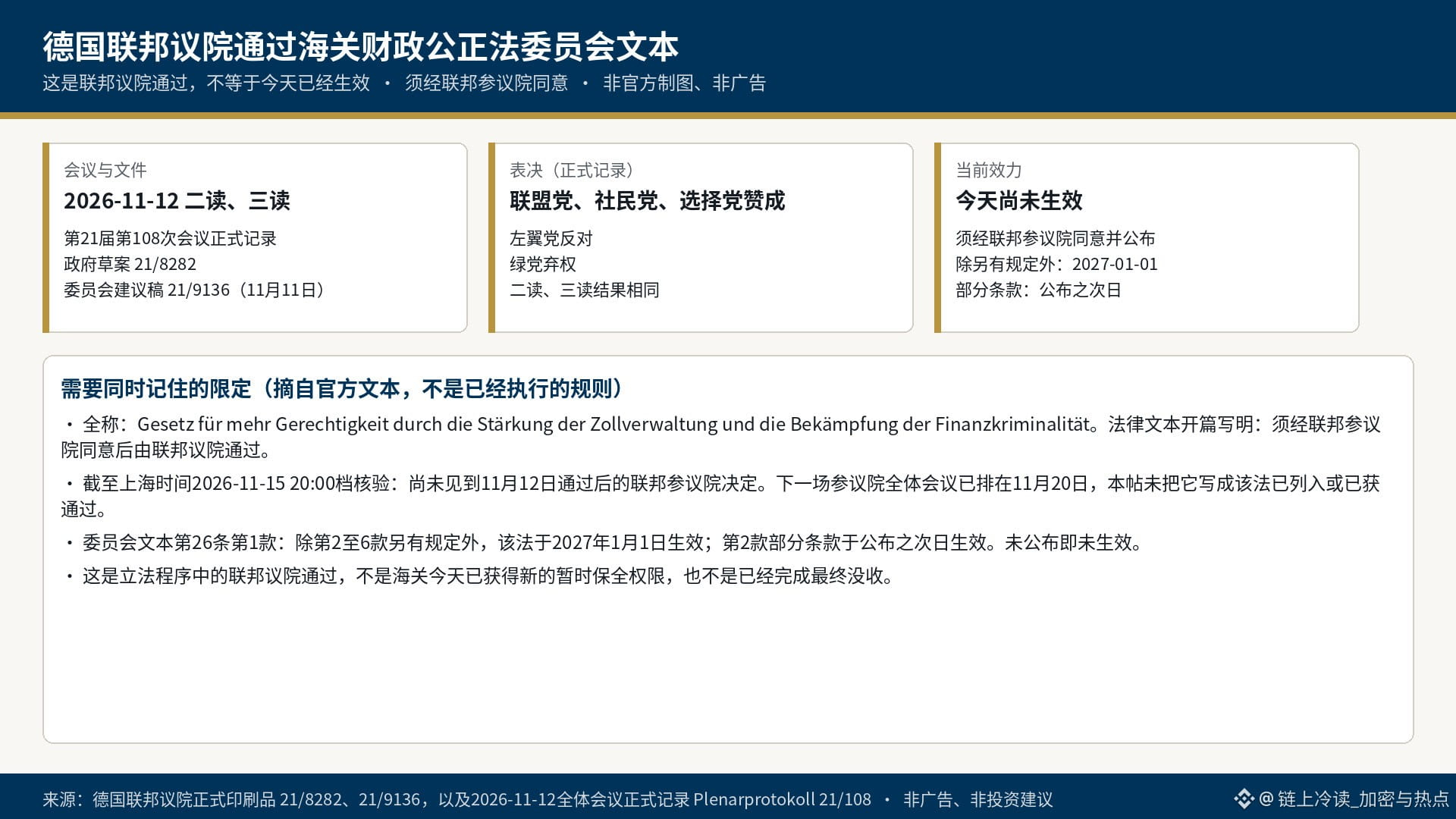
On Thursday, November 12, the German Bundestag passed, in its second and third readings, the federal government’s “Act to Promote Greater Justice through Strengthening Customs Administration and Combating Financial Crime,” based on the version recommended by the Finance Committee on November 11. This was approval by the Bundestag; it does not mean the law has already taken effect today, nor that customs can already temporarily secure crypto-assets under the new rules. The opening of the text states that it requires the consent of the Bundesrat. As of the time this post was checked (around 20:00 Shanghai time on November 15, 2026), no Bundesrat decision following the Bundestag’s passage on the 12th had been seen. Under Article 26(1) of the committee’s text, unless otherwise provided, the Act enters into force on January 1, 2027; some provisions enter into force on the day after promulgation.
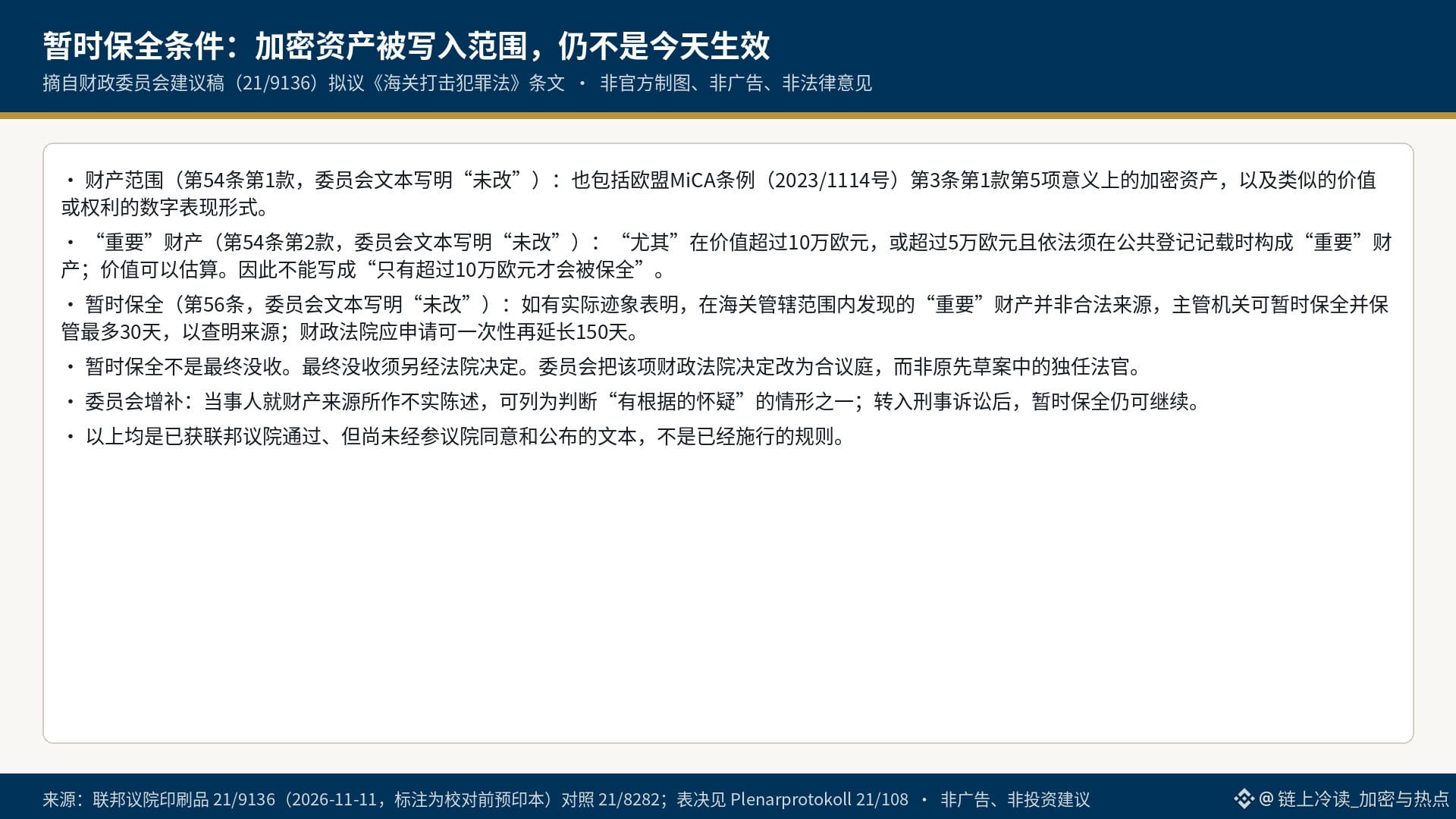
The committee’s text specifies the scope of assets covered by Section 54(1) of the proposed Customs Crime Act: it also includes crypto-assets within the meaning of Article 3(1)(5) of the EU MiCA Regulation (2023/1114), as well as digital representations of value or rights similar to them. Section 56 provides that if there are concrete indications that “significant” assets found within customs jurisdiction are not of lawful origin, the competent authority may temporarily secure and hold them for up to 30 days to determine their origin; upon application, the fiscal court may extend that period once by a further 150 days. Temporary securing is not final confiscation; final confiscation requires a separate court decision. Section 54(2) states that assets are considered “significant,” in particular, when their value exceeds €100,000, or exceeds €50,000 and they are required by law to be registered. Their value may be estimated, so it is inaccurate to say that “only assets worth more than €100,000 can be secured.”
The official minutes of the plenary sitting on the same day show that the CDU/CSU, SPD and Alternative for Germany voted in favor in both the second and third readings; The Left voted against, and the Greens abstained. The Finance Committee also changed the decision on final confiscation to be made by a panel of the fiscal court, added false statements by the person concerned as one of the circumstances for determining “reasonable suspicion,” and provided that temporary securing may continue after proceedings are transferred to the criminal justice system. None of these are rules that have yet entered into force.
My view is that crypto-assets have been explicitly included within the scope of temporary securing, but the thresholds, time limits and Bundesrat consent are all still obstacles to the law taking effect. Are you more concerned about whether the “in particular” €100,000 threshold might be interpreted more broadly, or would you rather first see whether the Bundesrat proposes amendments?