

The second purchase in our conservative copy-investment portfolio is complete, as announced a couple of hours ago. We’ve already explained why: a strong signal of a potential BTC low on the 3-day timeframe. For us, this is an impressive signal encouraging us to buy. This is only the sixth such signal in the asset’s entire history.
As a reminder, the first purchase was made on the night of November 2–3.
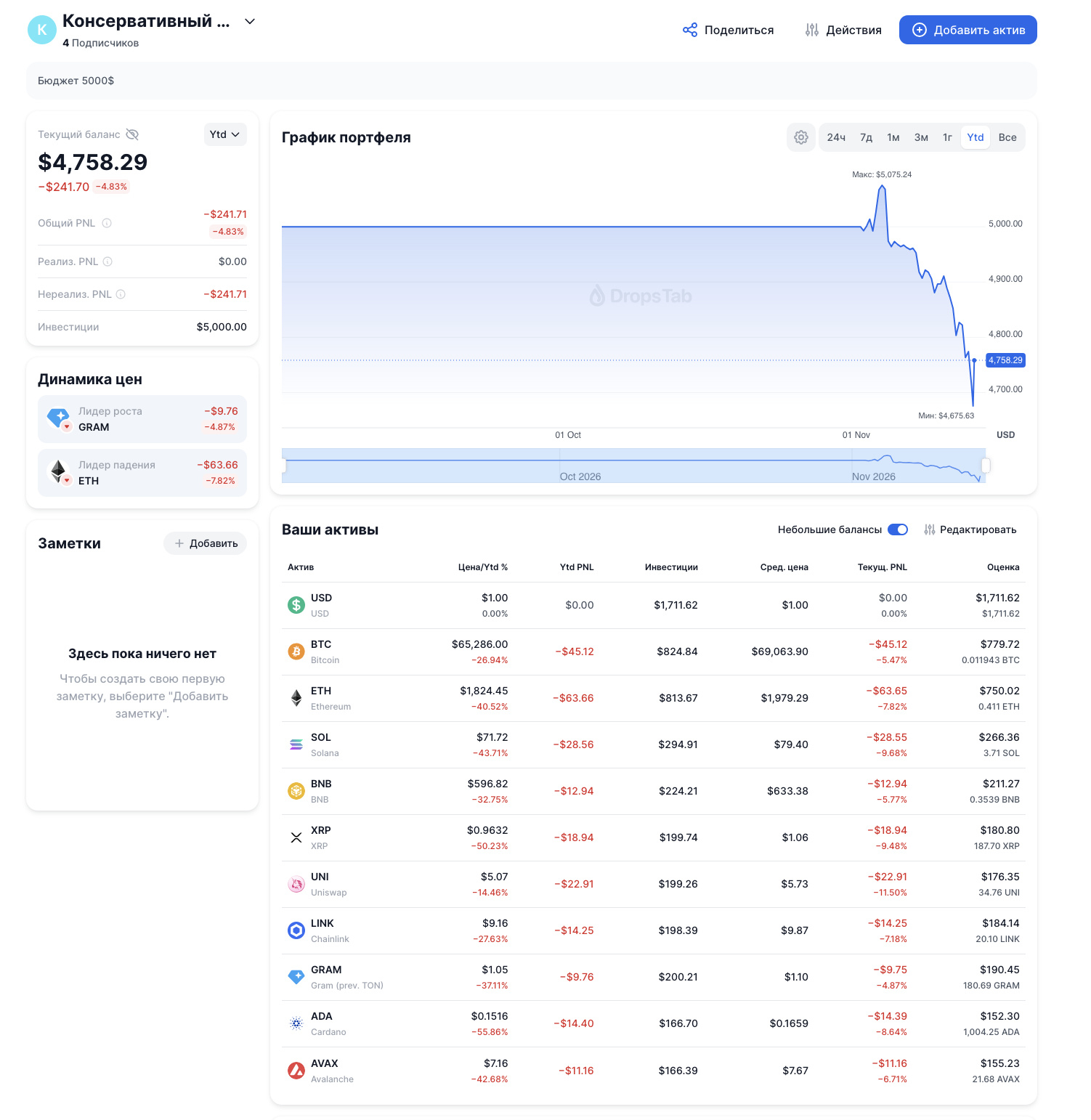
We've now improved our entry points during the current market downturn. How did the average entry prices change after the second purchase? Quite significantly, although they are still noticeably above current prices:
- #BTC: $76,910.10 -> $69,063.90; added to the position today at an average price of $64,074.88,
- #ETH: $2,255.96 -> $1,979.29; added to the position today at an average price of $1,755.15,
- #SOL: $92.06 -> $79.40; added to the position today at an average price of $69.9107,
- #BNB: $699.73 -> $633.38; added to the position today at an average price of $578.28,
- #XRP: $1.25 -> $1.06; added to the position today at an average price of $0.92510,
- #UNI: $7.10 -> $5.73; added to the position today at an average price of $4.80402,
- #LINK: $11.13 -> $9.87; added to the position today at an average price of $8.85762,
- #GRAM: $1.19 -> $1.10; added to the position today at an average price of $1.03500,
- #ADA: $0.1888 -> $0.1659; added to the position today at an average price of $0.14793,
- #AVAX: $8.40 -> $7.67; added to the position today at an average price of $7.04929.
Entry points improved most noticeably for UNI, XRP, and SOL.
Current portfolio status:
- Total budget: 5,000 USDT.
- Invested: approximately 3,288 USDT (65.8%).
- Available reserve: 1,711.62 USDT (34.2%).
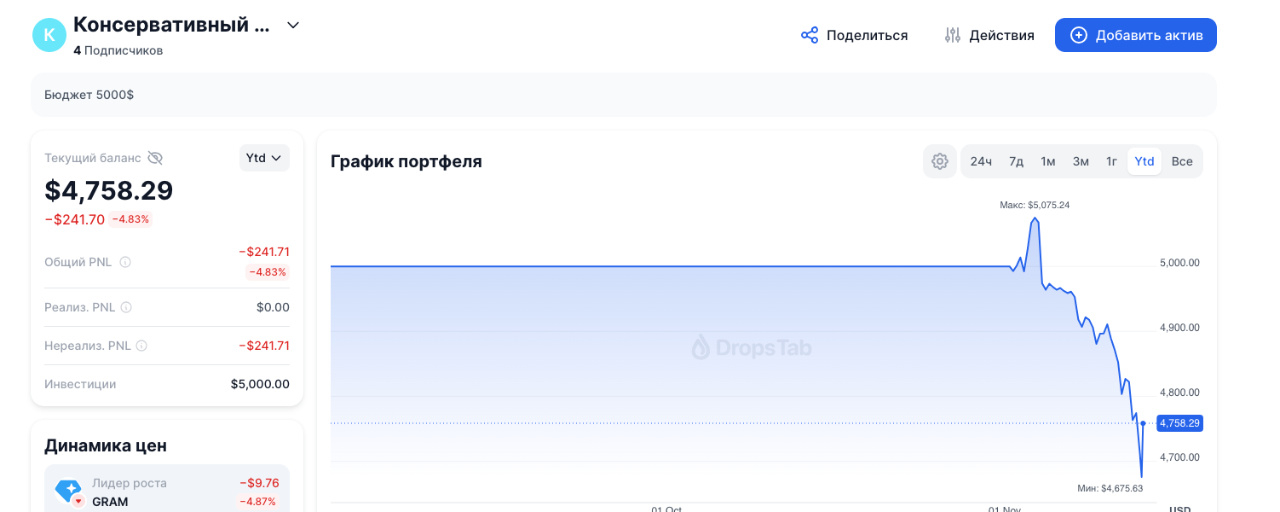
- Current portfolio value: $4,758.29.
- Unrealized result: minus $241.71 (-4.83%). Given the market dump it's going through, that's very good.
The final third of the capital remains in reserve. BUT as a reminder, we plan to put it into the market ONLY if asset prices begin to enter a sustained uptrend on the 2-week timeframe. That would be unequivocal confirmation of a bull market. But if BTC breaks its sustained uptrend on the weekly timeframe, that will be a signal to close the portfolio on the rebound and wait.
Purchases, as last time, were made for ourselves and copy traders on three exchanges—Binance, Exchange No. 2, and Exchange No. 3. Specifically:
1. As last time, on Exchange No. 2 we topped up the portfolio using perpetual futures with 1x leverage and isolated margin, because they don't offer spot copy trading.
2. This time, we managed to buy GRAM for copy traders on Exchange No. 3; last time, the exchange wouldn't let us do it.
3. Last time, for some reason, we managed to acquire only a little more than half of the BTC position on Exchange No. 2. We couldn't add to it afterward because the order size was below the minimum allowed. So this time, we topped up with a larger amount on Exchange No. 2.
Here's a reminder of the percentage allocation and rationale for purchases of each asset:
- 50% of the capital is allocated to #BTC and #ETH—25% to each asset. This is the foundation of the portfolio and also a way to reduce altcoin risk.
- The remaining 50% is allocated across major projects in different sectors:
-- #SOL, 9%—one of the largest and most actively used ecosystems.
-- #BNB, 7%—a bet on the Binance and BNB Chain ecosystem, with an eye toward expansion into the stock market.
-- #XRP, 6%—focused on payments and cross-border settlements.
-- #UNI, 6% (we're temporarily dropping our initial choice, #HYPE)—one of the strongest projects in DEX trading and derivatives.
-- #LINK, 6%—the largest infrastructure for oracles and transmitting external data to blockchains; whichever way you look at it, they're leaders in development.
-- #GRAM, 6%—a bet on the development of TON and its integration with Telegram's user base.
-- #ADA, 5%—one of the largest independent blockchain projects, with a well-developed staking and governance system.
-- #AVAX, 5%—blockchain infrastructure focused on specialized networks and real-world asset tokenization, with some interesting partnerships.
For convenience, here's the public portfolio on Dropstab. Everything is listed in detail there, including fees. You can see the overall average purchase price for the portfolio. It also smooths out the difference between spot and futures purchases.