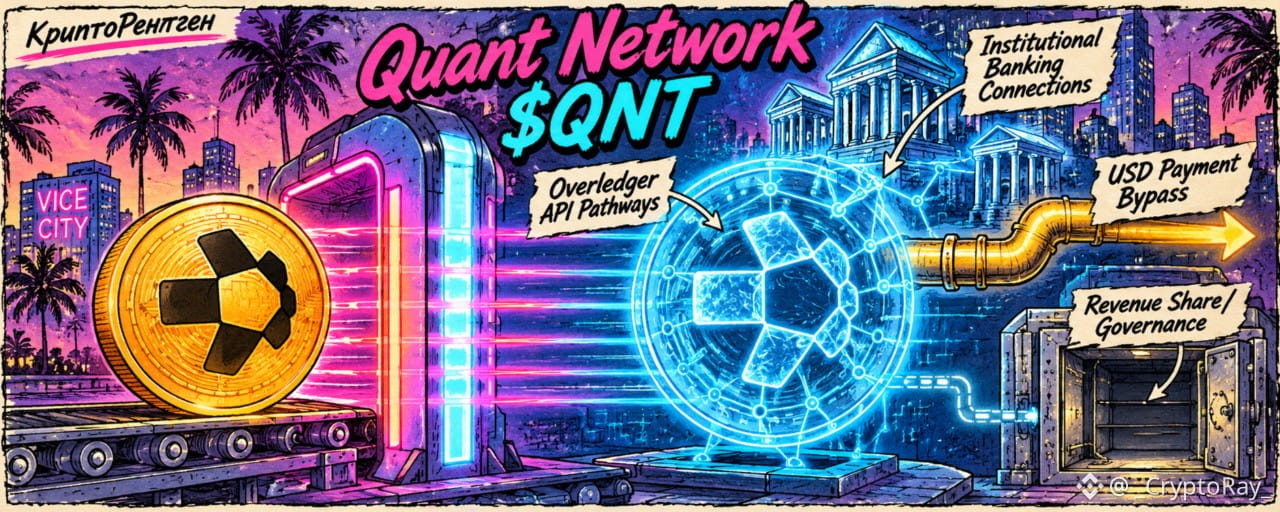
Quant Network is an infrastructure company that connects different blockchains with one another and with enterprise systems. Its main product is Overledger, an API layer (middleware) through which organizations connect to networks. It’s neither a standalone L1 nor a conventional L2. QNT is the utility token for the entire ecosystem.
The main conflict: the institutional side looks strong, but the link between business success and demand for the token is unclear. A client can pay for the platform in USD, and the bank doesn’t necessarily have to buy QNT on the market.
This analysis will be useful to those studying the tokenization of deposits and RWAs, and to anyone who wants to distinguish real demand for QNT from an attractive storefront. Data as of November 14, 2026.
Technology
Overledger lets organizations work with multiple blockchains through a single interface and integrate them into existing corporate systems. In practice, it is an integration layer: a bank does not need to build a separate connection for every network.
Fusion Rollup (Multi-Ledger Rollup). In 2026, Quant announced its mainnet launch. According to the company, at launch the infrastructure was connected to 74 blockchain networks. This is the project's own claim; there is no independent assessment of performance or the actual activity of each connection.
What QNT does here:
payment of gas and execution fees;
QNT staking by trusted-node operators in return for rewards.
Project with The Clearing House (TCH). On September 24, 2026, TCH announced that it had selected Quant for its On-Chain Money Initiative. Quant's role is to provide interoperability, orchestration, and transaction management for a clearing and settlement network for tokenized deposits. The network is intended to work alongside existing payment systems RTP and CHIPS.
TCH is owned by the largest commercial banks in the United States. Its payment networks process more than $2 trillion per day, but that figure reflects the entire existing infrastructure, not the future tokenized-deposit network. Launch for participating organizations is expected in the first half of 2027. For now, this is an announcement, not an operational network.
Tokenomics
Actual supply: 14 612 493,08 QNT. This figure dates from the burn on September 14, 2018, when Quant destroyed 9 545 765,95 QNT from its unsold allocation. It was a one-time historical burn, not an ongoing mechanism.
Distribution immediately after the burn, according to the company:
9 964 259,03 QNT - public / circulating;
4 648 234,05 QNT - company allocation.
This is a snapshot from 2018, not current wallet balances.
Vesting. A 12-month vesting period after the crowdsale, which ended on April 30, 2018, was set for managers and employees, running approximately until April 2019. Transfers were also restricted for two months. These terms apply to the initial distribution.
Staking rewards in Multi-Ledger Rollup should not automatically be considered new issuance: the source of the payouts and the mechanics of their distribution matter.
The market today. The price is around $155-157, approximately 63% below the ATH (around $427, in September 2021). 24-hour volume is $56-99 million.
Aggregators differ on circulating supply:
CoinMarketCap: 12 072 738 QNT, market cap around $1.88 billion;
CoinGecko and MetaMask: around 14.56 million QNT, market cap around $2.27-2.29 billion.
I won't declare either figure correct: the difference is methodological. CoinMarketCap also shows a max supply of around 14.88 million, while Quant's statement and Blockworks indicate 14.612 million.
What QNT is used for in practice
The official FAQ confirms that QNT is used to pay for subscriptions, licenses, and platform services, and in Multi-Ledger Rollup, also for gas and staking.
But platform fees can be paid in USD or QNT. That means clients are not required to buy the token on the market. The token provides no right to dividends or a share of profits, and gives no vote in the company's governance. There is also no mandatory market buyback or regular fee burn.
Conclusion: the utility mechanisms are real, but they do not generate automatic income for all holders.
On-chain and market structure
Holders. Aggregators show different numbers of addresses, and an address is not the same as an independent investor.
TVL is not a key metric for Quant: it is not a DeFi protocol. More important are the number of connected organizations, transaction volumes, and the share of transactions that specifically require QNT.
Corporate tokens. According to Blockworks (July 28, 2026), around 68,000 QNT are held in company wallets. They are not locked and may be sold. This is a small share of the supply.
Comparable competitors:
Chainlink CCIP - cross-chain transfers;
Polkadot XCMP - communication between parachains;
Cosmos IBC - a protocol for exchanging data between networks.
Quant's distinguishing focus is on regulated financial institutions and corporate processes. But the contract with TCH does not prove that banks will buy QNT.
The inside story
Facts
The burn of 9.545 million QNT is confirmed by a Quant statement (September 14, 2018). These are destroyed tokens, not a treasury balance.
TCH selected Quant on September 24, 2026. The network has not launched yet.
September 2026 rally: from a close of around $70.69 (September 23) to around $286.21 (September 27), approximately +305%. The biggest daily moves came on the days after the TCH announcement, but that is a timing coincidence, not proof that the announcement caused the entire rally.
QNT perpetual futures. Coinbase announced their launch for November 13, 2026, and a notice about market availability appeared later. These are derivatives, not a spot listing.
74 networks in Fusion Rollup - according to Quant.
Rumors and insider claims
“65% of the supply (9.55 million QNT) is held at a single treasury address.” Status: unconfirmed. This appears to be a mix-up: 9.55 million is the number of tokens burned.
“QNT is locked for 12 months under the license.” Status: unconfirmed.
“FINMA recognized QNT as a utility token.” Status: unconfirmed; no primary document is available.
“99.99% of QNT will be untradeable by 2027.” Status: unconfirmed.
“TCH has already launched the network, and banks are processing transactions.” Status: debunked; the launch is expected in the first half of 2027.
Strengths and weaknesses
Strengths
Contract with The Clearing House. A real institutional project, with launch announced for the first half of 2027.
Working product. Overledger solves a specific problem: integrating blockchains into corporate systems.
Fixed supply of around 14.6 million QNT following the 2018 burn.
Three use cases for the token: service payments, gas, and staking by trusted nodes.
Focus on banking infrastructure and tokenized deposits.
Weaknesses
Weak link between the business and the token. The platform can be paid for in USD.
No rights to profits or governance. Holders do not receive a share of revenue.
QNT's role in the TCH network has not been disclosed, nor have the participating banks or volumes.
Centralized governance. There is no DAO; control rests with the company.
Execution risk. The TCH launch is not until 2027.
Aggregators report inconsistent supply and market cap data, alongside high volatility: after the September peak, the price fell by nearly half.
Sources
Quant statement on the burn (archived): https://archive.ph/9X9kU
Blockworks, Token Transparency Filing: https://blockworks.com/token-transparency/filing/quant
The Clearing House, partnership announcement: https://www.theclearinghouse.org/payment-systems/Articles/2026/09/The-Clearing-House-Partners-with-Quant-to-Advance-the--On-Chain-Money-Initiative