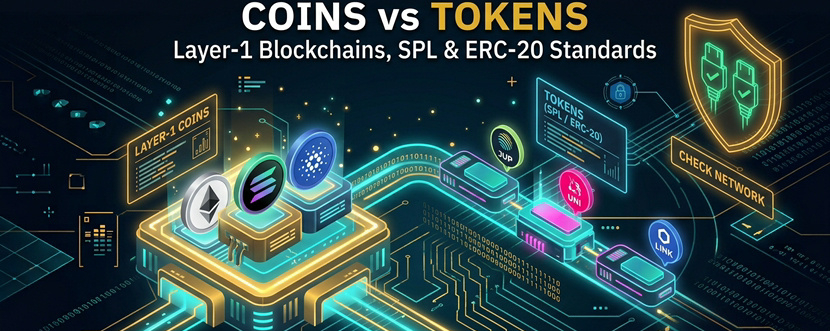

For most beginners, any cryptocurrency other than Bitcoin is simply an “altcoin.” But from a technical perspective, that’s a huge mistake: some assets are independent financial highways with their own blockchain, while others are just “passengers” riding on someone else’s rails.
Because they don’t understand this difference, beginners constantly confuse network standards and permanently lose their deposits during transfers. Let’s break down, without complicated theory, the three groups all altcoins fall into and how to avoid burning your coins when sending them. 👇

Group 1. Native blockchains (Layer 1 or “Coins”) 🛣️
These assets have their own independent network, their own validators or miners, and their own operating rules. They depend on no one and serve as the foundation for other projects.
The main examples on the market:
• Ethereum ($ETH ) and Solana ($SOL): the largest platforms for smart contracts and decentralized applications.
• Cardano ($ADA) and Toncoin ($TON): independent Layer 1 networks with their own architecture.
• Zcash ($ZEC): an independent blockchain focused on privacy, with its own mining.
These are the coins used to pay transaction fees (gas) on their respective networks.

Group 2. Tokens built on Solana (the SPL standard) ⚡
Hundreds of projects don’t spend years building their own blockchain from scratch. Instead, they launch their tokens on the already-established, fast, and inexpensive Solana network using the SPL technical standard.
Notable projects in the ecosystem:
• DeFi and infrastructure: Jito ($JTO ), Jupiter ($JUP), Raydium ($RAY), and the Pyth Network oracle ($PYTH).
• Memecoins: Bonk ($BONK) and dogwifhat ($WIF).
Important: to send any of these tokens to someone else, you must have a little $SOL in your wallet to pay the network fee.

Group 3. Tokens built on other networks (ERC-20, BEP-20) 🌐
A huge part of the market runs on top of other giants—primarily Ethereum (the ERC-20 standard) and BNB Smart Chain (the BEP-20 standard).
Examples of these projects:
• Built on Ethereum (ERC-20): the decentralized exchange Uniswap ($UNI ), the Chainlink oracle ($LINK), and the Aave lending protocol ($AAVE).
• Built on BNB Chain (BEP-20): the network’s largest exchange, PancakeSwap ($CAKE).
Many major projects issue their tokens on several networks at once (for example, the stablecoin $USDT exists as ERC-20, as SPL on Solana, and as TRC-20 on the Tron network).
Why this difference can save your deposit: two transfer scenarios ⚠️
Not understanding network standards is the main reason people lose money when withdrawing funds from an exchange to a Web3 wallet:
Option A: Correct transfer. You withdraw the $JUP token to a Phantom wallet, selecting the Solana network (SPL)—the coins arrive in a couple of seconds with a fee of less than a cent.
Option B: A beginner’s mistake. You send an ERC-20 $UNI token to a wallet address that only supports the Solana network (or select the wrong network when withdrawing stablecoins). At best, the transaction won’t go through; at worst, the funds will disappear with no way to recover them.
Remember: A Coin is the fuel and foundation of its own network. A Token is an application launched within someone else’s network. A token cannot exist without its blockchain’s native coin.
Security checklist before any transfer ✅
Before you click “Send,” always check these three things:
Matching sending and receiving networks: if you withdraw an asset using the BEP-20 standard, the recipient’s address must support BNB Smart Chain.
Having “gas” in your wallet: keep a small amount of the network’s native coin ($ETH, $SOL, or $BNB) in each wallet; otherwise, your tokens may be locked inside with no way to withdraw them.
Test transaction: when transferring a large amount, send $1–$5 first, make sure it arrives, and only then transfer the rest.👇@Cryptoland_88
⚠️ Disclaimer: This material is for informational and educational purposes only and does not constitute personalized investment advice, financial advice, or a recommendation to buy or sell any assets. The cryptocurrency market involves a high level of risk and volatility. Always do your own research (DYOR) before making any investment decisions.
#cryptoeducation #altcoins #solana #Ethereum #криптовалюты