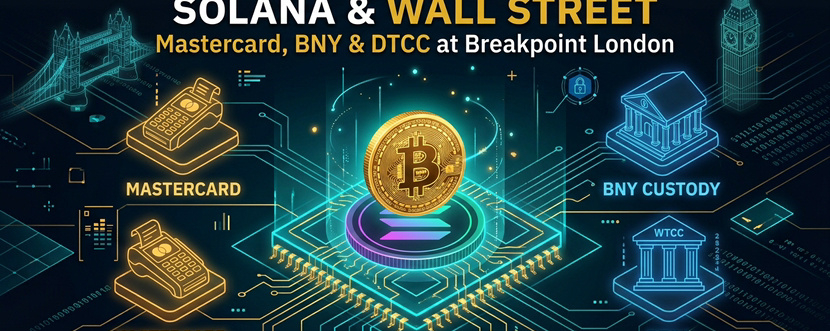
Many newcomers still think the Solana blockchain ($SOL ) is only useful for trading memecoins quickly. But the lineup of attendees at Solana Breakpoint 2026, the flagship conference kicking off in London from November 15 to 17, completely shatters that stereotype.
Joining crypto developers on stage are heavyweight names from global finance: Mastercard, America’s oldest bank, BNY, and DTCC, the stock market’s main clearinghouse. Let’s break down, without getting into complex theory, why these giants need blockchain and what it means for the crypto market. 👇

Who are these three giants, and why are they here? 🏛️
To understand the scale of what’s happening, just look at the stature of the companies discussing the integration of Solana technology:
• Mastercard: One of the world’s largest payment networks. The company is testing stablecoin settlements with crypto projects so that transfers between cards and banks can be completed in fractions of a second, without unnecessary fees.
• BNY (Bank of New York Mellon): America’s oldest bank and the world’s largest asset custodian, through which tens of trillions of dollars flow. Its involvement shows that major funds are looking for secure ways to hold tokenized assets on behalf of their clients.
• DTCC (Depository Trust & Clearing Corporation): The heart of the U.S. stock market. Almost all trades in U.S. stocks and bonds pass through DTCC. The corporation is exploring moving traditional securities onto blockchain rails (the RWA sector).
Why Wall Street banks need Solana ⚙️
The traditional banking system is slow: international transfers and securities settlements can take days, while intermediary fees eat into profits.
Option A: Traditional finance. Closed databases, no trading on weekends and holidays, expensive clearinghouses, and settlement waits that can last for days.
Option B: Blockchain infrastructure. 24/7 operation, transaction finality in 150 milliseconds, and fees of less than a fraction of a cent. For payment giants like Mastercard and DTCC, this is a way to make global settlements dramatically cheaper and faster.
Remember: The arrival of players like these doesn’t mean the price of $SOL will skyrocket tomorrow—macroeconomic factors and fund outflows are currently weighing on its short-term price. But fundamentally, this is a turning point: blockchain is no longer a toy for speculators; it’s becoming the invisible engine of the global financial system.
Checklist: trends for investors to watch ✅
To understand where big capital is headed in 2027, keep an eye on three areas:
The RWA sector (tokenization of real-world assets): bringing government bonds, funds, and stocks onto the blockchain—the main bridge between Wall Street and crypto.
Payment stablecoins: using digital dollars for real-world Mastercard and Visa transactions.
Institutional custody services: the emergence of licensed crypto-asset custody at major global banks like BNY.
A question for the community
What do you think—will the arrival of banking giants like Mastercard and DTCC benefit crypto by bringing in trillions of dollars, or undermine the original idea of decentralization? Share your thoughts in the comments! 👇@Cryptoland_88
⚠️ Disclaimer: This material is for informational and educational purposes only and does not constitute personalized investment advice, financial advice, or a recommendation to buy or sell any assets. The cryptocurrency market involves a high level of risk and volatility. Always do your own research (DYOR) before making any investment decisions.
#solana #sol #RWA #InstitutionalCrypto #криптовалюты