
We’ve already covered what a triangle is: three sets of quotes linked in a loop, where the focus is on whether the loop is properly balanced. This article explains how to match the three legs—what each one does, how to link them into the same loop, and what it takes for the loop to be fully matched.
I. What’s the principle?
When discussing “how to match the three legs” of a triangle, you don’t have to guess which way prices will move. Just remember this:
Take three related trading pairs and place one trade on each, all in the same direction around the loop, with quantities that line up. Once all three trades are linked, the key thing to watch is whether the loop is properly balanced; price movements themselves matter less.
To break it down, there are roughly three steps:
1) First, understand the three legs
• First trade: The first trading pair (for example, A/USDT).
• Second trade: The second trading pair (for example, B/A).
• Third trade: The third trading pair (for example, B/USDT), closing the cycle.
All three legs use quotes from the same exchange, just for different trading pairs. Ideally, they should fit into the same cycle; if they don’t, it probably isn’t a complete triangular cycle.
2) Link the directions along the same cycle
A common approach is to follow the cycle in one direction or go around it in reverse (this is only about how to match the trades, not a recommendation on direction):
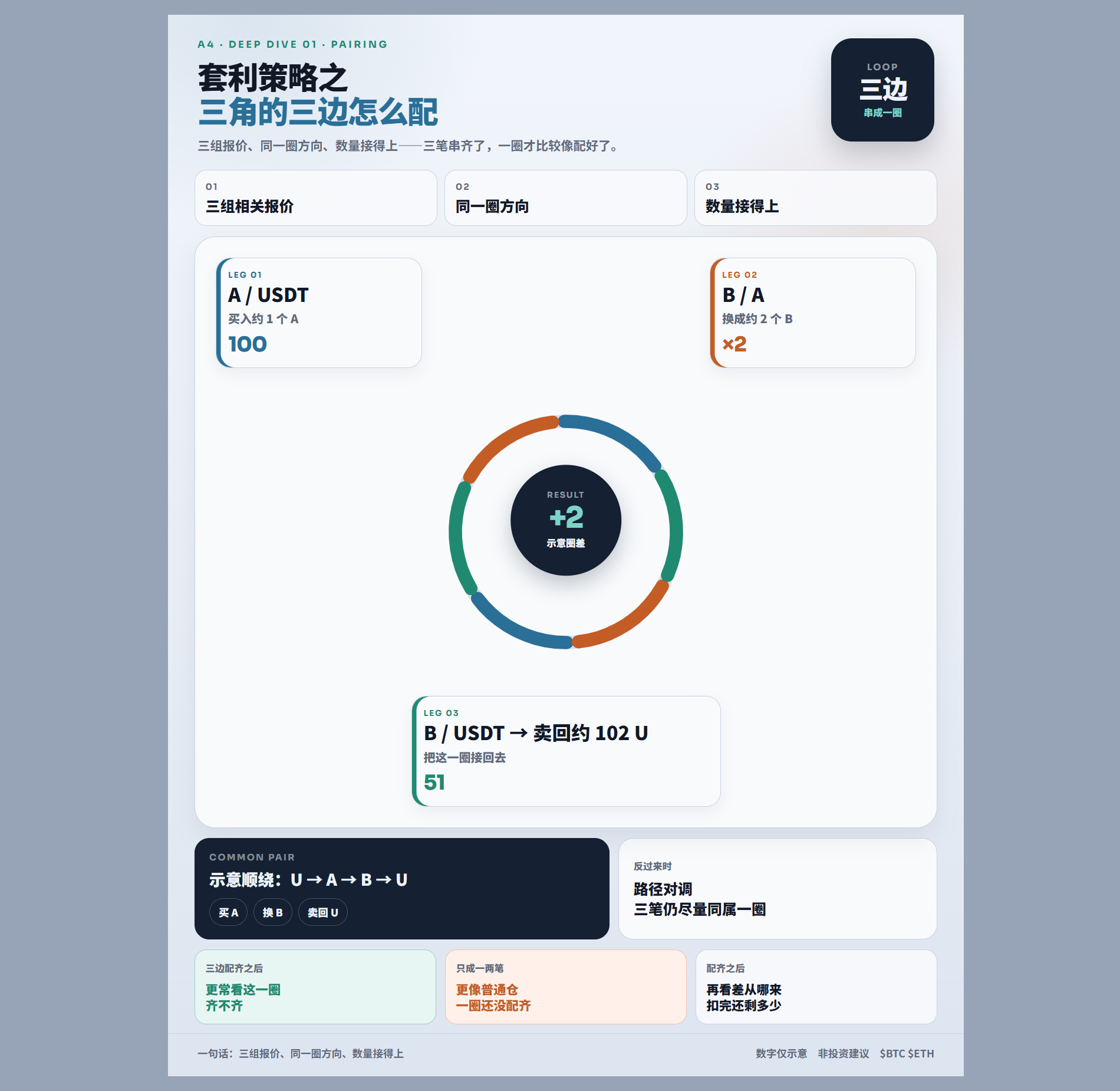
• Example, going one way: Use U to buy A → Exchange A for B → Sell B back for U
• In reverse: The path is reversed, but the three trades should still follow the same cycle as closely as possible
If the directions of the three trades are mixed up, it’s easy for the cycle not to link back up, leaving you with exposure in one direction.
3) Try to make the quantities line up
The amount received from the previous trade should be roughly enough for the next one. If you can’t buy enough or sell it all on one leg, it’s easy for the cycle to remain incomplete. If one leg is much larger and another much smaller, it may look like a cycle, but you’re still tilted toward one side.
You can start by remembering this:
How to set up the three legs of triangular trading ≈ three quoted pairs, directions following the same cycle, and quantities that line up.
II. An example
The numbers are for illustration only. Suppose the three quoted pairs on the exchange are:
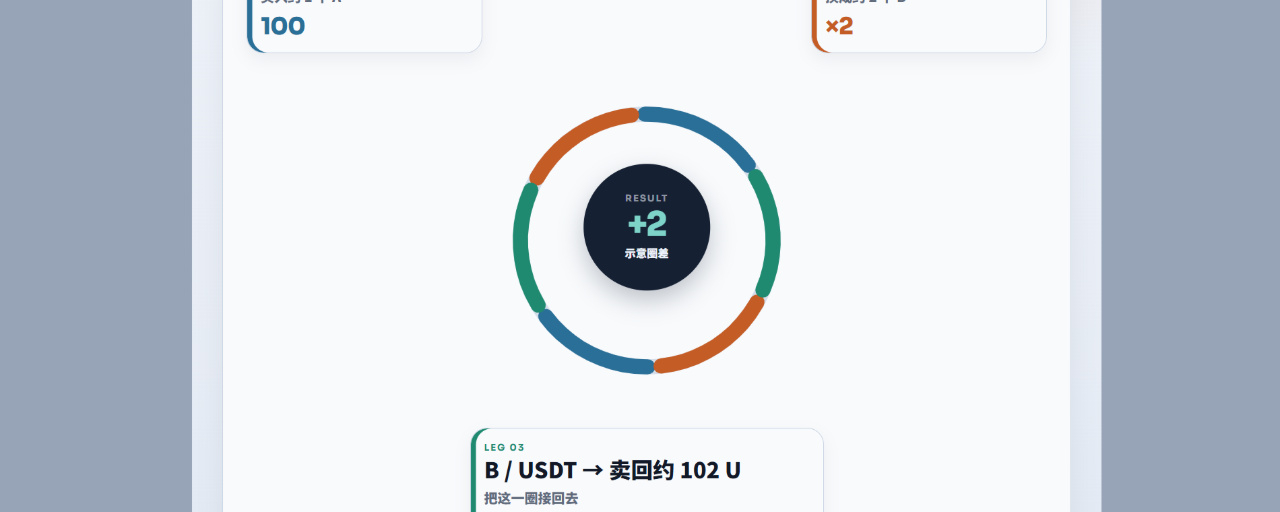
• A/USDT about 100
• B/A about 2
• B/USDT about 51
Illustrative setup (starting with about 100 U):
• First trade: Buy about 1 A
• Second trade: Exchange it for about 2 B
• Third trade: Sell back for about 102 U
If all three trades complete this loop, it’s more like a fully matched cycle. You start with 100 and come back with about 102, so there’s roughly +2 left over in the cycle—where the difference comes from and how much remains after costs will be covered later.
If you only complete the first two trades and the third doesn’t go through, you’re left holding B. The cycle isn’t complete, so for now it looks more like a regular position.
III. What are the two sides?
In triangular trading, what are called the “two sides” are actually more often three sides. They’re all trading pairs, linked together in the same cycle:
• First leg: Specify the pair, whether you’re buying or selling, and roughly how much.
• Second leg: Likewise, specify the trading pair, direction, and quantity; ideally, it should match up with the previous trade.
• Third leg: Close the cycle; the quantity should ideally line up with the first two trades.
To see whether the three legs match up, look at roughly three things: Are they the three pairs in the same cycle? Do their directions follow the same cycle? Do the quantities roughly line up? If any one of these doesn’t match, the cycle probably isn’t fully set up yet.
You can initially distinguish it from futures-spot trading and basis trading like this:
• Futures-spot / basis: Often two trades; after hedging the directions, you look at the price difference.
• Triangular trading: Often three trades linked into a cycle; you look at whether the cycle is complete at that moment.
This article is about on-exchange triangular trading: the three pairs are usually on the same exchange, so you generally don’t need to transfer funds between exchanges first.
IV. Where the profit comes from
This article mainly explains how to set up the trades. Here are just a few points about profit that are directly related to matching them:
1) Once all three legs are matched, the focus is usually on whether the cycle balances
When all three trades are in place, follow the same cycle, and have matching quantities, the focus is usually on how much is left over or missing from the cycle; the price movement itself is less prominent.
2) The setup should follow the “same cycle”
You can illustrate it in either direction, but ideally all three trades should follow the same path. If they’re linked in the wrong order, what you end up looking at may not be the cycle difference you intended to track.
3) A completed setup doesn’t mean a lot will necessarily remain after costs
Fees on all three trades, slippage on all three trades, and minimum order sizes are calculated separately. Matching the trades mainly means linking up the cycle correctly; how much remains after costs is a separate question.
V. Risks
Common issues related to “how to set up the trades” include the following.
The cycle isn’t complete
Only one or two trades go through
The first two trades go through but the third doesn’t, or the sequence is interrupted. You’re left with exposure in one direction, which for now looks more like a regular position. You can first assess the situation as it stands.
The three pairs don’t belong to the same cycle
You use the wrong trading pair, or force three unrelated pairs together. You might call it triangular trading, but in practice the trades often won’t link back into a cycle.
It looks like three trades, but the position is still tilted to one side
The quantities don’t line up
Precision limits or minimum order sizes on one leg get in the way, so you can’t buy enough or sell it all—the cycle probably isn’t evenly matched yet.
The directions are reversed, or the quantities use inconsistent units
You sell when you should buy, or the quantities across the three legs aren’t converted consistently. In that case, it’s easy to misjudge whether the cycle has actually been completed, even if it looks complete on paper.
Too much time passes between the three trades
One trade goes through first, and the other two later; in the meantime, the quoted prices may have changed. The closer together the three trades are placed in time, the less likely things are to shift in the gap.
In short, to set up the three legs of triangular trading, start with three quoted pairs, directions following the same cycle, and quantities that line up. Once the cycle is complete, it’s easier to look at where the difference comes from and what remains after costs.
This article is for explaining the principles only. It is not investment advice and does not recommend any specific combination of trades.