
AI can calculate transaction records perfectly and still reach the wrong conclusion. The problem may not be AI’s ability to calculate, but the fact that the data it receives is flawed.
For example, someone might send a screenshot of transactions after deleting some trade records or changing the transaction amounts. AI can still analyze it and generate a professional report. But it can’t tell from the screenshot alone whether the original data was altered, and having another AI analyze it may not reveal the changes either.
This is one of the problems @SpaceandTime aims to solve.
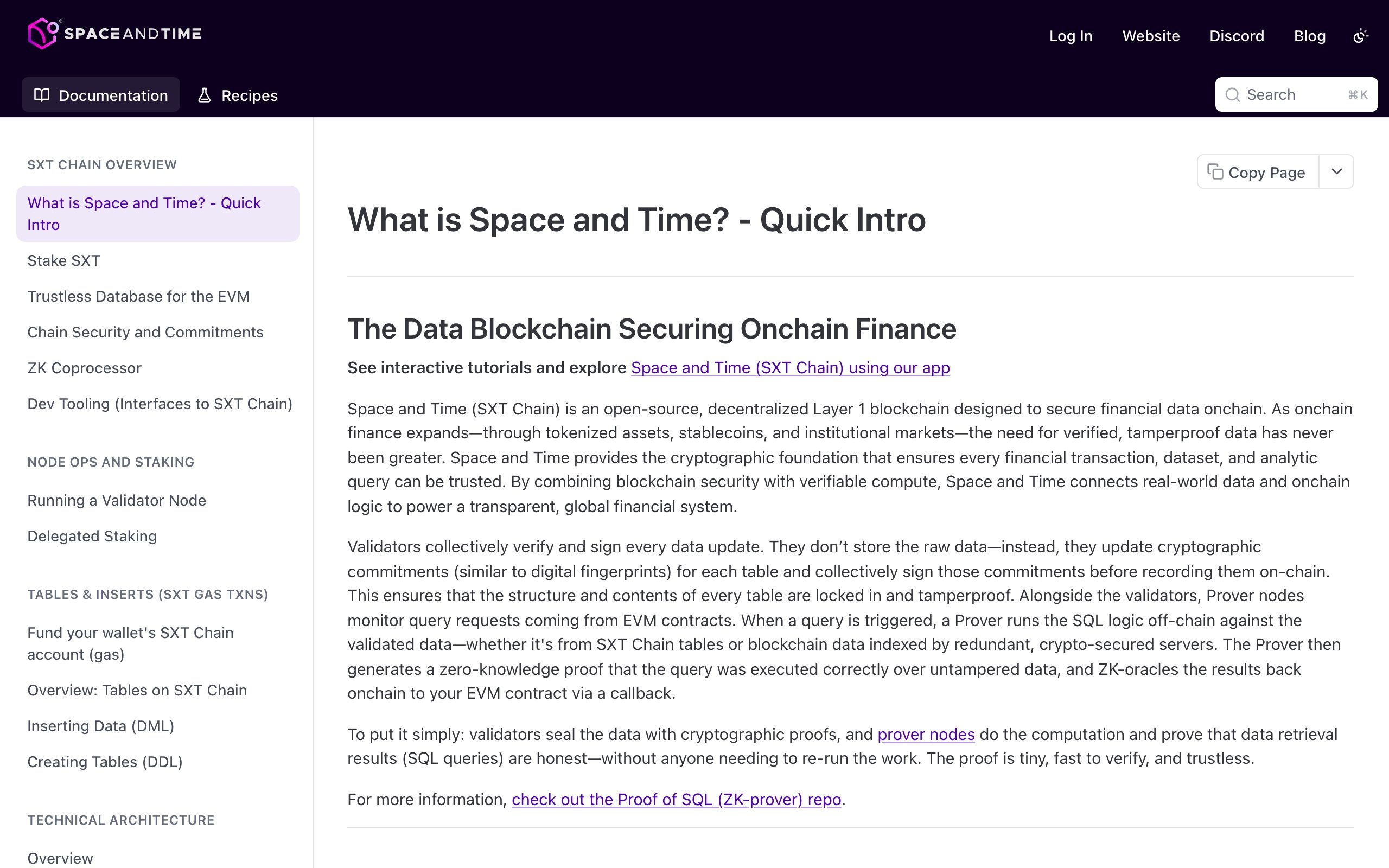
Space and Time built SXT Chain, a blockchain designed specifically for handling verifiable data. It makes data updates traceable and allows database query results to be independently verified. This infrastructure is primarily intended for AI, tokenized assets, and DeFi applications.
Its core technology works in two steps:
The first step is verifying data states. When data is updated, validator nodes jointly verify and sign the update, maintaining the corresponding cryptographic commitments. These commitments can later be used to check whether data matches a specific state, without requiring validator nodes to store the entire original database.
The second step is verifying computation results. After a developer submits an SQL query, prover nodes execute the computation off-chain and generate a zero-knowledge proof. A smart contract checks the proof to confirm that the computation meets predefined conditions, without having to execute the entire query again. The result can also be returned to EVM-compatible smart contracts through a callback.
These two steps address different problems. The first provides a basis for checking data states, while the second provides a basis for verifying query computations.
In practical applications, AI can analyze verifiable query results, reducing problems caused by computations on data that cannot be verified. Tokenized assets can use cryptographic commitments to check the state of asset-related data. DeFi applications can use query proofs to verify computation results before deciding whether to execute subsequent contract logic.
Space and Time also supports indexing data from networks such as Ethereum, Bitcoin, Polygon, and Sui, making it easier for developers to build query workflows around records on different blockchains.
What I value most is that the Space and Time network associated with $SXT brings data state verification, zero-knowledge proofs, and the delivery of results to smart contracts together in a single technical architecture.
#sxt $SXT @SpaceandTime