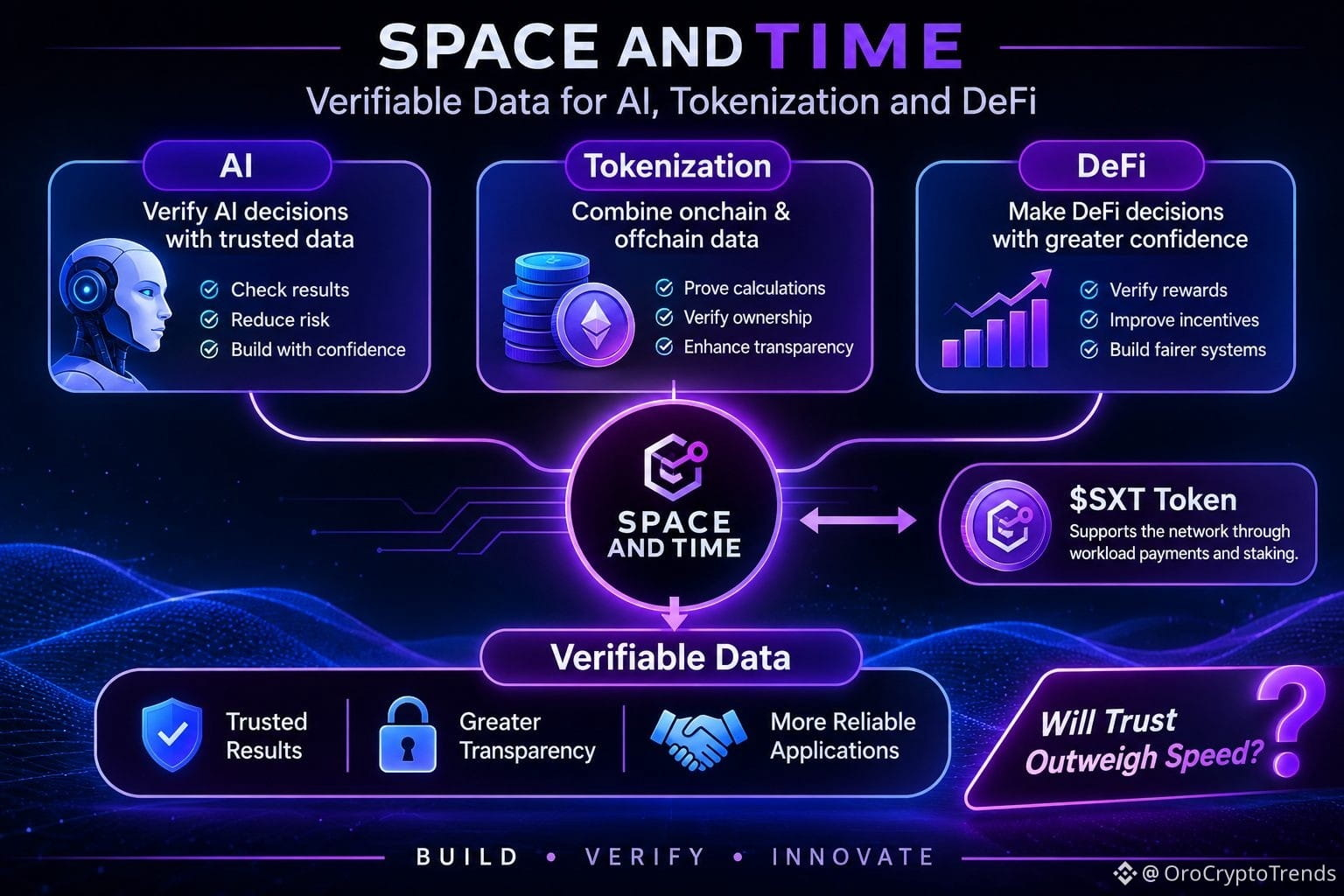

AI, tokenization, and DeFi have one important requirement: verifiable data.
This is where I think Space and Time is building something meaningful.
Consider the problem: an AI agent analyzing a DeFi protocol needs reliable information about its transactions, balances, and historical activity. Simply receiving data is not enough. The application also needs confidence that the underlying calculations were performed correctly.
Space and Time approaches this problem by making supported data queries and computations verifiable through cryptographic proofs, allowing results to be checked rather than simply trusted.
Here is how its technology connects three important sectors:
1. AI: AI agents can use verifiable query results to analyze blockchain activity and financial information. This matters because an AI system should not just receive an answer; its underlying data and calculations should also be open to verification.
2. Tokenization: Tokenized assets depend on more than blockchain records. Holdings, cash flows, and valuations may involve both onchain and offchain information. Space and Time can bring these datasets together and provide cryptographic proofs for supported calculations, helping applications verify how results were produced.
3. DeFi: DeFi applications can use historical blockchain data to evaluate reward eligibility and user incentives. The benefit is greater confidence in how those decisions are calculated, provided the underlying data and rules are reliable.
The $SXT token has a role in the network's economic model, supporting workload payments and validator staking. But network utility and token value are two different things. Sustainable token demand ultimately depends on whether real network usage creates consistent demand for $SXT .
For me, the bigger question is whether developers will prioritize independently verifiable data when building AI-driven financial applications, even if verification introduces additional cost or complexity. Will trust become more important than speed and convenience?
#sxt $SXT @SpaceandTime