
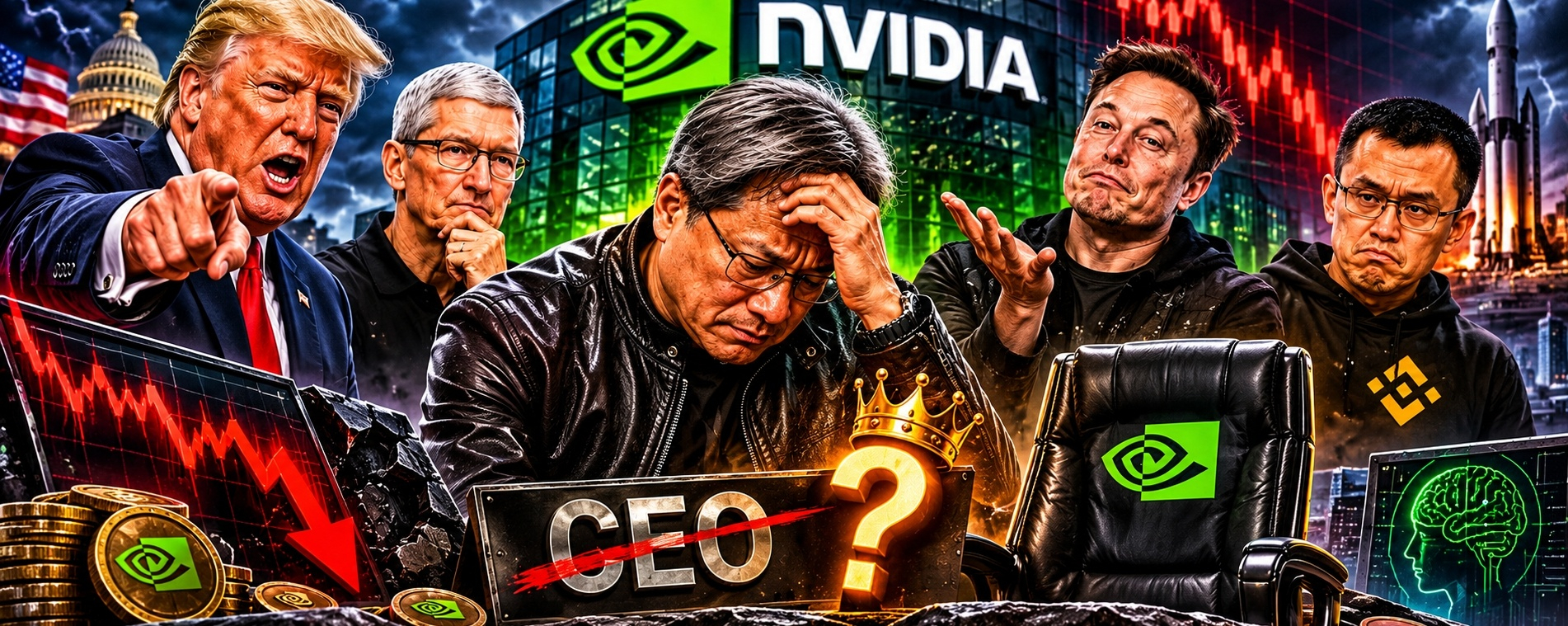

NVIDIA: An AI empire without a captain. How Jensen Huang found himself at the center of the year's biggest corporate upheaval
November 12, 2026. The story of a company that became one of the main driving forces behind the global technological revolution, and of events that could change its future.
Chapter 1. How the NVIDIA Empire Was Built
To understand the scale of what was happening, we need to go back a little.
In 1993, Jensen Huang founded NVIDIA with his partners. The company initially developed graphics processors for computers and video games.
At the time, no one could have imagined that decades later, its technology would be at the center of the global race for artificial intelligence.
NVIDIA gradually transformed from a graphics card maker into one of the key providers of computing infrastructure for the world’s largest technology companies.
The CUDA architecture played a particularly important role. It made it possible to use graphics processors not only for image processing, but also for the most complex parallel computations.
This area became the foundation for the company’s future success.
By the time artificial intelligence began developing rapidly, NVIDIA already had technologies that proved to be in extremely high demand.
Its hardware came to be used to train and run large language models, advance cloud computing and scientific research, and create new AI services.
Jensen Huang became one of the most recognizable executives in the technology industry. His black leather jacket became practically part of the company’s brand.
But behind the public image was a vast system: developers, engineers, manufacturing partners, suppliers, and the planet’s largest customers.
Chapter 2. When a Leader’s Personal Life Became a Corporate Problem
In November 2026, reports began to emerge about Jensen Huang that quickly went far beyond ordinary corporate news.
Initially, attention was drawn to reports of his alleged relationship with a Chinese businesswoman.
Reports that U.S. officials suspected the woman of having ties to Chinese intelligence and potentially influencing NVIDIA’s commercial interests made the situation particularly sensitive.
It is important to distinguish between facts and allegations here.
Suspicion of espionage does not constitute proof of involvement in intelligence activity. The Associated Press specifically noted that it was unable to independently confirm the espionage allegations.
There were also reports of an investigation in Singapore involving Megaspeed International and suspicions of false declarations about shipments of server equipment. Singaporean authorities did not confirm the espionage theory.
But that was not the end of the story.
Reports emerged of Huang’s alleged relationship with a senior NVIDIA employee who, according to media reports, reported to him.
These reports added even more tension to the situation.
For an ordinary person, a leader’s personal circumstances may remain a private matter. But when it involves a company working with advanced technology and of strategic importance to national security, the situation takes on an entirely different scale.
Chapter 3. The Board Begins an Investigation
On November 10, Bloomberg reported that independent NVIDIA board members had hired the law firm Wachtell, Lipton, Rosen & Katz to conduct an independent investigation.
The investigation was assigned to John Kim, a former acting U.S. Attorney for the Southern District of New York.
This was no longer just a discussion about a leader’s reputation.
The board had to examine the circumstances, assess potential corporate risks, and determine whether the events could have affected the company’s interests.
On November 11, reports emerged that the board was considering Huang’s future in the role.
The market began to grow nervous.
Investors understood perfectly well that this was not an ordinary executive who could be replaced with a single order.
For decades, Huang had shaped NVIDIA’s technological direction, taken part in strategic decisions, and become one of the leading public representatives of the entire AI industry.
That is precisely why the prospect of his departure was so painful for investors.
Chapter 4. The Main News: Jensen Huang Leaves NVIDIA
On November 12, events reached a conclusion that many would have considered unlikely only recently.
NVIDIA confirmed Jensen Huang’s departure.
According to a corporate filing, the board accepted his resignation on November 11. He stepped down as president, CEO, and a member of the board of directors.
Interim leadership of the company was handed to CFO Colette Kress.
She has been with NVIDIA since 2013 and must now oversee the company’s finances while also serving as interim CEO.
Harvey Jones, who has served on the company’s board since 1993, became its chair.
NVIDIA was therefore faced with the need to organize a leadership transition during one of the most consequential periods in its history.
And here is the central question: can you replace someone who did more than lead the company—someone who shaped its technological direction for decades?
Chapter 5. Who Could Take the CEO’s Seat?
After Huang’s departure, discussion began about possible successors.
One of the most discussed internal candidates was Ian Buck, who leads NVIDIA’s engineering organization and has been involved in the development of CUDA and the company’s computing infrastructure.
His advantage is a deep understanding of the technologies underpinning a significant part of NVIDIA’s business.
The second key candidate is Colette Kress.
She is already serving as interim CEO, knows the company’s financial structure well, and is familiar with its internal processes.
Rene Haas, head of Arm and a former NVIDIA employee, was also mentioned among the possible external candidates.
At the same time, it is important to understand that discussing candidates does not mean the company has already made a decision.
At the time this material was prepared, no permanent successor had been officially announced.
Meanwhile, the internet turned the succession question into a show of its own. Various estimates emerged of the likelihood that particular candidates would be appointed, but such figures reflect the views of participants in prediction markets, not actual board decisions.
Chapter 6. Donald Trump Unexpectedly Puts Forward His Own Candidate
Another well-known figure entered the story.
U.S. President Donald Trump publicly weighed in on a possible successor to Huang.
His suggestion was unexpected: he said Tim Cook should become head of NVIDIA.
There is an interesting detail here.
Tim Cook had already stepped down as Apple’s CEO after 15 years leading the company in September 2026, and now serves as executive chairman.
Trump described him as someone who could replace one technology legend with another.
However, this was the president’s personal public suggestion, not an appointment announcement.
NVIDIA has its own board of directors, which must independently determine the company’s future leadership structure.
So this story brought together two tech giants, two well-known executives, and a U.S. president who decided to add his own candidate to the list of contenders.
Chapter 7. CZ Disagrees with Huang’s Departure
Binance founder Changpeng Zhao, known as CZ, also commented on the situation.
He said NVIDIA had made a mistake by allowing Jensen Huang to leave.
His position is understandable given Huang’s role in the company’s development.
Huang did more than occupy the CEO’s seat. For several decades, he was one of the people shaping the direction of the computing industry.
This kind of continuity is highly important in the technology business.
But there is another side to the issue: even the most influential leader does not exempt a company from following corporate procedures and addressing potential risks.
So the question is not only how successful Huang was, but also how NVIDIA can maintain its position after his departure.
Chapter 8. Elon Musk Also Makes a Statement
Elon Musk also weighed in.
He said it would be an honor for him to hire Jensen Huang at his company.
That is an interesting twist, given how important computing power is to Musk’s artificial intelligence projects.
Today’s AI companies compete not only for users and investment. They need engineers, developers, equipment, and people capable of building large-scale technological infrastructure.
That is why the prospect of working with someone of Huang’s stature inevitably draws market attention.
However, this statement does not indicate any confirmed agreement for Huang to join Musk’s company.
Chapter 9. Wall Street Reacts: NVIDIA Shares Under Pressure
The financial consequences were not long in coming.
After reports of possible problems involving the company’s leadership emerged, NVIDIA shares fell sharply.
After reports about the second alleged relationship were published, the stock lost more than 8% in over-the-counter trading.
During subsequent trading, the decline reached around 14% at certain points.
The company’s market capitalization fell below the $4 trillion mark.
To put this in perspective, we are not talking about a small technology firm, but one of the world’s largest publicly traded companies.
Why did investors react this way?
Because NVIDIA sits at the center of a vast ecosystem.
Its products affect server manufacturers, cloud platforms, AI model developers, and companies building their own artificial intelligence infrastructure.
When leadership changes at a business of this scale, investors begin assessing not only the news itself, but also its potential implications for the company’s future strategy.
Other technology stocks also came under pressure.
At the same time, some of NVIDIA’s competitors, including AMD and Broadcom, gained market support at certain points amid expectations that changes at NVIDIA could shift the balance of power in the industry.
Chapter 10. The U.S. Market Tries to Recover Its Losses
Amid the turmoil surrounding NVIDIA, the U.S. stock market saw sharp intraday swings.
Reports emerged of a powerful market reversal, during which the combined market capitalization of U.S. stocks rose by more than $1 trillion over a short period.
However, reliable market sources were unable to independently confirm the exact size of this increase, so it should not be treated as an established fact.
What is confirmed is that the major U.S. indexes did recover some of their initial losses, even as NVIDIA shares remained under pressure.
This is an important distinction.
Even when the overall market starts to recover, an individual company may still be going through its own crisis.
Conversely, problems at one corporation do not necessarily signal the beginning of a collapse across the entire technology industry.
Chapter 11. Why Huang’s Departure Matters to the Entire AI Industry
The greatest danger for NVIDIA is not that its graphics cards will stop working tomorrow.
The company has a huge engineering team, manufacturing partners, software platforms, and long-term contracts.
But there is one factor that cannot simply be replaced by a new leader overnight.
That factor is strategic vision.
For decades, Huang made decisions that helped NVIDIA move from graphics processors for gaming to computing infrastructure for artificial intelligence.
He understood that the future of computing would involve not just processors, but entire systems: software, networks, memory, servers, and specialized accelerators.
That is why investors are closely watching to see who will shape the company’s next stage of development.
If the new leader maintains the current course, NVIDIA will be able to continue executing its strategy.
If the company changes direction, the market will have to reassess its prospects and its place in the global AI race.
Chapter 12. What Happens Next?
NVIDIA now faces several serious challenges.
First, it must stabilize its leadership.
Colette Kress must ensure the company continues operating smoothly while the board searches for a permanent leader.
Second, it must address reputational and corporate issues.
The company will need to complete the necessary reviews and determine the circumstances that led to such a major crisis.
Third, it must maintain investor confidence.
The market needs more than bold statements: it needs a clear strategy, stable financial performance, and confidence that the business will continue to grow.
Fourth, it must preserve its technological advantage.
Competition in artificial intelligence does not stop because of leadership changes. AMD, Broadcom, and other market participants continue to develop their own solutions.
NVIDIA will have to prove that its success rests not only on one leader’s personality, but also on a strong technological foundation.
Conclusion. One Company, One Era, and a Huge Question Mark
NVIDIA’s story in November 2026 served as a reminder of just how closely technology, corporate governance, politics, and financial markets are intertwined today.
The company that helped shape the modern AI industry faced an unexpected crisis at the very top.
Jensen Huang stepped down, Colette Kress took over on an interim basis, Ian Buck emerged as one of the internal candidates under discussion, Donald Trump proposed Tim Cook, CZ criticized the founder’s departure, and Elon Musk publicly said he would be willing to hire him.
And all of this happened in just a few days.
But there is one point that is especially important to understand.
NVIDIA is not one person in a leather jacket. It is tens of thousands of specialists, years of research, highly complex technologies, and global infrastructure.
A leader’s departure can change a company’s history. But only time will tell whether it can change the future of the entire industry.
And perhaps the most intriguing question right now is not who will get the CEO’s seat.
It is whether NVIDIA can prove that its future is much bigger than the name of the person who led the company for 33 years.
Because building a technological empire is incredibly difficult. Proving that it can survive without its founder can sometimes be even harder.