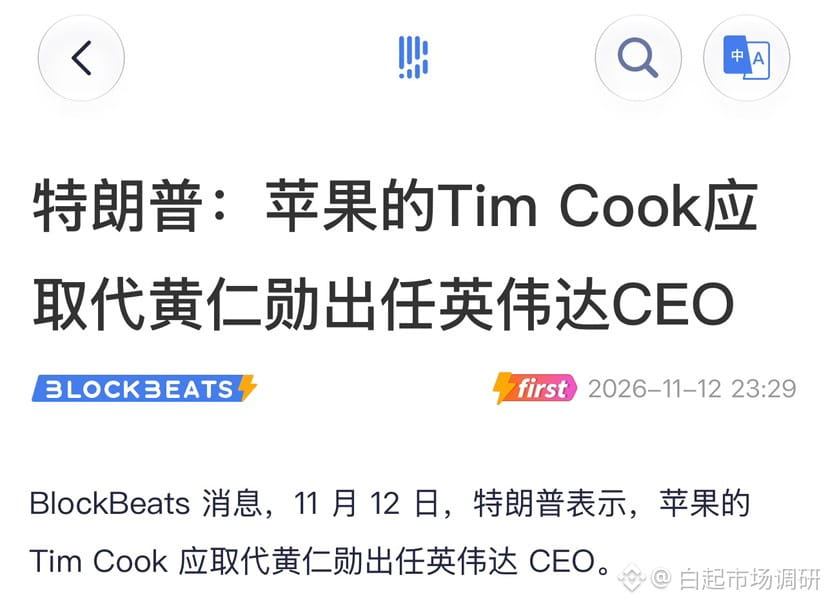
🚨 Jensen Huang had just been forced out of Nvidia when Trump eagerly named Cook as his successor.
The most troubling aspect of this matter goes beyond Huang’s personal scandal. $NVDAB
On November 8, Trump praised Huang for his contributions to the United States. On the 9th, he said he believed Huang’s explanation and thought he would be fine.
On the 12th, Huang resigned, and Trump immediately publicly recommended former Apple CEO Tim Cook to take over Nvidia.
In just a few days, the tide had completely turned.
Why Cook, of all people?
His best-known strengths are managing global supply chains, coordinating complex international business relationships, and dealing with Washington.
And Nvidia happens to sit at the intersection of U.S. AI competition, restrictions on chip exports to China, and national security reviews.
This raises a question worth thinking deeply about:
When a company’s technology becomes important enough to affect national strategy, can its CEO still be chosen solely according to business considerations?
Trump has no formal power to appoint Nvidia’s CEO, but a public endorsement from the president is enough to add political uncertainty to the succession question.
More subtly, on November 18, Huang was still scheduled to give a closed-door briefing to three U.S. congressional committees.
Resigning may end his career, but it may not end the scrutiny of Nvidia.
For investors, the key concern now is no longer whether Huang can return, but what priorities the next CEO will serve.
Technological innovation? Shareholder returns? Or U.S. national strategy?
A company’s valuation may be determined by Wall Street, but if its fate is increasingly shaped by Washington, investors must reassess the risks.
#黄仁勋辞任CEO,英伟达战略走向受关注 #英伟达突发换帅,美国芯片股跌幅扩大