
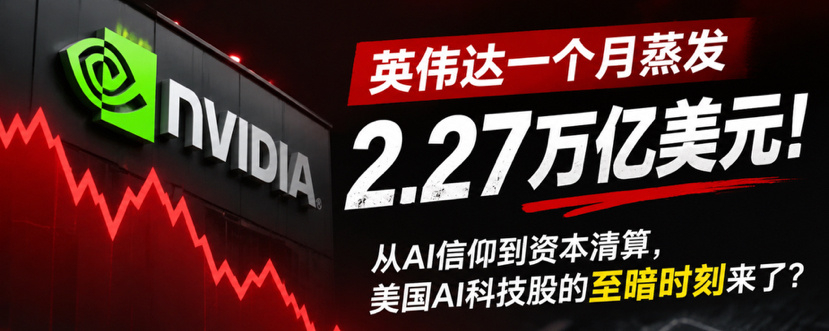

As of premarket trading on November 12, the share price had fallen to $149.23. Just a month earlier, on October 6, Nvidia ($NVDA) had hit an intraday high of $243.35.
In just over a month:
The share price fell 38.68%, wiping out $94.12 per share. Its market capitalization dropped from about $5.87 trillion to $3.60 trillion, erasing roughly $2.27 trillion in total!
This is no longer an ordinary technical pullback; it is a restructuring of valuation logic across the entire AI tech industry.
Looking back at the four stages the market has gone through over the past month or so:
Stage One: October 6–27, when AI capital spending began to worry the market.
Microsoft, Google, Amazon, and Meta continue to expand their data center investments, with hundreds of billions of dollars pouring into GPUs, servers, storage, and power infrastructure.
AI investment is growing ever larger, but can commercial revenue and free cash flow keep up? For the first time, the market is beginning to seriously scrutinize the returns on AI investment.
Stage Two: October 28–October 30. Tech giants' earnings reveal another side of AI capital expenditure.
Alphabet's cloud business grew, but its search business underperformed expectations, and cash flow pressures fueled market concerns.
Microsoft and Oracle won market approval thanks to their relatively strong financing capabilities and cash flow, while Alphabet suffered a sharp decline.
Then Amazon signaled higher capital expenditure, and Intel plunged about 30% after issuing a disappointing earnings outlook.
The market finally realized that not every company can profit from building out AI, and massive capital expenditure does not necessarily mean future profits.
Stage Three: November 3–November 5. The U.S. midterm elections changed expectations for AI industry policy.
The Democrats won both chambers of Congress, and the market began reassessing whether the Trump administration's AI policies would continue.
Data center construction, energy consumption, grid expansion, and AI regulation could all face stricter congressional scrutiny.
On November 5, panic erupted: the Nasdaq fell 5.52%, the S&P 500 fell 4.36%, and the Philadelphia Semiconductor Index plunged 12.2%.
Semiconductor companies including Nvidia, AMD, and Micron came under broad pressure. This decline reflected doubts not just about individual companies' performance, but about the entire investment thesis for AI infrastructure.
Stage Four: November 8–November 12. A major upheaval at Nvidia itself.
On November 8, Nvidia's board announced an independent investigation in response to reports that Jensen Huang may have been a target of foreign intelligence activity.
On November 12, Nvidia officially announced that Jensen Huang had resigned as CEO, with CFO Colette Kress serving as interim CEO.
For a company once valued at nearly $6 trillion and whose strategy had long been led by its founder, this is undoubtedly a major shock. Nvidia must now contend not only with a valuation reset across the AI industry, but also with uncertainty stemming from a change in its top leadership.
So, what does this series of events really tell us?
The investment thesis for AI has changed. In the past, the market rewarded capital expenditure; now, it demands that spending translate into revenue, profits, and free cash flow.
The policy environment for the U.S. AI industry has changed. After the midterm elections, uncertainty around data center construction, energy supply, and AI regulation has increased, but the U.S. will not give up the AI race easily.
AI tech stocks are starting to diverge. Companies with real cash flow, stable customers, and technological advantages will face very different market treatment from those dependent on financing, continued expansion, and long-term valuations.
One final point:
I don't believe the AI revolution is over, but I think the era of AI stocks rising indiscriminately may be coming to an end.
In the past, the market was willing to pay a premium for AI's future. Now, it is starting to demand that companies prove they can turn computing power into profits.
AI hasn't lost on the technology front; AI stocks are facing a reality check from the capital markets.
What is really worth looking for next isn't the AI stock that has fallen the most, but the companies that can continue generating cash flow after this round of shakeout.