
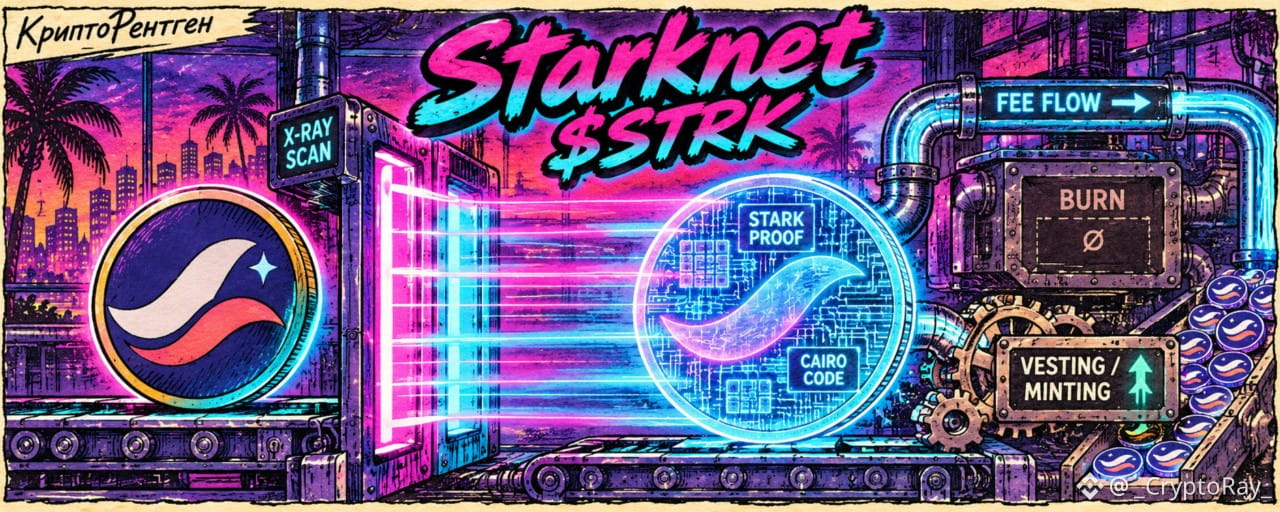
Starknet is a Layer 2 zk-rollup on Ethereum. It uses STARK proofs and the Cairo programming language. STRK is used for gas, staking, and voting. The project’s main tension is that the token has a real role, but no mechanism that returns value to holders. Fees are not burned, while supply grows through vesting and staking. This analysis is for those studying the L2 sector who want to understand the token’s mechanics, not just its price.
Technology
Transactions are executed on L2. Cryptographic proofs of execution correctness are sent to Ethereum. These are validity proofs: verification does not rely on a challenge period.
For developers, this means a separate stack. Cairo is a proprietary language that is not directly compatible with Solidity. It is designed for provable computation, but has a steeper learning curve than EVM ecosystems.
Since September 1, 2025, fees have been payable only in STRK. The sender transfers tokens to the sequencer when the transaction is executed.
Tokenomics
Initial issuance: 10 billion STRK. The allocation included:
Early Contributors
Investors
Grants and Development Partners
StarkWare
Foundation Strategic Reserves
Community Provisions
Community Rebates
Foundation Treasury
Donations
The 10 billion figure is the initial issuance, not a hard cap. According to CoinGecko, total supply is ≈ 10.185 billion, circulating supply is ≈ 7.665 billion, and max supply is not specified. Starknet's documentation explicitly provides for additional minting through staking.
Vesting. The official schedule provides for monthly unlocks of up to 127 million STRK from April 2025 through March 2027.
The next tranche, on November 15, 2026:
volume: 127 million STRK
Early Contributors: 66.61 million
Investors: 60.39 million
share of the initial 10 billion: 1.27%
share of circulating supply: ≈ 1.66%
value: ≈ $4.83 million at a price of $0.038
An unlock is not the same as a sale. Tokens become available to recipients, and the pressure depends on their subsequent transfers.
Inflation. The documentation gives an effective coefficient of 4% for Mainnet. But this is not a fixed 4% annual issuance: rewards depend on staking parameters and the minting curve. The Starknet website says that, with the initial parameters, inflation should remain below 1.6%.
Burning. At present, fees are not burned; they go to the sequencer.
Investors
Paradigm, Pantera, Sequoia, Polychain, and other major funds invested in the project. The funding rounds were substantial, and the company's valuation peaked at $8 billion. It cannot be directly compared with the token's market capitalization: one is a valuation of StarkWare's business, while the other is the market value of a circulating asset. It works as a gauge of the scale of expectations, but not as an equivalent.
On-chain activity
Market data as of November 12:
price: ≈ $0.0365–0.0387
market capitalization: ≈ $280–296 million
FDV: ≈ $387 million
24-hour volume: ≈ $23–25 million
TVL: ≈ $223 million
daily fees/revenue: ≈ $2.3 thousand
The gap between TVL and fees is noticeable. There is capital in the network, but the cash flow from usage is still modest. Different aggregators calculate metrics differently, so they should be tracked over time rather than judged from a single snapshot.
Compared with its peers: Arbitrum has a market capitalization of around $1 billion, while Aztec is at around $37 million. Starknet is in the middle in terms of size, but Arbitrum is significantly ahead in the scale of its ecosystem.
The inside story
Facts:
fees payable only in STRK since September 1, 2025
unlock schedule runs through March 2027
total supply is already above 10 billion
no fee burning
no direct distribution of sequencer revenue to holders
Rumors and insider claims:
The figure of “1.3 million STRK issued every three days” is circulating in discussions, but is not confirmed by reliable sources. Rewards depend on staking parameters.
Claims about a 950 million STRK team reserve and an increase of 720 million over 90 days have also not been confirmed by primary sources.
A test of a quantum-resistant wallet on the testnet is a technology update, not evidence that the feature is ready for Mainnet.
Strengths and weaknesses
Pros:
STARK proofs and Cairo: a strong cryptographic foundation
Operational L2 infrastructure
Real utility: gas, staking, governance
Staking development as part of the network's security
A clear, public unlock schedule
Cons:
Monthly unlocks through March 2027
Additional minting through staking
Fees are not burned
Holders do not receive a share of sequencer revenue
Low fees despite substantial TVL
Market capitalization is far below previous venture valuations
Sources
docs.starknet.io
coingecko.com (STRK page)
Official Starknet website, staking section
