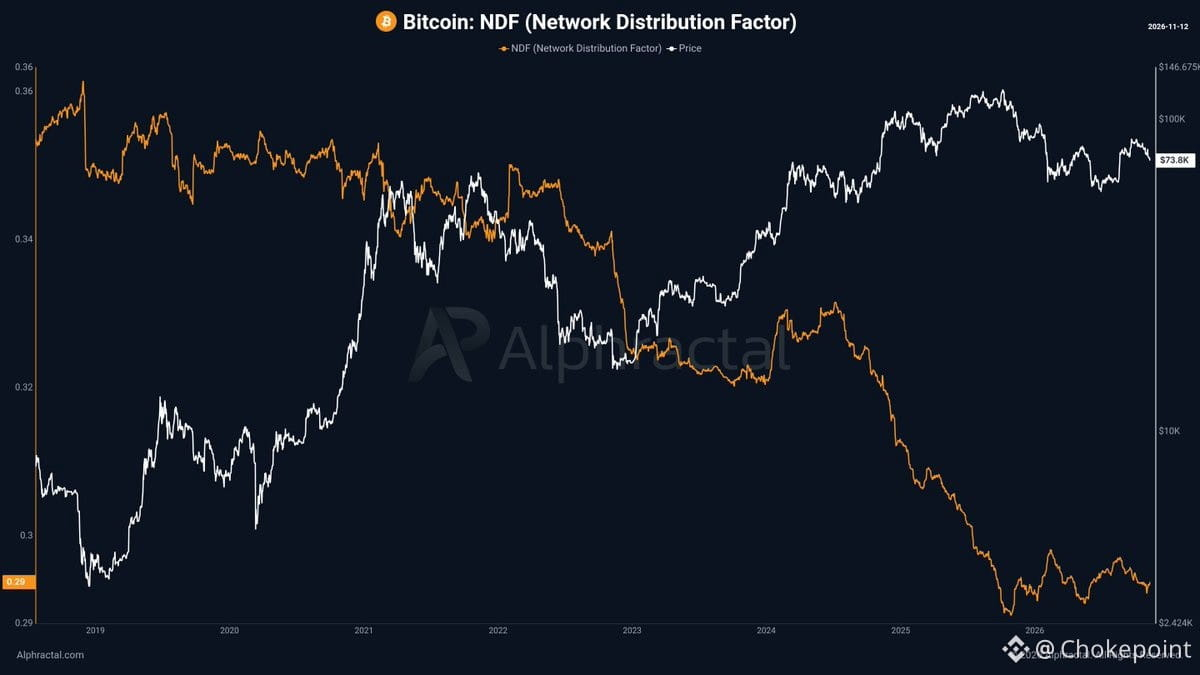
Bitcoin's supply is spreading out — and the data is striking.
The Network Distribution Factor (NDF) tracks how much $BTC is held by addresses controlling at least 0.01% of total supply. In 2018, these large holders controlled over 35% of all Bitcoin. Today? That's dropped to roughly 29% — one of the lowest readings on record.
What makes this more interesting: Bitcoin hit fresh all-time highs multiple times in recent years, yet concentration among these addresses kept falling. Supply is dispersing even as price climbs.
But here's the catch — addresses aren't people. The rise of ETFs, exchanges, and institutional custody means a single "large address" could represent thousands of investors, or one fund slicing holdings across multiple wallets. So the real question isn't just "is Bitcoin more distributed?" — it's "are we seeing genuine decentralization, or just a shift in how institutions custody their coins?"
Either way, the structural trend is clear: fewer mega-wallets controlling the float. Whether that's retail accumulation or institutional infrastructure buildout, it's a meaningful shift in how $BTC is held on-chain.