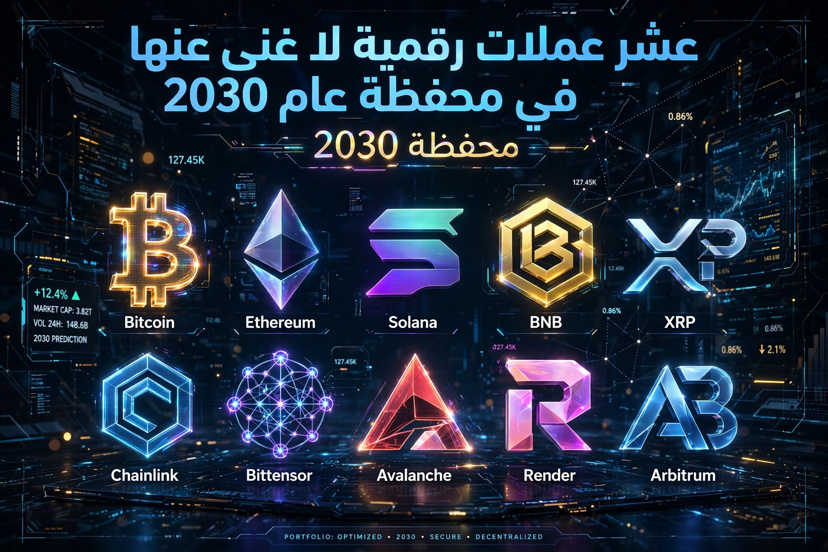

If we imagine that we have moved forward to 2030, the logic behind evaluating cryptocurrencies will have changed radically. The market will no longer reward media hype or fleeting trends; instead, it will ask just one question: Does this project have a real-world use that generates revenue and solves an existing problem? Based on this logic, ten cryptocurrencies stand out as pillars of the new digital economy and should be included in any balanced portfolio.
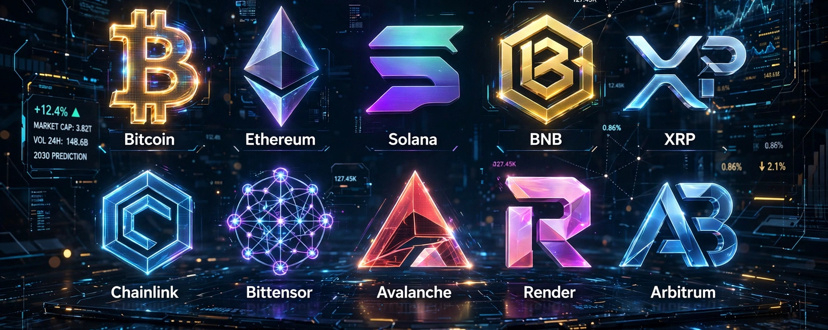
First: Bitcoin (#BTC ) - Digital gold
Bitcoin is currently trading at $73,476 on November 12, 2026. By 2030, its price is expected to range between $150,000 and $250,000 in a realistic scenario. Its place in a portfolio is justified by its established position as a globally recognized reserve asset among central banks, pension funds, and major financial institutions. Its value lies not in its ability to make fantastical price surges, but in being the primary hedge against inflation and the erosion of fiat currencies. It is the cornerstone that protects a portfolio from sharp fluctuations.
Second: Ethereum (#EHT ) - The operating system of the decentralized economy
Ethereum is currently trading at $2,045, with a realistic forecast of reaching between $8,000 and $12,000 in 2030. More than eighty percent of financial applications, companies, and games with real-world use are built on its network. After reaching high speeds and low energy consumption, investing in it has become like investing in the internet infrastructure itself in its early days. It is a bet on the growth of the sector as a whole, not on a single application.
Third: Solana (#sol ) - Instant payments infrastructure
Solana is currently trading at $82.95, and is expected to range between $400 and $700 in 2030. This network stands out for its exceptional speed and nearly negligible transaction costs. In a world where mobile payments, stablecoins, and instant international transfers have become the norm, networks capable of processing hundreds of thousands of transactions per second are the ones that will prevail and capture a share of the payments market.
Fourth: #bnb coin - An integrated services ecosystem
BNB is currently trading at $680, with expectations that it will reach between $1,500 and $2,200 in 2030. It is no longer just a coin for a trading platform; it has become the currency of an integrated ecosystem that includes a blockchain network, a wallet, payment cards, booking services, and payments. Its strength lies in the number of real users who use it every day beyond speculation, giving it sustained demand.
Fifth: Ripple ($XRP ) - International settlement network
Ripple is currently trading at $1.05, and is expected to range between $3.5 and $6 in 2030. Having resolved its regulatory battles, its network has become the choice of central banks and financial institutions for settling cross-border payments in seconds. It does not target individuals, but aims to replace the old SWIFT system with infrastructure that is faster, cheaper, and more transparent.
Sixth: Chainlink ($LINK ) - The bridge between blockchain and the real world
Chainlink is currently trading at $10.38, with expectations that it will reach between $50 and $90 in 2030. Smart contracts cannot operate in isolation from the outside world; they need reliable, real-world data about stock prices and weather conditions. Chainlink is the network that provides this data securely and in a decentralized way. It is the invisible infrastructure relied upon by every decentralized application, without the average user ever seeing it.
Seventh: Bittensor)$TAO O) - The Internet of AI
TAO is currently trading at $213.9, and is expected to range between $800 and $1,500 in 2030. It is considered the largest decentralized network for training and exchanging AI models. Instead of allowing large corporations to monopolize AI, this project lets anyone contribute computing power and earn rewards. It represents the democratization of AI and one of the fastest-growing sectors.
Eighth: Avalanche) #AVAX✈️ X) - The platform for institutions and nations
AVAX is currently trading at $8.50, with expectations that it will reach between $60 and $120 in 2030. This network has succeeded in attracting banks, governments, and companies to create their own networks within its ecosystem. Its flexibility in customizing rules and complying with regulations has made it the preferred choice for institutions that want to enter the world of blockchain without sacrificing control and privacy.
Ninth: Render (RNDR) - Fuel for the creative economy
Render is currently trading at $1.50, and is expected to range between $15 and $30 in 2030. With the explosion of augmented reality, metaverse, and 3D modeling applications, demand for graphics processing power has become enormous. The Render network allows unused graphics card capacity around the world to be rented out, making it the infrastructure for the entire future digital content industry.
Tenth: Arbitrum (ARB) - Ethereum scaling solution
Arbitrum is currently trading at $0.149, and is expected to range between $2 and $4 in 2030. Despite Ethereum's development, it cannot handle all global transactions on its own. Layer 2 networks such as Arbitrum carry the real burden, processing transactions quickly and at lower cost before recording them on the main network. Without them, applications cannot operate at scale to serve billions of users.