
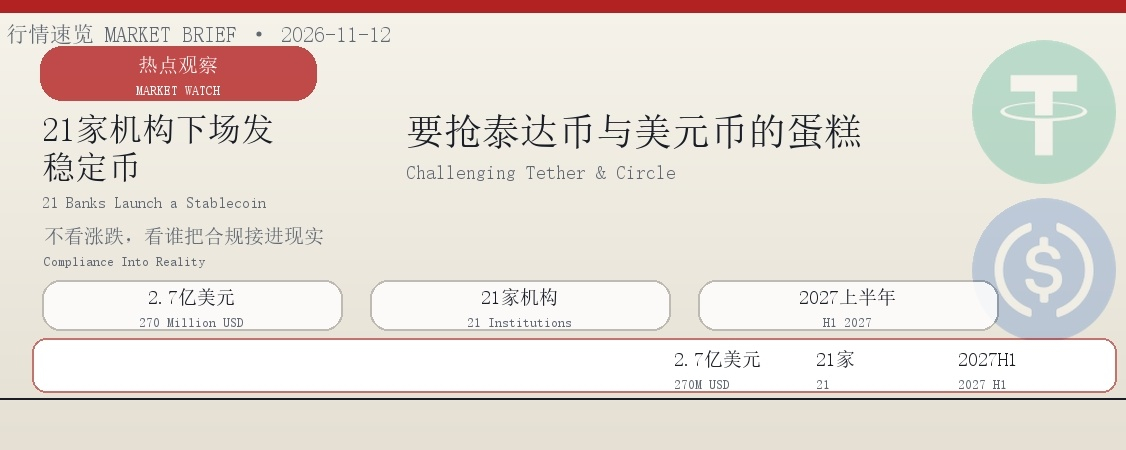

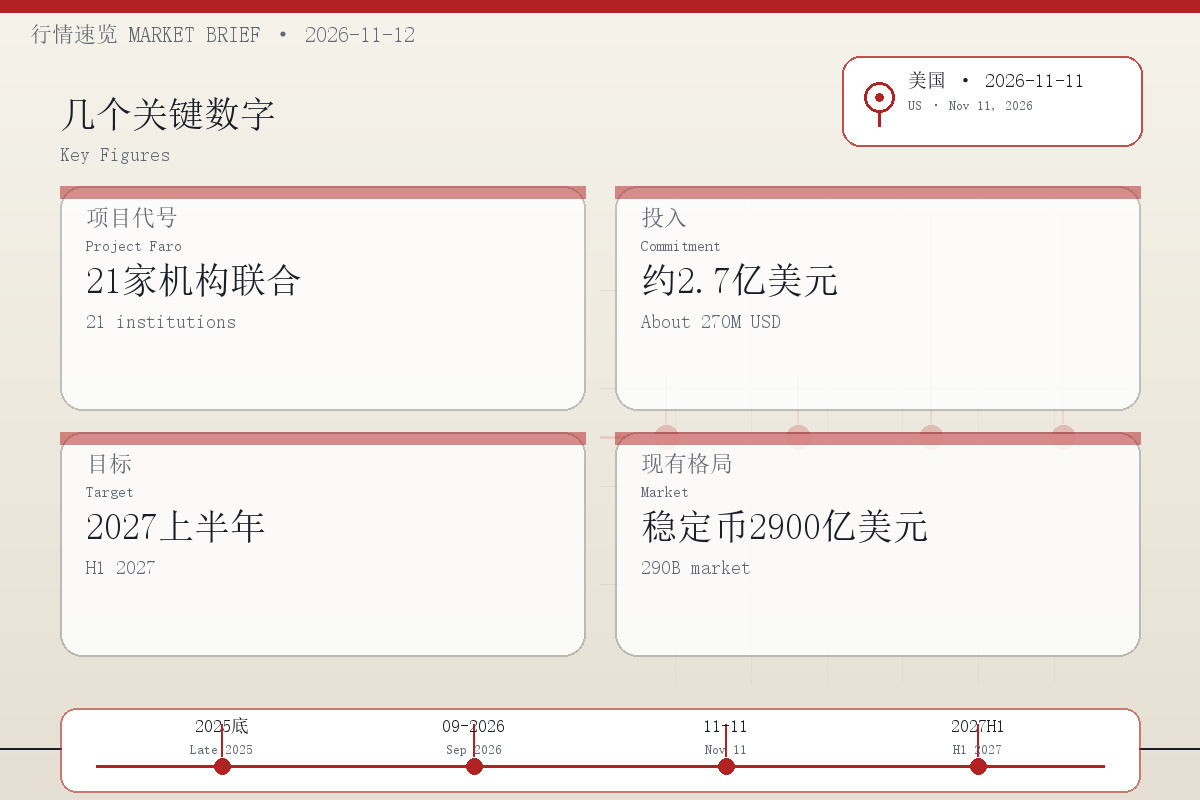
On November 11, 2026, multiple media outlets, including Global Market Broadcast, confirmed that 21 financial institutions—including Goldman Sachs and Citigroup, which are leading the effort, as well as Santander, Deutsche Bank, Bank of America, Wells Fargo, Fidelity Investments, and UBS—have pledged approximately $270 million to a joint stablecoin project to support its operations during its first five years after launch.
Internally codenamed Project Faro, the project plans to establish a stablecoin-issuing entity in the United States and launch a stablecoin pegged 1:1 to the U.S. dollar in the first half of 2027. It will then gradually expand to the currencies of the other Group of Seven (G7) countries, with a euro stablecoin as a priority. The funding comes from traditional financial institutions, not crypto-native teams, and the project targets cross-border payments and asset settlement in wholesale finance, institutional markets, and retail.
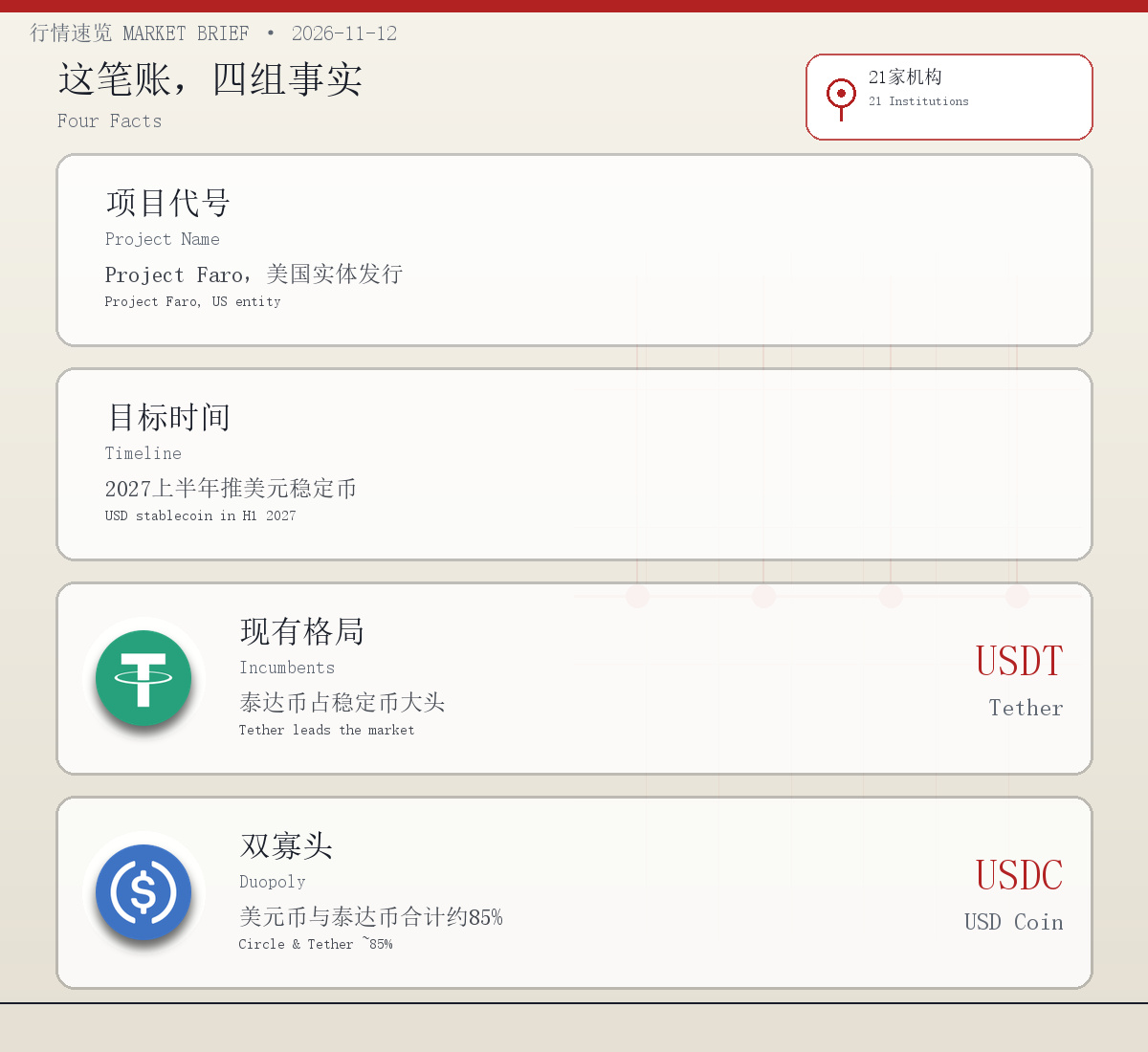
The current landscape: USDT and USDC account for 85%
The global stablecoin market is worth around $290 billion. Tether (USDT), issued by Tether, and USD Coin (USDC), issued by Circle, together hold about 85% of the market. It’s no easy feat for a new player to take market share from these two. Project Faro is explicitly addressing gaps in compliance, institutional trust, and cross-border payment infrastructure—areas where existing issuers are weakest—rather than attracting users with high yields.
Regulation is both a threshold and a moat
USDC was just recognized by the EU in November as the first “significant e-money token”—regulation is already taking the lead. Project Faro has stated outright that it will comply with U.S. law (the GENIUS Act) and the EU’s MiCA regulation. When traditional banks enter the market, the competition isn’t about who offers the highest yield, but who can integrate compliance, custody, and payment networks into the mainstream financial system.
Where the money goes: cross-border payments and settlement
If this works, the competition in stablecoins will shift from “who issues the coin” to “who can connect money to the real world.” Banks’ payment networks, custody capabilities, and institutional clients are precisely where crypto-native issuers fall shortest. Another compliant option gives users another choice, but whether it can truly shift the landscape will depend on adoption after the product launches.
What do you think—can banks issuing stablecoins themselves shake up the USDT and USDC landscape, or do you see it as just another compliant option? Share your take.#USDC #稳定币 #英伟达Q3财报将至:能否化解市场疑虑?